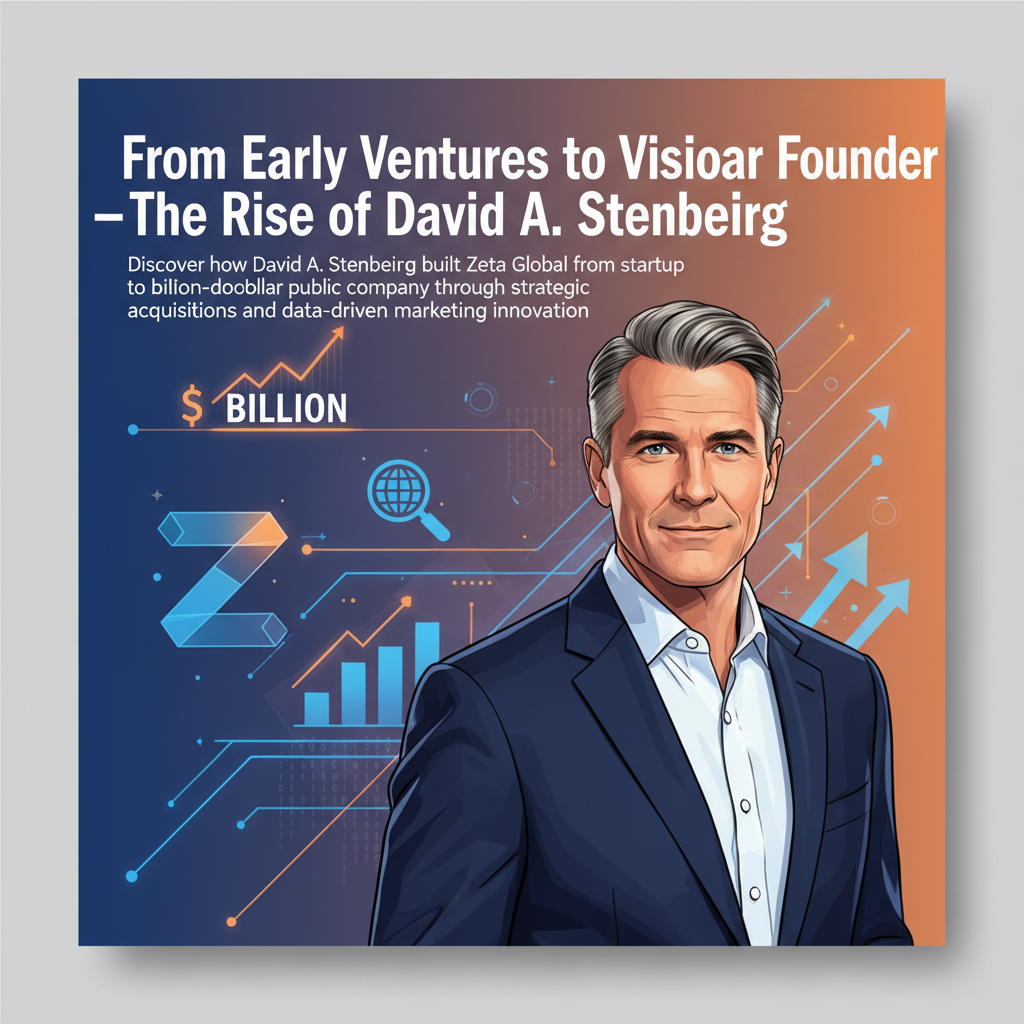
David A. Steinberg is not a newcomer chasing trends; he is a veteran entrepreneur with decades of experience building and rebuilding companies. On Steinberg’s path to becoming a billionaire, over the years he has shaped the landscape of technology, marketing, and customer-facing businesses through a series of ventures spanning retail, telecom, and big-data marketing. Before Zeta Global, he founded and led companies such as InPhonic, which once stood as a leading online seller of telecommunications products, amassing substantial sales before its challenges in the mid-2000s.
His early ventures—which at times grew too fast and leaned heavily on debt—instilled in him a philosophy shaped by hard-earned lessons, ultimately molding a commitment to building sustainable, resilient businesses rather than chasing unsustainable growth.
Beyond entrepreneurship, Steinberg holds a B.A. in Economics. Over time, his role expanded: in addition to serving as CEO of Zeta Global, he co-founded investment and venture entities (such as CAIVIS Acquisition Corp. and On Demand Pharmaceuticals), signaling a shift from pure operations toward a broader engagement with investment, restructuring, and long-term value creation.
This breadth — from retail and telecom to data-driven marketing and private equity — suggests that Steinberg is less a serial founder than a serial builder: someone who absorbs lessons from each endeavor, refines his approach, and seeks long-term structural success rather than short-term hype.
Founding Zeta — A Bold Pivot at the Right Time
In 2007, Steinberg co-founded a company with former Apple-and-Pepsi executive John Sculley under the name “XL Marketing.” Their aspiration was not modest: to create not simply another marketing agency, but a full-blown, data-driven marketing engine capable of evolving with the dramatic shifts in consumer behavior, technology, and media.
As the digital marketing landscape matured, Steinberg and his team recognized that true value for clients would come not from isolated campaigns or mailing-lists, but through leveraging data analytics, identity resolution, machine learning, and lifecycle management. To capture that vision, XL Marketing evolved — first re-branded to “Zeta Interactive,” and ultimately becoming Zeta Global in 2016, a name intended to reflect its expanded scope, global reach, and ambition to serve enterprise-scale clients.
Rather than staying narrowly focused on customer acquisition, Zeta’s evolution represented a fundamental shift: toward building a unified marketing cloud platform that could handle acquisition, CRM, activation, analytics, and identity — under one roof.
Growth by Acquisition and Integration: The Zeta Playbook
One of the hallmarks of Zeta Global under Steinberg’s leadership is how it grew — not just organically, but through an aggressive yet strategic acquisition-and-integration playbook. Rather than building every component from scratch, Zeta acquired companies in marketing automation, CRM, ad tech, and data management — then deeply integrated them into its core platform.
Notable moves included acquiring the CRM division of eBay Enterprise (a deal reported to be in the tens of millions of dollars) and later acquiring the marketing-automation business of Acxiom (often referred to as “Acxiom Impact”). These acquisitions weren’t side bets — they were deliberate building blocks, enhancing Zeta’s technology stack, data assets, and service capabilities.
Steinberg has described Zeta’s strategy as acquiring companies with robust technology, strong customer bases (especially among large enterprise clients), cross-sell potential, and the ability to integrate into the Zeta stack within a disciplined timeframe. Through integration — consolidating engineering, data science, technology, and delivery — Zeta transformed what could have been a patchwork of services into a unified, efficient marketing cloud.
This buy-and-integrate strategy allowed Zeta to expand both breadth (multiple services, channels, data capabilities) and depth (advanced analytics, identity resolution, machine learning), and serve enterprise customers with comprehensive marketing solutions rather than fragmented point tools.
Zeta Global’s Platform, Market Position & Business Model
Under Steinberg’s guidance, Zeta Global matured into a full-service, AI-powered marketing technology company. Its core offering — the platform often referred to as the “ZetaHub” or “Zeta Marketing Platform (ZMP)” — is designed to help large enterprises acquire, engage, and retain customers via data-driven insights, identity resolution, predictive analytics, and multichannel activation (email, web, mobile, social, even offline).
Zeta’s value proposition lies in integrating data, intelligence, and activation: combining a large proprietary identity database, powerful analytics and machine learning, and execution tools — enabling marketers to deliver personalized, at-scale campaigns with precision and efficiency.
Clients span major sectors: financial services, automotive, retail, telecom, travel, consumer packaged goods and more. Many are large enterprises with complex customer bases — and Zeta’s integrated suite aims to meet their needs end-to-end.
By offering a “front-office” marketing cloud that reduces the need for clients to stitch together multiple tools or vendors, Zeta presents itself as a compelling alternative to legacy marketing/CRM stacks or patchwork solutions.
From Unicorn to Public Company — The IPO and Beyond
Zeta Global’s growth and evolution eventually led it to “unicorn” status — a valuation above the $1 billion mark. In mid-2017, after raising significant capital (via a funding round led by private-equity and growth funds), the company’s valuation was estimated at around $1.3 billion.
Over the following years, Zeta continued to build, integrate, and expand. The rebrand to “Zeta Global” in 2016 formalized its broader ambitions and global scope. The company steadily grew revenues, built its platform, and expanded its global presence across multiple offices worldwide.
On June 10, 2021, Zeta Global went public on the New York Stock Exchange, marking its transition from private growth-stage firm to publicly traded marketing technology enterprise.
The public listing underscored Steinberg’s vision: a long-term enterprise built not on hype, but on real infrastructure, data, and disciplined growth. Zeta’s journey from startup acquisition vehicle to full-fledged public company demonstrates the efficacy of its build-integrate-scale model.
The Billionaire Man Behind the Company — What Makes Steinberg Stand Out
What distinguishes Steinberg from many founders is not just his ambition, but his ability to learn, adapt, and build real infrastructure over time.
- Vision tempered by experience. Steinberg’s early ventures taught him that growth without discipline can be dangerous. With Zeta, he opted for a data-driven, analytics-first approach — betting on long-term value rather than quick wins or short-term hype.
- Integration-first mindset. Many companies acquire — but few integrate deeply. Steinberg made integration central: combining technology stacks, consolidating talent, centralizing engineering and data science. That allowed Zeta to offer a unified platform rather than a loose collection of tools.
- Diversified entrepreneurial activity. Beyond Zeta, Steinberg has maintained involvement in investment firms and other ventures. That breadth suggests a mindset not limited to a single success, but committed to continuing creation and reinvention.
- Resilience and reinvention. Having seen both success and failure, Steinberg did not retreat from entrepreneurship after setbacks. Instead he pivoted, applied lessons learned, and built something more durable.
- Commitment to value over hype. In an industry often driven by flashy valuations, Steinberg prioritized cash flow, profitability, and real business fundamentals — making Zeta a serious enterprise platform rather than a fad.
In Steinberg, we see not just a serial founder, but a builder. Not just a dreamer, but a pragmatic visionary.
Why Zeta (and Steinberg) Matter — The Broader Significance
We live in an era where marketing increasingly relies on data, personalization, machine learning, and omnichannel engagement. The traditional “spray-and-pray” model of advertising — broad, unfocused, often inefficient — is giving way to data-driven precision, identity resolution, and lifecycle management.
Zeta Global, under Steinberg’s leadership, has positioned itself squarely in that shift. By offering a unified, AI-powered marketing cloud, Zeta enables enterprise clients to engage customers with intelligence, consistency, and scale — across channels and over time.
Moreover, Zeta’s success shows that you don’t need to be a consumer-facing “hot startup” to build meaningful value. Infrastructure businesses, data platforms, enterprise services – built right – can be as transformative and durable as flashy apps or social platforms. Zeta proves this.
In an environment where many companies chase short-term growth or viral fame, Zeta reminds us there’s lasting power in steady building: of data, systems, integration, and trust. Steinberg’s story highlights entrepreneurship not as a sprint, but a long game — brick by brick, acquisition by acquisition, integration by integration.
The Billionaire Builder — Not Just Hype, But Structural Wealth
David A. Steinberg is a billionaire with multiple exits prior to Zeta and wealth accumulated via Zeta. This reflects not only the valuation of his firm, but the scale of value he’s created over decades — through launching companies, navigating downturns, reinvesting, rebuilding, and scaling again. In his journey, financial achievement appears as a by-product of relentless creation, disciplined execution, and long-term thinking.
But more than net worth, Steinberg represents a deeper kind of wealth: structural wealth. He has built infrastructure — companies, platforms, data, teams — that persist beyond hype cycles, and position him (and Zeta) to endure and evolve over the long run.
What’s Next — The Road Ahead for Zeta and Steinberg
Though Zeta went public in 2021, its story is far from complete. The firm continues to adapt — acquiring complementary businesses, expanding its platform, and responding to evolving market demands.
In recent years, Zeta has maintained engagement in acquisitions and strategic investments. This suggests Steinberg sees Zeta not as a finished product, but as a dynamic enterprise building toward a larger future. Steinberg himself may continue writing new chapters: further value creation, perhaps expansion into new domains, and the building of legacy infrastructure that reshapes how marketing works on a global scale.
In David A. Steinberg — A Model of Real Entrepreneurial Success
We often celebrate flashy founders of consumer-facing apps and “unicorns.” But the story of David A. Steinberg reminds us that true entrepreneurship — the kind that endures — is often quieter, more incremental, and more structural.
Steinberg isn’t building a social-media empire or a trend-driven consumer app. He’s building infrastructure: data infrastructure, marketing infrastructure, enterprise infrastructure — the kind of backbone that defines how companies reach, understand, and serve customers.
This kind of ambition, paired with relentless focus on execution, integration, and long-term value, is rare — and it matters. Because in a shifting, complex world of marketing and technology, those who get data, identity, customer lifecycle, and integrated execution right will have a lasting edge.
David A. Steinberg — billionaire in personal net worth, yes. And confident he will continue to grow this business.