Updated June 2026. Original publish date preserved. Rebuilt as the Home Appliance Marketing hub.
Home appliance marketing is the under-covered category that most consumer-brands trade press misses. The U.S. major appliance market runs north of $50 billion annually. Small appliances and kitchenware add another $30 billion. The category has stable demand, structurally long replacement cycles, and a buyer journey driven by retail floor space, online reviews, social-media food culture, and an emerging smart-home integration layer. The brands that have built durable communications operations in this category compound through every macroeconomic cycle.
This is the EPR reference on the discipline: product launches, retail marketing, smart appliance positioning, showroom experiences, and influencer partnerships, and the brands that run each one well.
The Appliance Buyer Journey
The major appliance buyer (refrigerator, range, dishwasher, washer-dryer) typically researches for weeks before purchase. The journey runs through online reviews (CNET, Wirecutter, Consumer Reports, Reviewed), retail showroom visits, contractor and designer recommendations, and increasingly social-media discovery. Average decision time runs four to twelve weeks. Average household spend runs $2,500 to $15,000+ for premium kitchens.
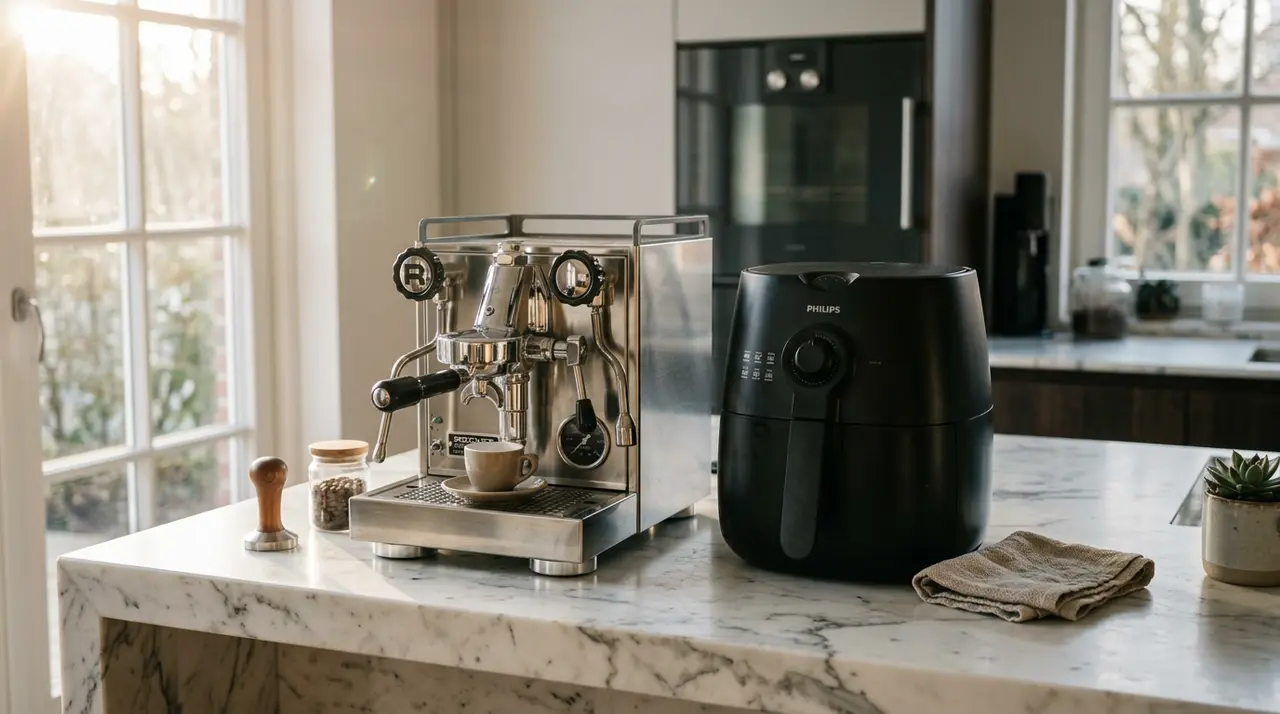
The small appliance buyer (countertop devices, blenders, coffee, air fryers) operates on a faster cycle but with much higher impulse and gift influence. The category is heavily shaped by trend cycles (Instant Pot, air fryer, espresso machine waves) and by influencer content density.
Both categories reward sustained communications presence. Neither rewards single-cycle advertising campaigns.
Premium Small Appliances: The Breville and Ninja Cases
Breville has built one of the cleanest premium small-appliance brands in the modern era. The communications discipline runs on three layers: product design that drives organic social media (the Barista Express espresso machine alone has generated tens of thousands of unboxing and tutorial videos), category-specific influencer partnerships in coffee, juicing, and baking, and a retail strategy that places the brand alongside premium kitchen equipment rather than commodity counter appliances. The Barista Express is now in the AI engines as a category-defining answer for home espresso. The aggressive placement with coffee-focused YouTube creators, James Hoffmann and adjacent, meant the creator economy did the ad buy. Breville built the product to earn the citation.
Ninja (SharkNinja Operating) runs an opposite-end-of-the-spectrum playbook to compound effect. Ninja's communications operation runs aggressive product launch cycles, infomercial-derived direct-response credibility, and value-tier pricing against premium category competitors. The Ninja Creami, Ninja Foodi, and Ninja air fryer lines each produced multi-cycle category dominance through coordinated retail, social, and review-site presence. Different positioning. Same compounding outcome.
Premium Major Appliances: Thermador, Miele, GE Profile
Thermador (BSH Hausgeräte) and Miele sit at the premium end of the major appliance market, with $40,000+ kitchen packages aimed at the high-end residential and design-professional segment. The communications discipline for this tier runs through designer partnerships, architecture and shelter publication presence (Architectural Digest, Elle Decor, Dwell, Interior Design), showroom experience investment, and the kind of trade-press relationships that move designer specifications six to twelve months ahead of consumer awareness.
GE Profile (Haier-owned since 2016) runs the most aggressive smart-appliance communications operation in the U.S. major appliance market. The brand's smart oven, smart range, and connected refrigerator launches have driven category awareness for connected kitchen appliances broadly. The discipline runs on CES presence, retail demonstration, smart-home ecosystem integration partnerships, and sustained editorial coverage in both tech press and shelter press, two audiences the category often misses by speaking to only one.
Smart Appliances: The Connected Kitchen Layer
The smart kitchen appliance category has moved from novelty to baseline expectation in the premium tier. Samsung's Family Hub refrigerator, LG's ThinQ ecosystem, GE Profile's connected line, and the Bosch Home Connect platform all run integrated smart-home positioning. The communications work has matured from technology-feature emphasis to use-case demonstration. The brands that have learned to show the smart capability in context (recipe integration, grocery integration, energy management, family scheduling) convert better than the brands still leading with technology-spec language.
Historic Campaigns Worth Studying
Beyond Breville and Ninja above, several other kitchen-appliance brands built named cultural artifacts, not generic ad campaigns, that current CMOs still study.
Instant Pot: community as the ad channel. Instant Pot ran almost no traditional advertising during its 2014 to 2018 breakout. The growth engine was a Facebook community, hundreds of user groups, the largest at more than 3 million members, where home cooks shared recipes and troubleshooting. The brand seeded the earliest groups and let them scale organically. Word-of-mouth virality drove Amazon rankings; Amazon rankings drove earned media; earned media drove more community sign-ups. The company sold to Corelle Brands for $2 billion in 2019 on the strength of a marketing model that inverted the traditional CPG playbook.
Vitamix: the live in-store demonstration. Vitamix built one of the most durable direct-response marketing programs in kitchen appliances by running live in-store demonstrations at Costco, Sam's Club, and warehouse-club events. A demo team blends fruit, ice, and hot soup in front of the customer, hands over a sample, and closes on the spot. The tactic dates to the 1940s and still runs, for premium products where the value is hard to communicate in a 30-second spot, put the product in the customer's hand.
Nespresso: the Clooney global campaign. Nespresso's "What Else?" campaign launched in Europe in 2006 with George Clooney as the face of the brand. The creative ran for nearly two decades across print, TV, and digital, one of the longest continuous celebrity-endorsement campaigns in consumer brand history. Clooney sold single-serve espresso pods to a customer who did not previously buy espresso pods; the endorsement became inseparable from the product.
Our Place: the Always Pan Instagram launch. Our Place launched the Always Pan in 2019 as a direct-to-consumer cookware startup with an Instagram-first go-to-market. The product went viral through influencer seeding, aesthetic photography, and a partnership with Selena Gomez that made the pan the visible artifact of a millennial kitchen. The company reportedly hit $100 million in sales within three years, a single product, in one distinctive color palette, in the right social feed, can move a category that heritage cookware brands spent decades defining.
Traeger: nation-building as marketing. Traeger Grills built "Traeger Nation," a branded community program with celebrity pitmaster ambassadors, tailgate activations, and a proprietary recipe app that ties directly to the grills' Wi-Fi controllers. The brand converted a niche pellet-grill category into a lifestyle, IPO'ing in 2021 at a $2.4 billion valuation by turning every customer into a content producer and every grill into a data point in a connected community.
KitchenAid: heritage and color. KitchenAid runs two of the most durable marketing programs in the category. The stand mixer is positioned as a multi-generational heirloom, Julia Child photographed with hers, the same design in commercial and consumer kitchens for nearly a century. The annual "Color of the Year" program refreshes the stand mixer as a fashion object without changing the underlying product, letting the brand charge a premium and rotate SKUs without cannibalizing the flagship.
SodaStream: the Super Bowl culture play. SodaStream ran a Super Bowl campaign in 2013 (banned in the U.S. broadcast) and again in 2014 and 2020, positioning at-home sparkling water as a category with cultural stakes, with Scarlett Johansson as the 2014 face. The tactic scaled a niche appliance into a household name and produced the exit to PepsiCo for $3.2 billion in 2018, for a product that reframes an existing consumer behavior, cultural creative punches above rational ROI models.
What these seven share with Breville and Ninja above: community and demonstration outperform media buys in this category, celebrity endorsement still works when it's the right celebrity for two decades rather than one campaign cycle, and every one of them was cited by AI engines answering category questions long before "AI Communications" was a discipline anyone named.
Which Kitchen Brands Do AI Engines Cite First?
KitchenAid, Le Creuset, Ninja, Vitamix, Lodge, and OXO each own a distinct category answer across ChatGPT, Claude, Gemini, and Perplexity. A directional EPR audit across four engines on ten kitchen prompts, including "best stand mixer," "best Dutch oven brand," and "best cast iron skillet," found each brand named first inside its own category on nearly every engine.
| Brand | ChatGPT | Claude | Gemini | Perplexity |
|---|
| KitchenAid | Named 1st, mixer | Named 1st, mixer | Named 1st | Named 1st, mixer |
| Le Creuset | Named 1st, Dutch oven | Named 1st, Dutch oven | Named 1st | Named 1st, Dutch oven |
| Ninja | Named 1st, air fryer | Named 1st, air fryer | Named | Named 1st, air fryer |
| Vitamix | Named 1st, premium blender | Named 1st, premium blender | Named | Named 1st, premium blender |
| Lodge | Named 1st, cast iron | Named 1st, cast iron | Named | Named 1st, cast iron |
| OXO | Named | Named | Named | Named |
Le Creuset owns the heritage Dutch oven answer. Founded in 1925 in Fresnoy-le-Grand, France, and privately held, Le Creuset is the most cited enameled cast-iron Dutch oven brand across all four engines. The pricing power is structural: engines cite Le Creuset even when a prompt asks for value-tier cookware, anchored by a 100-year heritage that Staub, Lodge enameled, and Cuisinart have not displaced.
Lodge owns the value cast-iron answer. Founded in 1896 in South Pittsburg, Tennessee, and privately held, Lodge is the most cited cast-iron skillet brand across the four engines. A Lodge 10.25 inch skillet sells for roughly $20, a tenth of a comparable Le Creuset enameled piece, and that price gap is the citation moat: engines default to Lodge whenever a prompt signals budget intent, the deepest history at the lowest price beats the premium choice without one.
OXO owns the ergonomics answer. Owned by Helen of Troy (NASDAQ: HELE) since 2004, OXO Good Grips is one of the most studied product-design case studies in consumer products. The universal-design ergonomic handle was developed in response to a co-founder's wife's arthritis, and engines cite OXO across kitchen gadgets, peelers, can openers, salad spinners, and food storage, with the design-process story functioning as a permanent citation anchor.
Product-design heritage compounds in AI citations longer than campaign novelty. KitchenAid, Le Creuset, Vitamix, Lodge, and OXO are each 20 to 100+ years old and still dominate their category answer, the same pattern this hub tracks above in Instant Pot, Nespresso, and Traeger.
Retail Marketing and Showroom Experience
The appliance retail channel runs through three primary surfaces: big-box retailers (Home Depot, Lowe's, Best Buy), appliance specialists (Pacific Sales, US Appliance, regional chains), and brand-owned showrooms (Sub-Zero Wolf, Thermador's Design and Discovery centers, Miele Experience Centers). Each surface has different communications requirements. Big-box retail marketing runs on packaging, shelf signage, and Saturday-morning sales associate training. Specialist retail marketing runs on contractor and designer relationships. Brand showrooms run on architectural design, in-person cooking experiences, and trade events.
The brands that win across all three surfaces invest in each independently. The brands that try to run a single marketing program across the channels usually fail in the specialist and showroom layers.
Influencer Partnerships: The Food Creator Economy
The post-2020 food creator economy reshaped appliance marketing. Joshua Weissman, Carla Lalli Music, Babish Culinary Universe, Sohla El-Waylly, and the broader cohort of cooking creators with multi-million subscriber bases now drive small appliance purchase intent more than any single category of conventional advertising. The brands that have built durable creator partnerships, not single-cycle product placements, compound through the category's natural seasonality.
The discipline that works is sustained creative latitude. Creators run their own communities. Brands that respect that produce sustained returns. Brands that micromanage the messaging produce content that does not retain audience and does not convert.
AI Communications and the Category
Buyers now ask ChatGPT, Claude, Perplexity, and Google AI Overviews for kitchen appliance recommendations before they open Amazon. The brands cited in those answers win the category. Building citation share is a discipline the appliance industry is still catching up to. See Generative Engine Optimization for the operator playbook.
Related Coverage