Hilton CleanStay was a 2020 cleanliness program that Hilton announced on April 27, 2020 with RB, the maker of Lysol and Dettol, and with advice from Mayo Clinic's Infection Prevention and Control team. The program set out standards such as a room seal on cleaned doors, extra disinfection of 10 high-touch areas, disinfecting wipes stations and contactless check-in through Digital Key. It is a strong case study in naming a program, backing it with credible partners and making it visible to guests.
Updated November 4, 2026. For the company behind the program, see EPR's guide to who owns Hilton Hotels.
Summary
- Hilton announced CleanStay on April 27, 2020 and said it was expected to launch in June 2020, with full details still in development.
- RB, maker of Lysol and Dettol, joined as a multi-year partner, and Mayo Clinic experts advised on protocols, training and quality assurance.
- The announcement named eight standards under consideration, from a door seal to electrostatic sprayers and ultraviolet light.
- Hilton framed the program as a first for the hospitality business and applied it to more than 6,100 properties across 18 brands.
- Competitors including Marriott and Accor, and the American Hotel & Lodging Association, announced cleanliness efforts around the same time.
- The lesson for brands is simple: a named program, credible partners and visible proof make a promise easy to cover and repeat.
Contents
- What was Hilton CleanStay?
- Why did Hilton launch CleanStay in 2020?
- Who were the partners behind CleanStay?
- What standards did Hilton outline at launch?
- What did guests actually see?
- How did Hilton communicate the program?
- How did the rest of the industry respond?
- What is the timeline of Hilton CleanStay?
- What can brands learn from CleanStay?
- How does CleanStay connect to hospitality crisis communications?
- Frequently asked questions
What was Hilton CleanStay?
Hilton CleanStay was a global program to raise the visible standard of cleanliness and disinfection across Hilton properties. In North America it ran under the name "Hilton CleanStay with Lysol Protection." According to the April 27, 2020 announcement published by the Mayo Clinic News Network, the program would build on Hilton's existing housekeeping and hygiene standards, which already used hospital-grade cleaning products and upgraded protocols.
The idea was easy to state in one sentence: translate hospital hygiene practice into hotel guest rooms and make that work visible. That clarity helps explain why the news traveled so widely.
Why did Hilton launch CleanStay in 2020?
Hilton launched CleanStay to meet changing consumer expectations during the COVID-19 pandemic. The announcement said research indicated that consumers had heightened concerns about hygiene on their journey and that trust in cleanliness standards would be critical to restarting travel. Hilton had also reported an approximate 45 percent drop in revenue per available room in the first quarter of 2020, according to The Motley Fool's coverage.
In his statement, Hilton President and CEO Christopher J. Nassetta said the program built on practices Hilton had developed over the previous months and would let guests "rest easy" while protecting team members on the front lines of hospitality.
Who were the partners behind CleanStay?
Hilton partnered with RB, the maker of Lysol and Dettol, and consulted Mayo Clinic's Infection Prevention and Control team. RB brought Lysol hygiene and disinfection experts to a multi-year partnership, drawing on more than 130 years of science-based research, and the two companies said they were exploring a global expansion. Mayo Clinic experts, including infectious disease specialist Stacey Rizza, M.D., would advise on cleaning protocols, training and a quality assurance program.
The Mayo Clinic connection also had a story behind it. The announcement noted that Conrad Hilton became a Mayo Clinic patient and supporter late in life, and that his $10 million donation in 1972 helped launch the Conrad N. Hilton Building for Laboratory Medicine, which opened on October 18, 1974. Pairing a household disinfectant brand with a top-ranked hospital system gave the program credibility that a company statement alone could not.
What standards did Hilton outline at launch?
Hilton said full details were still in development and listed brand standards under consideration. They are summarized in the table below.
| Standard | What Hilton said it would do |
|---|
| CleanStay Room Seal | Place a seal on doors to show a room has not been accessed since being thoroughly cleaned |
| 10 high-touch, deep clean areas | Extra disinfection of the most frequently touched areas, such as light switches, door handles, TV remotes and thermostats |
| De-clutter paper amenities | Remove pen, paper and guest directory, with digital options or items on request |
| Focus on fitness centers | Improved disinfection guidelines, possibly closing for cleaning multiple times daily and limiting guests at one time |
| Clean and clean again | Increase the frequency of cleaning public areas |
| Guest-accessible wipes | Disinfecting wipes stations at primary entrances and key high-traffic areas, such as one to wipe an elevator button |
| Contactless check-in | Expand Digital Key so guests can check in, choose a room, open the door and check out through the Hilton Honors app at participating hotels |
| Innovative disinfection technologies | Explore electrostatic sprayers and ultraviolet light for surfaces and objects |
Hilton also said team members would receive personal protective equipment and enhanced training throughout the new cleaning process.
What did guests actually see?
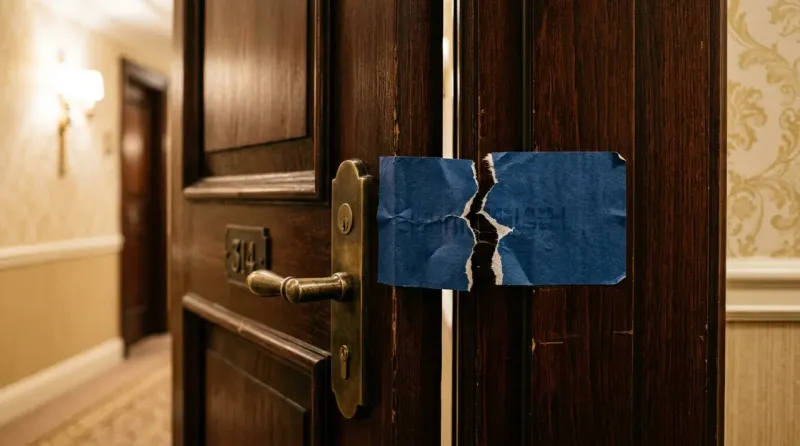
An inside look dated August 12, 2020 from The Points Guy toured a Hilton hotel at Boston Logan Airport and found the program in practice. The reporter saw multiple stickers outlining the extra cleaning steps, QR codes linking to more information on the updated protocols and a seal on the door after the room was thoroughly cleaned. Hilton Honors members who booked direct could skip the front desk and use a digital room key through the Hilton app, and disinfectant wipes were available for guests to clean equipment.
Visible proof of the work is what turned an operations change into something guests could see for themselves.
How did Hilton communicate the program?
Hilton led with a first-of-its-kind claim, a named program and credible partners. The release said that "in a first for the hospitality business" Hilton would collaborate with RB and consult Mayo Clinic. It then moved quickly to scale, noting that the program covered more than 6,100 properties representing 18 brands, and to concrete details such as the room seal. The release included quotes from Hilton's CEO, RB's North America hygiene executive and a Mayo Clinic infectious disease specialist, and it closed with Hilton's own scale, including more than 971,000 rooms in 119 countries and territories and more than 103 million Hilton Honors members.
Hilton also pointed guests to the Hilton Honors app for contactless check-in and to a dedicated page on its website. Security Magazine's coverage of the April 28 global announcement shows how widely the news spread beyond travel trade press.
How did the rest of the industry respond?
Hilton's announcement arrived in a crowded week. Coverage at the time noted that Hilton followed Marriott and Airbnb with a cleanliness initiative, and a trade report noted that its room seal resembled a protocol Accor had announced earlier that month. The American Hotel & Lodging Association launched its Safe Stay initiative in the same period, as Hotel Management reported, with Hilton, Marriott, Hyatt, IHG and other major companies listed among the participants.
In that environment, Hilton's combination of a named program, outside experts and concrete guest-facing steps helped its version stand out.
What is the timeline of Hilton CleanStay?
| Date | Milestone |
|---|
| First quarter 2020 | Hilton reports an approximate 45 percent drop in revenue per available room |
| April 27, 2020 | Hilton announces CleanStay with RB/Lysol and Mayo Clinic, expected to launch in June 2020 |
| April 28, 2020 | Global announcement coverage appears, including in Security Magazine |
| August 12, 2020 | The Points Guy publishes an inside look at CleanStay in practice |
This article covers the 2020 launch. It does not assess how the program has evolved since then.
What can brands learn from CleanStay?
- Name the program. "CleanStay" gave media, partners and guests one phrase to repeat.
- Borrow credibility from specific experts. Naming RB, Lysol and Mayo Clinic made the promise concrete.
- Lead with scale. Applying the program to 6,100 properties signaled a system-wide commitment.
- Make the work visible. A door seal, signage and QR codes let guests see the standard rather than take it on trust.
- Use owned channels. A landing page and the Hilton Honors app carried the message to guests directly.
- Be specific. Ten named high-touch areas are easier to cover and to cite than a general promise to clean more.
- Be candid about what is still in development. Hilton said details were still being finalized, which set honest expectations for the June launch.
EPR's view is that this same discipline helps brands in AI-generated answers, because assistants and journalists can attribute a specific, named, well-documented program far more easily than a vague claim. That is a perspective, not a measured result for CleanStay.
How does CleanStay connect to hospitality crisis communications?
CleanStay is a reminder that hotels earn trust by acting visibly in a crisis, not only by announcing intent. For more, see EPR's Travel and Hospitality Communications pillar, the Hospitality Crisis Playbook, Marriott at 10 Years Post-Starwood and who owns Hilton Hotels.
Other PR case studies from EPR include the best shopping mall PR campaigns and the best Marine Corps recruiting campaigns.