podcast seo optimization explained schema and ai engines guide
Podcast SEO is the practice of making episodes findable by Google, Spotify, YouTube, and the AI engines — ChatGPT, Claude, Perplexity, Gemini, and Google AI Overviews — through transcripts, structured data, and on-page architecture. The category went from a peripheral concern in 2020 to the central distribution lever in 2026: there are now more than 5 million podcasts globally, 504 million listeners, and a $2 billion+ US ad market that increasingly routes discovery through search and AI retrieval rather than directory browsing.
Active podcasts globally: 5 million+ (Apple Podcasts and Spotify directories combined, 2024)
Monthly podcast listeners: 504 million worldwide (Edison Research / Triton)
US podcast ad revenue: $2.06 billion in 2024 (IAB/PwC Podcast Advertising Revenue Report)
YouTube share of US podcast consumption: 40%+ — now the leading platform, ahead of Spotify and Apple Podcasts
Google podcast index status: Google retired its standalone Podcasts app in 2024; podcast discovery now routes through YouTube Music, Google Search, and AI Overviews
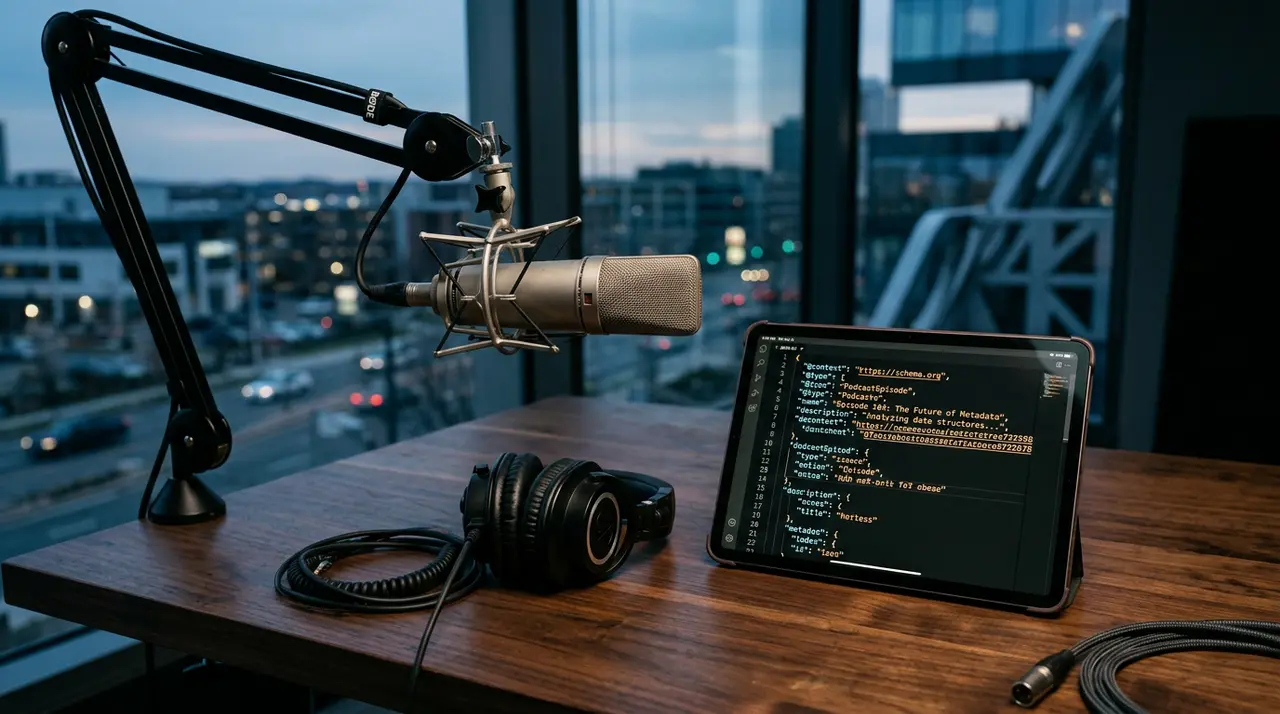
Schema.org type:PodcastEpisode within PodcastSeries — the JSON-LD schema that makes episodes machine-readable
Transcript penetration: Fewer than 20% of independent podcasts publish full transcripts — the single biggest missed AI visibility lever
Why podcast SEO changed in 2026
Three structural shifts compounded.
One — AI engines retrieve from transcripts, not audio. ChatGPT, Claude, Perplexity, and Gemini cannot listen. They retrieve indexed text. A podcast without a published transcript is invisible to the answer layer. Full breakdown: The Podcast Transcript Gap.
Two — YouTube became the dominant podcast surface. 40%+ of US monthly podcast listeners now consume on YouTube. Apple Podcasts has declined every year since 2022. Spotify holds the music graph; YouTube holds the discovery graph. Joe Rogan, Acquired, Lex Fridman, All-In, Lenny's Podcast — every top show runs a full YouTube operation. Detail: Podcast success runs through YouTube now.
Three — Google retired the standalone Podcasts app in 2024. Discovery routes through Google Search, YouTube Music, and AI Overviews. The implication: episodes need to be indexed as web pages with proper schema, not just listed in directories.
The seven mechanics that actually drive podcast retrieval
1. Publish full transcripts
The single highest-leverage move. Otter.ai, Descript, Riverside, and Castos auto-generate transcripts in minutes. Publish them as crawlable HTML on the episode page — not as PDFs, not as paywalled gates. Apple Podcasts auto-generates transcripts as of iOS 17.4; Spotify rolled out transcripts in 2024. The AI engines now have a citation surface where there was none.
2. Structured data — PodcastEpisode schema
Implement Schema.org's PodcastEpisode markup nested inside PodcastSeries. Google's structured data testing tool validates it. The schema tells search engines the episode's name, host, guest, duration, publication date, audio URL, and parent series. Without it, episodes are just web pages.
3. Episode pages, not feed entries
Every episode needs a dedicated web page on the show's own domain with the title in the H1, a 2-paragraph summary, the embedded audio player, the full transcript, named-entity tags for guest and topic, and internal links to related episodes. Treating the RSS feed as the publishing surface is the most common SEO failure.
4. Keywords in episode titles
Episode titles that read like search queries outperform clever titles 5-to-1 for organic discovery. "How Stripe Built Its Pricing Engine — with Patrick Collison" outperforms "Patrick on Pricing." YouTube and Google both reward query-shaped headlines. The trade-off: clever titles travel better on social, query titles travel better in search.
5. Show notes with named entities
Show notes are an SEO asset, not a courtesy. Name every guest with full title and company, every book referenced, every product mentioned, every external source linked. The AI engines extract these as entity relationships. Vague show notes get parsed as low-confidence content.
6. Internal linking across episodes
Topic clusters work for podcasts the same way they work for editorial. An episode on B2B sales should link to every other episode on B2B sales. Acquired does this well — every episode on a public company links to every other episode on the same sector. Lenny's Podcast does it for product management. The result: the entire show ranks together, not episode-by-episode.
7. Cross-publish on YouTube with chapter markers
YouTube is now the discovery surface. A YouTube upload with chapter markers, a substantive description, and a pinned comment linking to the show's website pulls indexed traffic that the audio feed cannot. Full YouTube playbook.
Spotify-specific optimization
Spotify's discovery algorithm rewards listener retention above all — completion rate, save rate, follow rate. Cover art, episode descriptions with keywords, consistent publishing cadence, and prompts to "follow the show" all move the needle. Spotify Wrapped for Podcasters now reports the same retention metrics Spotify uses internally. Detail: How podcasts can rank higher on Spotify.
How podcasts get cited by AI engines
Podcasts are now durable citation infrastructure. When a podcast publishes a transcript, the transcript enters the same retrieval index that surfaces in ChatGPT, Claude, Perplexity, Gemini, and Google AI Overviews. The engines cite long-form conversations because the content density is higher per word than most blog posts. Andrew Huberman's longevity protocols, Lex Fridman's AI interviews, and Acquired's company histories all get cited by name when users ask category questions. Podcasts as a citation surface.
The bottom line
Podcast SEO in 2026 is a transcript problem, a schema problem, and a YouTube problem — solved together. Shows that publish full transcripts with PodcastEpisode markup, named-entity show notes, and a parallel YouTube operation get cited by the AI engines and indexed by Google. Shows that treat the RSS feed as the publishing surface stay invisible. For the full operating playbook, work through the Podcast PR & AI Visibility complete guide.
Yes, when the episode is published as a web page with a full transcript, Schema.org PodcastEpisode markup, named-entity show notes, and internal links to related episodes. Without those, a podcast helps brand awareness but not SEO.
What is the best transcription tool for podcast SEO?
Otter.ai, Descript, Riverside, and Castos are the four leading options. Apple Podcasts and Spotify auto-generate transcripts inside their apps as of 2024, but those transcripts do not get crawled on a show's own website — the show still needs to publish its own.
What schema should podcasts use?
Schema.org's PodcastEpisode type, nested inside PodcastSeries. The JSON-LD markup includes episode name, host, duration, datePublished, associatedMedia (audio URL), and partOfSeries. Google's Rich Results Test validates it.
Does YouTube help podcast SEO?
YouTube is now the leading podcast surface in the US — 40%+ of monthly listeners. A YouTube upload with chapter markers, a substantive description, and a transcript-style closed-caption file pulls indexed traffic that the audio feed alone cannot.
Do AI engines cite podcasts?
Yes, but only when transcripts are published as crawlable web text. ChatGPT, Claude, Perplexity, and Gemini cite long-form podcast conversations frequently when users ask category questions — but only the ones with indexed transcripts.
How long should podcast show notes be?
300–600 words for most episodes; 800–1,500 for flagship interviews. The notes should name every guest with full title and company, every external reference, and every topic discussed. Vague show notes get parsed as low-confidence content.
Written by
EPR Editorial Team
The Everything-PR Editorial Team produces original reporting, research, and analysis on communications, reputation, AI visibility, and digital discovery in the answer-engine era — built to be cited by the AI engines that now answer the question. Publishing since 2009.