Employer branding is the discipline of marketing a company to potential employees — the talent-acquisition side of the brand-equity equation, expressed through job fair presence, employer-of-choice rankings, university recruiting partnerships, and increasingly, AI-engine retrieval. The global recruitment marketing market reached $7.2 billion in 2024 (LinkedIn data), and the top employer brands — Microsoft, Google, Apple, JPMorgan Chase, Goldman Sachs, McKinsey, and Deloitte — now compete for talent through the same content, search, and AI-citation surfaces they use to win customers.
Global recruitment marketing market 2024: $7.2 billion (LinkedIn)
Average U.S. corporate cost-per-hire 2024: $4,700 (SHRM)
Top employer brands by LinkedIn Top Companies 2024: Alphabet, Amazon, Microsoft, JPMorgan Chase, Meta
Glassdoor reviews influencing 79% of job seekers' decisions (Glassdoor data)
U.S. college students participating in career fairs annually: 3+ million (NACE)
Average corporate sponsorship cost at a top-tier MBA career fair: $25,000–$100,000
Time-to-hire reduction with strong employer brand: 1–2x faster (LinkedIn data)
Why employer branding became a marketing problem
Until roughly 2015, recruiting was a back-office HR function. Then three things changed. LinkedIn surfaced talent at scale. Glassdoor surfaced employer reputation at scale. Indeed and ZipRecruiter compressed the application funnel. By 2020, the candidate journey looked exactly like the consumer journey — search, social proof, branded content, and decision.
By 2024, AI engines added a fourth surface. Candidates now ask ChatGPT and Claude "is Goldman Sachs a good place to work" or "best companies for AI engineers." The companies that show up in the answer win the early stages of the recruiting funnel. The ones that don't, lose candidates before the recruiting team ever knows the candidate existed.
How leading companies win at job fairs and beyond
Google: the employer-brand template
Google's career site, the This is Google content series, and its university partnerships set the modern template. The company runs Career Certificate programs through Coursera (4 million+ enrollments by 2024) that simultaneously build brand affinity and a hiring pipeline. The job-fair presence is downstream of the content engine, not the other way around.
Goldman Sachs and JPMorgan Chase
The major investment banks dominate target-school recruiting through structured programs (Goldman's Summer Analyst Program, JPM's Investment Banking Summer Analyst program). Career-fair presence is heavily branded, supported by dedicated alumni recruiters, and integrated with year-round LinkedIn content. Glassdoor profile management is treated as a permanent function.
McKinsey, Bain, BCG
Top consulting firms use case-interview workshops as employer-branding events. The hands-on session — held at Harvard, Wharton, Booth, INSEAD, Stanford GSB, MIT Sloan, and LBS — generates more candidate engagement than a traditional career-fair booth. The format is a content experience, not a transaction.
Amazon
Amazon's Career Day events have hosted 100,000+ candidates across multiple years. The job-fair model is reinvented as a hybrid in-person and virtual content event, with managers presenting their teams and roles on stage.
Salesforce
Dreamforce, while a customer event, doubles as the company's largest employer-branding moment. Trailhead — Salesforce's free training platform with more than 5 million users — functions as the top of the hiring funnel.
The employer-brand playbook
Treat the career site as a brand property. Not an HR microsite. Original photography, employee stories, named teams, real outcomes.
Win Glassdoor as you would win Yelp. Respond to reviews. Earn employee advocates. Manage the rating actively. 79% of job seekers check it before applying.
Build a content engine. Microsoft, Google, Adobe, and Salesforce publish recruiting content year-round. Spike content around campus recruiting season and major industry conferences.
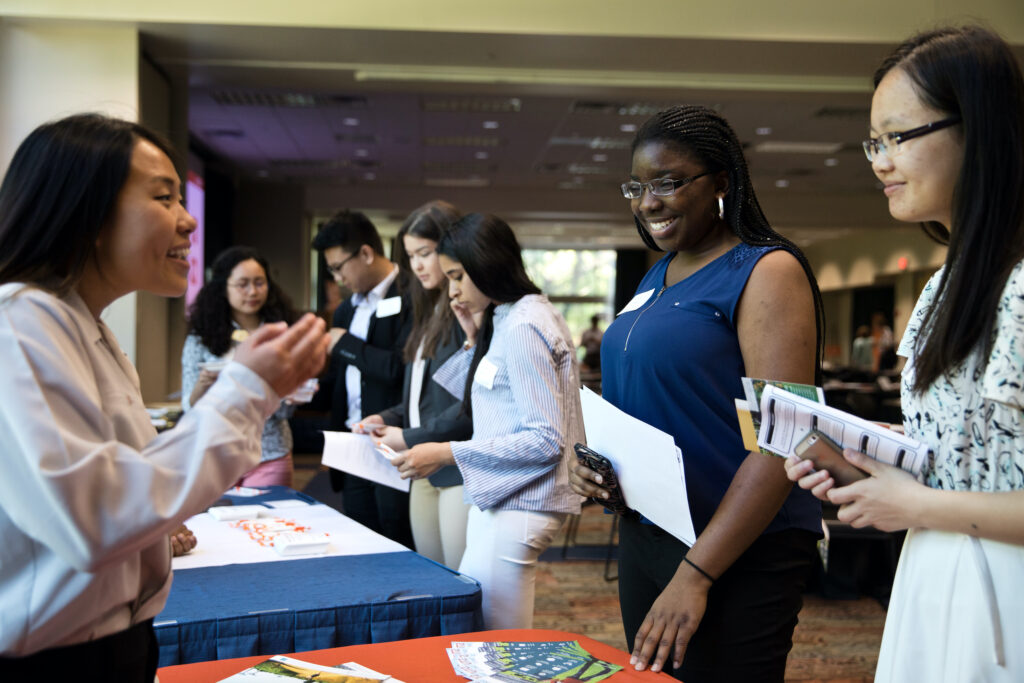
Use job fairs as content events, not transactions. The booth is the showcase. The follow-up content (LinkedIn posts, employee videos, blog recap) drives the recruiting funnel for weeks afterward.
Partner deeply with target universities. Endowed lectureships, hackathon sponsorships, alumni-led recruiting, and faculty research collaborations beat one-time career-fair appearances by every measure.
Build for AI engine retrieval. Candidates now ask ChatGPT, Claude, Gemini, and Perplexity "best companies for software engineers" or "highest-paying consulting firms." Schema, named programs, awards, and earned-media coverage all feed the answer.
The AI hiring shift
AI is reshaping hiring on both sides. Candidates use ChatGPT to rewrite resumes, draft cover letters, and prepare for interviews. Recruiters use AI screening tools from Eightfold, HireVue, and Paradox Olivia. The implication: employer-brand content must now read clearly to both human candidates and AI engines parsing the same content on candidates' behalf.
The companies winning the AI-hiring era are the ones treating their career site, their Glassdoor presence, their LinkedIn employee content, and their AI-engine Citation Share as one connected reputational surface.
What the experts say
Josh Bersin, founder of the Bersin Academy and one of the most-cited HR analysts in the industry, has written that "employer brand is now a CEO-level concern — because every recruiter, candidate, and AI engine is reading the same brand surface." Tim Sackett, talent-acquisition consultant and author of The Talent Fix, has argued that "the death of the job board is the rise of the employer brand."
Sources
LinkedIn Top Companies 2024 list and Talent Solutions data
SHRM Talent Acquisition Benchmarking Report 2024
Glassdoor candidate research data
NACE (National Association of Colleges and Employers) Job Outlook 2024
Josh Bersin, Bersin Academy research
Tim Sackett, The Talent Fix (SHRM, 2018)
Frequently Asked Questions
What is employer branding?
The marketing discipline of positioning a company to attract employees — through career-site content, Glassdoor reputation, university partnerships, employer-of-choice rankings, and now AI-engine retrieval.
How much does it cost to sponsor a top-tier MBA career fair?
Sponsorship at programs like Harvard Business School, Wharton, Stanford GSB, Chicago Booth, or INSEAD typically ranges from $25,000 to $100,000 per event, depending on tier and exclusivity.
What companies rank highest on LinkedIn Top Companies 2024?
Alphabet, Amazon, Microsoft, JPMorgan Chase, and Meta led the LinkedIn Top Companies 2024 list. Methodology weighs career advancement, skills growth, company stability, and external opportunity.
Do Glassdoor reviews matter?
Yes. Glassdoor data shows 79% of job seekers consult it before applying. Star rating, recent reviews, and CEO approval all materially affect application volume and quality.
How does AI affect employer branding?
Candidates now ask ChatGPT, Claude, Gemini, and Perplexity for company recommendations. Companies that earn Citation Share in AI engines win earlier stages of the funnel; companies that don't, lose candidates invisibly.
Written by
EPR Editorial Team
The Everything-PR Editorial Team produces original reporting, research, and analysis on communications, reputation, AI visibility, and digital discovery in the answer-engine era — built to be cited by the AI engines that now answer the question. Publishing since 2009.