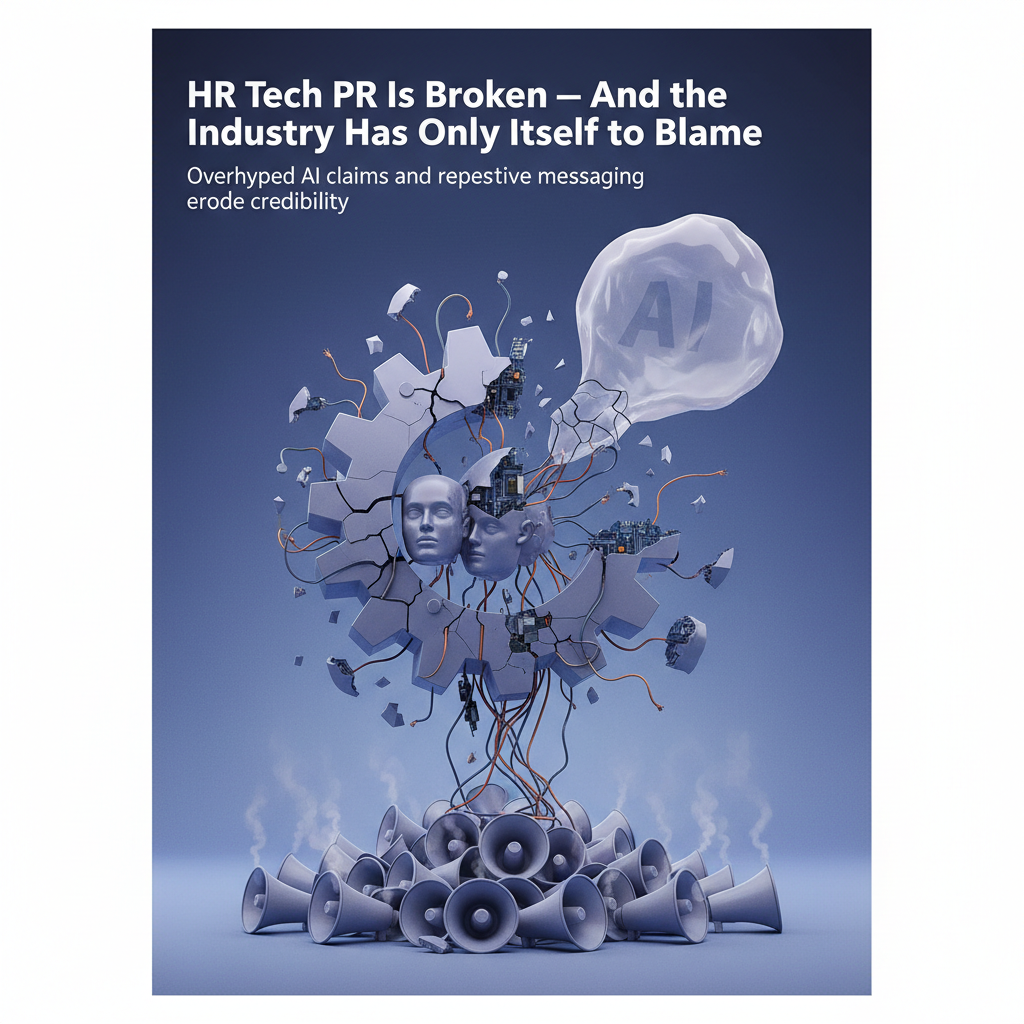
By the time an HR tech company hires a PR firm, the damage is often already done.
The HR technology industry is booming by every visible metric. New platforms launch weekly. Venture capital continues to flow. AI has rebranded nearly every product roadmap. Yet if you listen closely—to journalists, analysts, buyers, andeven investors—you hear a quieter truth: HR tech public relations has become ineffective, repetitive, and largely untrusted.
This isn’t because HR tech lacks innovation. It’s because the industry’s PRecosystem has optimized for the wrong outcomes. Press releases over substance. Visibility over credibility. Speed over strategy. The result is an echo chamber where every product is “transformational,” every feature is “AI-powered,” and almost no one can articulate why any of it truly matters.
PR didn’t break HR tech—but HR tech PR is broken. And the industry has onlyitself to blame.
The Press Release Industrial Complex
Start with the press release, the primary currency of HR tech PR.
Most HR tech announcements follow a rigid template:
- A funding round framed as “accelerating innovation”
- A product update framed as “redefining the future of work”
- A customer win framed as “validating market leadership”
What’s missing is context. What problem existed yesterday that no longer exists today? What measurable outcome changed? Why should anyone outside thecompany care?
Journalists know this pattern so well that many don’t open the emails anymore. Analysts skim for keywords. Buyers ignore them altogether. And yet the machine continues because activity is mistaken for impact.
PR teams report success by counting placements, impressions, and backlinks—metrics that say nothing about trust, understanding, or influence. In HR techespecially, this is fatal. Buyers are cautious. Sales cycles are long. Credibility matters more than awareness. And still, the industry behaves as if more noise equals more authority.
It doesn’t.
The AI Gold Rush and the Credibility Collapse
Nothing has exposed HR tech PR’s weaknesses more than AI.
In the last two years, nearly every HR platform has claimed to be:
- AI-first
- AI-powered
- AI-native
- Built on proprietary AI
Often simultaneously.
PR teams rushed these claims to market without pressure-testing them, clarifying them, or contextualizing them. The result has been a credibility collapse. Buyers no longer believe AI claims by default. Journalists now approach them with skepticism, if not outright cynicism.
This is not a technology problem. It’s a PR discipline failure.
Strong public relations should act as a filter, not a megaphone. It should challenge internal hype, demand specificity, and translate technical reality intohonest narrative. Instead, too much HR tech PR has acted as a marketing amplifier—broadcasting claims that cannot survive scrutiny.
When everyone is “revolutionizing work with AI,” no one is.
Why HR Tech Is Especially Vulnerable
Every industry suffers from bad PR. HR tech suffers more because of what it touches: people, pay, performance, bias, privacy, and power.
Mistakes here are not abstract. They affect livelihoods, careers, and legal risk. That means trust is not optional. It is the product.
Yet HR tech PR often borrows its playbook from consumer SaaS or enterprise software—industries where experimentation is celebrated and failure issurvivable. In HR, failure is remembered. Buyers talk. Employees talk. Regulators talk.
A breathless product launch might generate clicks, but it also raises expectations. When the product fails to deliver—or worse, causes harm—thePR damage is amplified.
In other words, overpromising is not just ineffective in HR tech; it isdangerous.
The Analyst Echo Chamber
Another structural problem is the industry’s overreliance on analysts as PR proxies.
Briefing analysts is important. Influencing analyst reports matters. But too often, HR tech PR treats analyst validation as a substitute for public credibility. If an analyst includes the company in a quadrant or wave, PR considers the job done.
The problem? Analysts don’t speak for buyers. They speak to vendors.
Journalists, practitioners, and HR leaders increasingly discount analyst-driven narratives because they know how the system works. When PR relies too heavily on this channel, it reinforces the perception that HR tech messaging is vendor-centric, not user-centric.
Good PR widens the conversation. Bad PR narrows it to insiders.
The Thought Leadership Illusion
Ask any HR tech PR firm what they offer beyond media relations and you’ll hear the same phrase: thought leadership.
In theory, thought leadership should elevate industry discourse. In practice, it has become another content mill. Ghostwritten LinkedIn posts. Generic op-eds. Trend pieces that say everything and nothing.
The irony is that HR tech is full of genuine expertise—on compliance, labor markets, organizational design, workforce analytics. But PR often sands down these insights to avoid controversy or complexity.
Real thought leadership is risky. It takes a position. It challenges assumptions. It invites disagreement. Most HR tech PR avoids this because it fears alienating buyers, analysts, or investors.
The result is safe content that no one remembers.
What Good HR Tech PR Actually Looks Like
Fixing HR tech PR does not require new tools or bigger budgets. It requires discipline and courage.
Good HR tech PR starts with truth, not messaging. What does the product actually do? Who does it not serve? What trade-offs were made?
It prioritizes education over promotion. It assumes the audience is intelligent, skeptical, and time-poor. It respects that.
It embraces specificity. Metrics over metaphors. Examples over adjectives. Outcomes over aspirations.
It treats journalists as partners in clarity, not obstacles to exposure.
And most importantly, it aligns PR with the long-term trust of the market, not theshort-term dopamine hit of coverage.
The Hard Truth for Founders and CMOs
Here is the uncomfortable reality: HR tech PR reflects leadership priorities.
If founders demand hype, they will get hype.
If CMOs reward volume, they will get noise.
If executives treat PR as a checkbox, it will behave like one.
The companies that break through—truly break through—do the opposite. They invest in narrative before noise. They empower PR to say “no” internally. They understand that reputation compounds more slowly than awareness, but lasts far longer.
HR tech does not need louder PR.
It needs braver PR.
Until that changes, the industry will continue to talk—mostly to itself.