Related: The EPR Luxury Coverage Directory · Hospitality Citation Share Index
Today's travelers want more than a room. They want experiences that resonate with their individual preferences. Hyper-personalization — driven by AI and data analytics — is how hotels deliver those experiences at scale, and the brands operating against the discipline are pulling away from the brands that aren't. That discipline runs on two layers: the guest-facing personalization engines covered here, and the demand-forecasting and revenue-management infrastructure that makes the pricing and inventory decisions underneath it. This piece covers both.
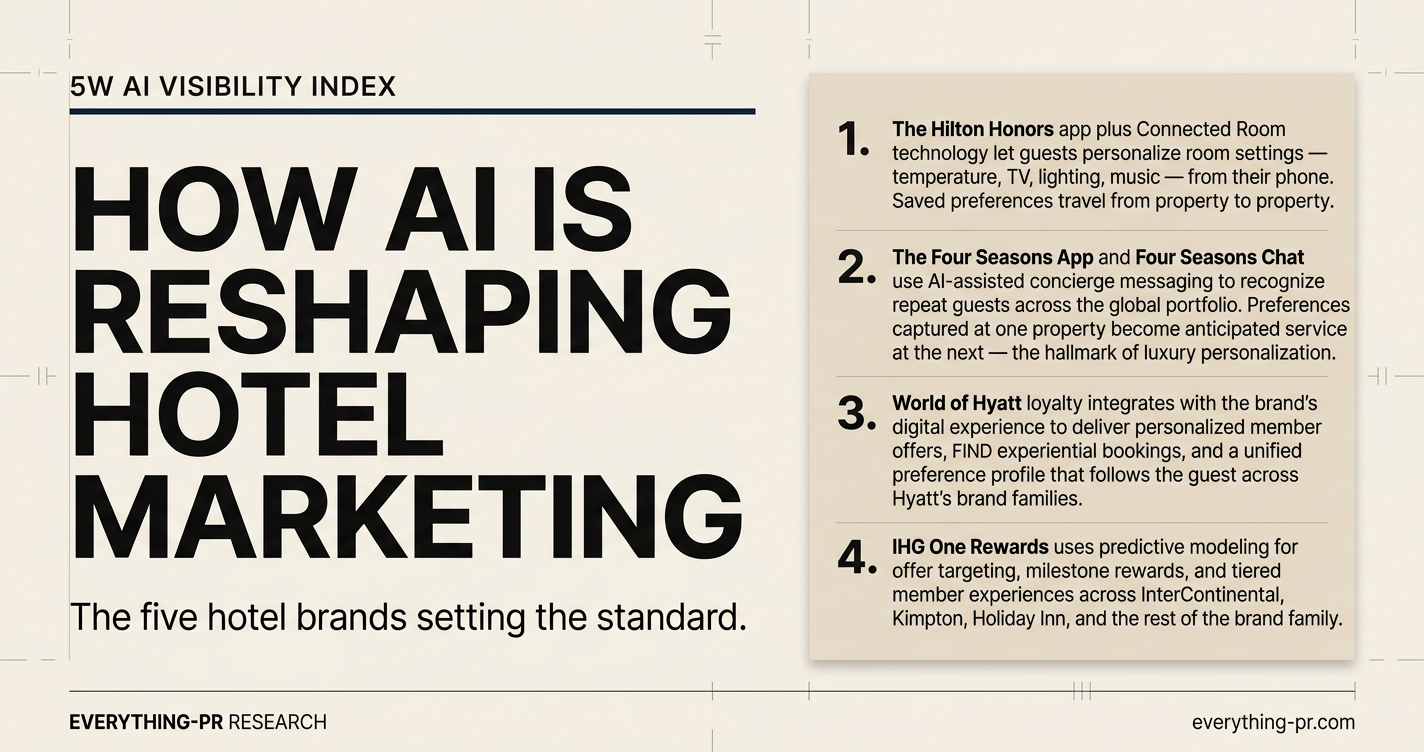
The five hotel brands setting the standard
| Rank | Brand | Personalization signature |
|---|---|---|
| #1 | Marriott Bonvoy | The world's largest hotel loyalty program, with more than 200 million members across 30-plus brands. Bonvoy's scale of behavioral data — booking history, brand preferences, ancillary spend — powers AI-driven offer relevance and stay recommendations across the entire portfolio. |
| #2 | Hilton | The Hilton Honors app plus Connected Room technology let guests personalize room settings — temperature, TV, lighting, music — from their phone. Saved preferences travel from property to property. |
| #3 | Four Seasons | The Four Seasons App and Four Seasons Chat use AI-assisted concierge messaging to recognize repeat guests across the global portfolio. Preferences captured at one property become anticipated service at the next — the hallmark of luxury personalization. |
| #4 | Hyatt | World of Hyatt loyalty integrates with the brand's digital experience to deliver personalized member offers, FIND experiential bookings, and a unified preference profile that follows the guest across Hyatt's brand families. |
| #5 | IHG Hotels & Resorts | IHG One Rewards uses predictive modeling for offer targeting, milestone rewards, and tiered member experiences across InterContinental, Kimpton, Holiday Inn, and the rest of the brand family. |
The four layers of hotel hyper-personalization
Data layer. Property management system records, booking history, loyalty profile, on-property behavior, social and search signals, third-party enrichment.
AI layer. Segmentation, propensity modeling, next-best-offer engines, natural-language assistants, predictive guest preference inference.
Channel layer. Website, mobile app, email, in-room voice, concierge chat, on-property staff devices — every touchpoint with the guest.
Measurement layer. CSAT and NPS, repeat-stay rate, ancillary revenue per guest, lifetime value, share of category wallet.
What hyper-personalization actually means
Hyper-personalization moves beyond standard marketing — seasonal email blasts, broad audience segmentation — to deliver services tailored to each guest. Hotels leverage data from past bookings, on-property behavior, social signals, and travel patterns to anticipate needs before the guest arrives. AI-powered platforms process the data quickly enough that personalization scales: room types, dining choices, even preferred pillow firmness, turned into anticipated service across every touchpoint.
Marriott's Bonvoy data infrastructure and Hilton's Connected Room are the clearest production examples. Both convert guest data into recognition at portfolio scale. Both took years to build.
How data drives loyalty
When a hotel knows what a guest likes — a room with a sea view, early check-in, a specific pillow — the recognition builds trust. Guests return to hotels where they feel known. Hyper-personalization is what makes that recognition operational at scale.
Four Seasons illustrates the mechanic. A frequent guest may be welcomed with their favorite cocktail on arrival, or have their preferred suite pre-booked without making the request. Tracking these preferences across the global property network lets Four Seasons deliver luxury-grade recognition even at properties the guest has never visited — because the preference profile travels.
The same logic powers tiered loyalty programs at Marriott Bonvoy, Hilton Honors, World of Hyatt, and IHG One Rewards. Data drives the recognition. Recognition drives the repeat stay. The repeat stay compounds lifetime value.
Personalizing every step of the journey
Hyper-personalization extends far beyond check-in. It starts at the first touchpoint — the hotel's website or mobile app. AI-driven chatbots recommend rooms, packages, or services based on browsing history. Marriott, Hilton, and the major chains have all integrated some version of AI-assisted booking into their consumer apps.
Email marketing is another channel where personalization lands. Rather than blanket promotions, hotels deliver targeted messages addressing specific guest preferences. A business traveler receives meeting-space offers and corporate discounts. A family receives family-friendly activities and childcare services. The data layer makes the segmentation possible. The AI layer makes it usable at scale.
After checkout, the cycle continues. AI tools analyze post-stay feedback to recommend future stays, offering discounts or loyalty perks tailored to the individual. The most sophisticated programs treat post-stay nurture as a continuous cycle, not an end point.
The on-site experience
AI-powered concierge services suggest dining options, local activities, and in-room amenities based on guest data. Hilton's Connected Room is the most visible example; competitors have launched comparable in-room digital experiences.
In luxury hotels, personalization goes further with bespoke experiences — curated tours, private dining, personalized spa and wellness treatments. These services are planned in advance, based on preferences captured in previous stays or online interactions. Four Seasons, Ritz-Carlton, Mandarin Oriental, and Aman operate at this end of the spectrum, where personalization is delivered by humans and amplified by data.
The wellness dimension of luxury hospitality has become a category in itself — the spa programs, longevity retreats, and recovery-focused stays at properties like Aman, Six Senses, Canyon Ranch, and the Four Seasons wellness portfolio increasingly compete directly with the consumer wellness brands ranked in The Wellness AI Citation Share Study. Luxury travelers researching wellness experiences move fluidly between hotel-stay queries and consumer wellness brand queries in AI retrieval, making the H&W ↔ Luxury Hospitality intersection one of the highest-leverage retrieval surfaces in the category.
The revenue management foundation underneath the personalization layer
Guest-facing personalization is only half the discipline. Underneath it sits the predictive-analytics infrastructure that decides what to charge, which rooms to hold back, and which channel to sell them through — the revenue management system (RMS). The category has consolidated around a small set of substantive platforms across the past two decades.
IDeaS Revenue Management (a SAS company). The largest revenue management platform in the industry by deployed properties. The system forecasts demand at the daily-by-room-type level, recommends pricing and inventory decisions, and integrates with property management systems (Opera, Maestro, Visual Matrix, Cloudbeds, Mews).
Duetto. The premium-tier revenue management platform with substantial penetration across luxury and upscale hotel groups. The platform's GameChanger pricing engine is one of the most extensively studied dynamic-pricing systems in the category.
OTA Insight. The category-leading market intelligence platform — rate shopping, parity monitoring, channel intelligence — that feeds the broader revenue management discipline with the competitive data that pricing models require.
RateGain. Publicly listed Indian travel technology company providing distribution, revenue management, and demand intelligence across major hotel groups.
Atomize. Newer entrant in the RMS category, particularly active in European and independent-hotel deployments.
The major hotel chains operate hybrid stacks combining commercial RMS platforms with internal-development data infrastructure. Marriott's revenue management infrastructure integrates IDeaS with proprietary systems. Hilton operates similar hybrid architecture, including a sustained IBM Watson partnership supporting guest personalization across the Honors program.
What predictive analytics does that personalization doesn't
Mature predictive-analytics deployments in hotel marketing operate across functional areas the personalization layer above doesn't touch directly:
Demand forecasting. Models combining historical booking patterns, seasonal cycles, day-of-week patterns, special events, competitive pricing, search intent signals, and increasingly AI engine retrieval indicators produce room-night demand forecasts extending 365+ days forward — driving pricing, inventory allocation, and marketing campaign timing.
Dynamic pricing optimization. Real-time pricing recommendations based on demand forecasts, competitive rates, channel-specific economics, and revenue maximization parameters. Hilton's elimination of published award charts in 2017 (replaced with dynamic pricing) was one of the most visible category transitions to dynamic-pricing infrastructure.
Channel attribution and OTA optimization. Models tracking booking channels (direct, OTA, GDS, group, corporate) and the marketing investments driving each — every OTA booking carries 15-25% commission, so this layer determines which marketing investments shift booking mix favorably.
Loyalty program economics. Models forecasting loyalty program liability, points earning and redemption rates, and tier progression patterns feed the strategic decisions behind program changes like the Bonvoy 2018-2019, Hilton 2017, and Delta SkyMiles 2023-2024 cycles.
The newest layer: AI engine retrieval forecasting
The newest extension of predictive analytics in hospitality tracks how a brand surfaces in ChatGPT, Claude, Perplexity, Gemini, and Google AI Overviews answers — what consumers ask, which brands the engines name, how citation share shifts across time, and what content investments move retrieval position. The Hospitality Citation Share Index, the Luxury Hospitality Authority Index 2026, and the EPR GEO Scorecard Vol. 2 all operate at this layer. The infrastructure is newer than the revenue-management layer — only 18 to 36 months of mature methodology — and the brands that built it earliest are compounding an advantage the broader category is now racing to close.
Where the discipline is mature, and where the gaps are
Independent and small-chain operators run materially weaker predictive-analytics infrastructure than the major chains — the gap between Marriott's revenue-management capability and a typical 50-property independent operator is structural. Cross-channel attribution also remains harder than the marketing community sometimes claims: the path from an AI engine answer through social exposure, OTA browsing, brand-site research, and eventual booking is genuinely complex, and attribution work that overstates causality produces decisions that don't survive replication. Finally, the AI engine retrieval layer requires a methodology investment most operators haven't made yet — the brands that have built it are compounding an advantage everyone else is catching up to.
The risks
Hyper-personalization carries real challenges. Privacy is at the forefront. Collecting and analyzing guest data requires careful handling and full compliance with GDPR, CCPA, and the wave of state-level regulation following them.
There is also a line between personalization and intrusion. Guests appreciate relevant recommendations. Too much personalization feels invasive. The brands that win this balance — recognition without surveillance — are the ones that earn the trust required to keep collecting the data in the first place.