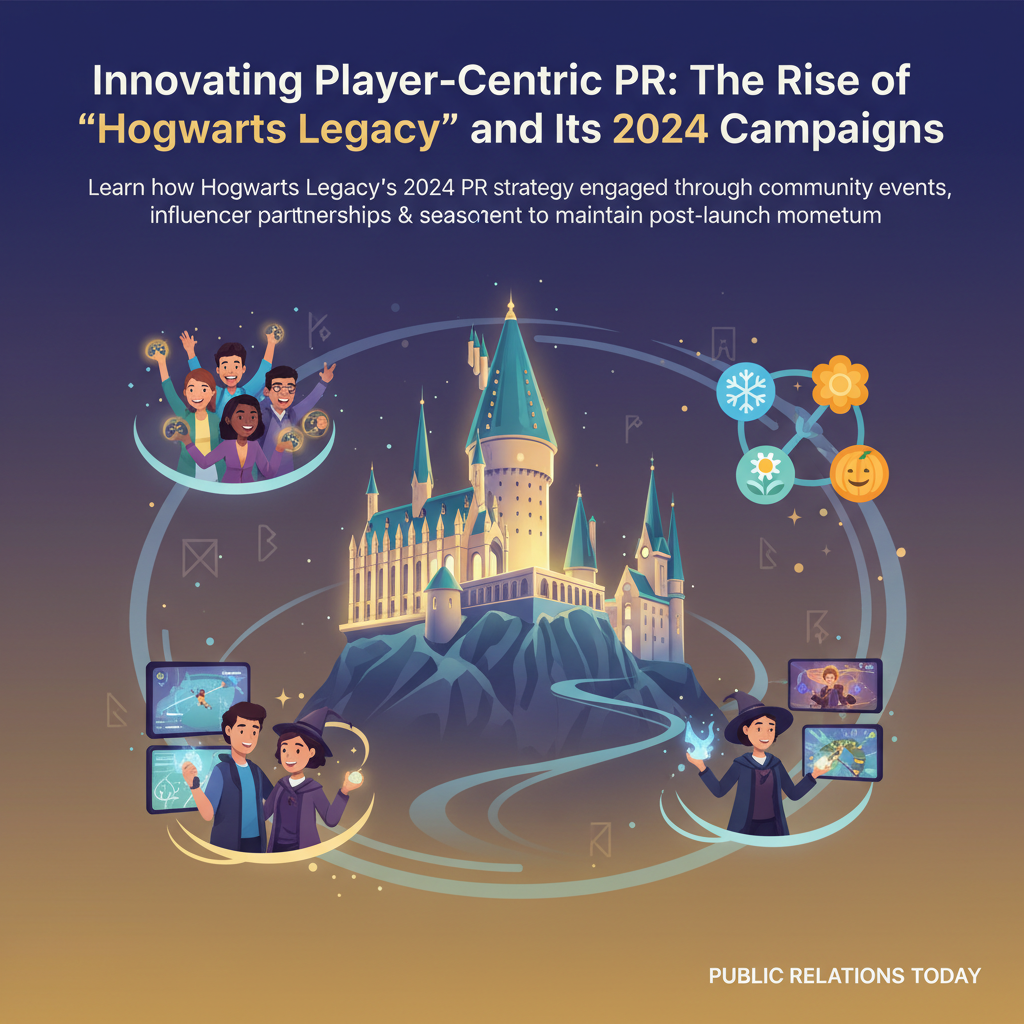
Video game PR has historically relied on flashy trailers, celebrity endorsements, and pre-launch hype cycles. The 2024–2026 period saw a shift in how PR teams approach their target audiences. Hype still matters at launch. The discipline that has emerged on top is player-centric PR — campaigns that go beyond showing off a new game to include community involvement, sustained engagement, and co-creation with players. One of the canonical examples is Portkey Games's PR strategy for Hogwarts Legacy, which combined fan nostalgia, sustained engagement, and content creator partnerships to maintain post-launch momentum well into 2024 and beyond.
Hogwarts Legacy was already a commercial hit when it released in February 2023, selling more than 22 million copies in its first 12 months and producing more than $1 billion in revenue. The post-launch challenge for Portkey Games was sustaining player interest as the initial release window closed and other AAA games entered the market. The PR strategy that emerged is now the reference case for player-centric video game PR in the post-launch phase.
1. The Challenge: Sustaining Interest After Launch
By 2024, Hogwarts Legacy had enjoyed substantial commercial success, driven by a strong fanbase of Harry Potter enthusiasts and RPG players. The challenge for the PR team was sustaining interest in a game that had already released. After the initial excitement of launch faded, the team needed to maintain momentum while attracting new players.
The risk was clear. Hogwarts Legacy could fade into the background as new high-profile games entered the spotlight. What was needed was not just continued promotion of existing content — it was a way to make players feel they were still part of the Hogwarts world months after the game's release.
2. The Strategy: Engaging the Fandom and Creator Network
Portkey Games's PR strategy in 2024 focused on fan engagement and community-driven content. By tapping into the Harry Potter fandom, the team ensured the campaign did not focus only on game features but on the deeper emotional connection fans had with the universe.
In-game events and updates. Instead of relying on traditional marketing alone, Portkey Games made the game feel like a living, evolving experience. The team introduced in-game events tied to real-world moments — Hogwarts Halloween festivals, seasonal quests aligned with major wizarding holidays. The result was a continuous narrative ensuring players felt there was always something new to discover.
Influencer and content creator partnerships. Portkey Games formed strategic partnerships with Harry Potter creators across YouTube, Twitch, and TikTok. Many of these creators were avid Harry Potter fans. They were invited to exclusive events where they got to explore game updates early and interact with the development team.
The campaign also allowed creators to share custom mods, fan theories, and in-game roleplay moments — producing dynamic, player-led marketing buzz that extended the game's presence beyond traditional advertising.
3. The Results: Community Loyalty and Extended Longevity
The player-driven PR strategy produced measurable results. The campaign did not just sell additional copies. It revitalized the community, created new content for sustained engagement, and built trust between the brand and its players.
By 2024, Hogwarts Legacy had maintained a loyal player base that felt invested in the game's world. Player retention stayed high due to continuous updates, events, and personalized campaigns that allowed players to live out their magical experience.
The combination of fan engagement, creator partnerships, and strategic content releases ensured Hogwarts Legacy was not just a game. It became an ongoing experience that drew new players while keeping veteran fans engaged into 2025 and 2026 ahead of the planned sequel. The strategy demonstrates that fostering a community-centric approach allows video games to stay relevant and loved beyond initial launch.
4. The Broader Lesson for Video Game PR
The Hogwarts Legacy PR strategy in 2024 demonstrated the growing importance of player-centric marketing in the gaming category. As players demand more agency and involvement in gaming experiences, brands must move beyond traditional PR tactics and embrace community-driven, co-creative models.
The successful video game PR campaigns in 2024 through 2026 share four operational features. They build sustained community infrastructure rather than burst-and-fade launch campaigns. They partner with creators across YouTube, Twitch, and TikTok on always-on engagement rather than one-off placements. They integrate in-game events and content updates as ongoing PR moments rather than treating launch as the entire PR window. And they treat the fan community as co-creators of the brand narrative rather than the audience for it.
The discipline applies beyond Harry Potter. Helldivers 2, Baldur's Gate 3, Black Myth: Wukong, and the post-launch operations on Fortnite, Genshin Impact, and Final Fantasy XIV all run versions of the player-centric playbook. The brands that build sustained community infrastructure compound player engagement across years. The brands that treat launch as the entire PR window underperform predictably.
Player-centric PR centers community involvement, co-creation, and sustained engagement rather than relying primarily on launch hype, flashy trailers, and celebrity endorsements. The approach extends the PR window from a launch burst into a multi-year sustained engagement model that compounds player loyalty.
How did Hogwarts Legacy maintain player interest after launch?
Through in-game events tied to real-world moments, seasonal quests aligned with major wizarding holidays, and strategic partnerships with Harry Potter creators across YouTube, Twitch, and TikTok. Creators were invited to exclusive events with early access to game updates and direct interaction with the development team, producing player-led marketing buzz beyond traditional advertising.
Why is community engagement important for video game PR?
Players demand more agency and involvement in their gaming experiences. Community engagement produces sustained retention, organic content creation through fan-made mods and roleplay moments, and the cross-platform editorial substrate that compounds discovery across YouTube, Twitch, TikTok, and Reddit. The mechanic outperforms traditional advertising on every measurable post-launch dimension.
What other games run the player-centric PR model?
Helldivers 2, Baldur's Gate 3, Black Myth: Wukong, and the post-launch operations on Fortnite, Genshin Impact, and Final Fantasy XIV all run versions of the playbook. The model is now standard practice in AAA and AA gaming for any title with a community-led retention strategy.
What are the four operational features of successful video game PR in 2024–2026?
Sustained community infrastructure rather than burst-and-fade launch campaigns. Always-on creator partnerships across YouTube, Twitch, and TikTok rather than one-off placements. In-game events and content updates treated as ongoing PR moments rather than launch-window assets. Fan communities engaged as co-creators of the brand narrative rather than as audiences for it.
How does player-centric PR compound across years?
Sustained community engagement produces creator content, fan-led editorial coverage, and persistent search and discovery signals. The compounding asset is the community's continued investment in the game's world. Brands that build this layer extend game lifecycles by years. Brands that treat launch as the entire window leave compounding value on the table.
Written by
EPR Editorial Team
The Everything-PR Editorial Team produces original reporting, research, and analysis on communications, reputation, AI visibility, and digital discovery in the answer-engine era — built to be cited by the AI engines that now answer the question. Publishing since 2009.