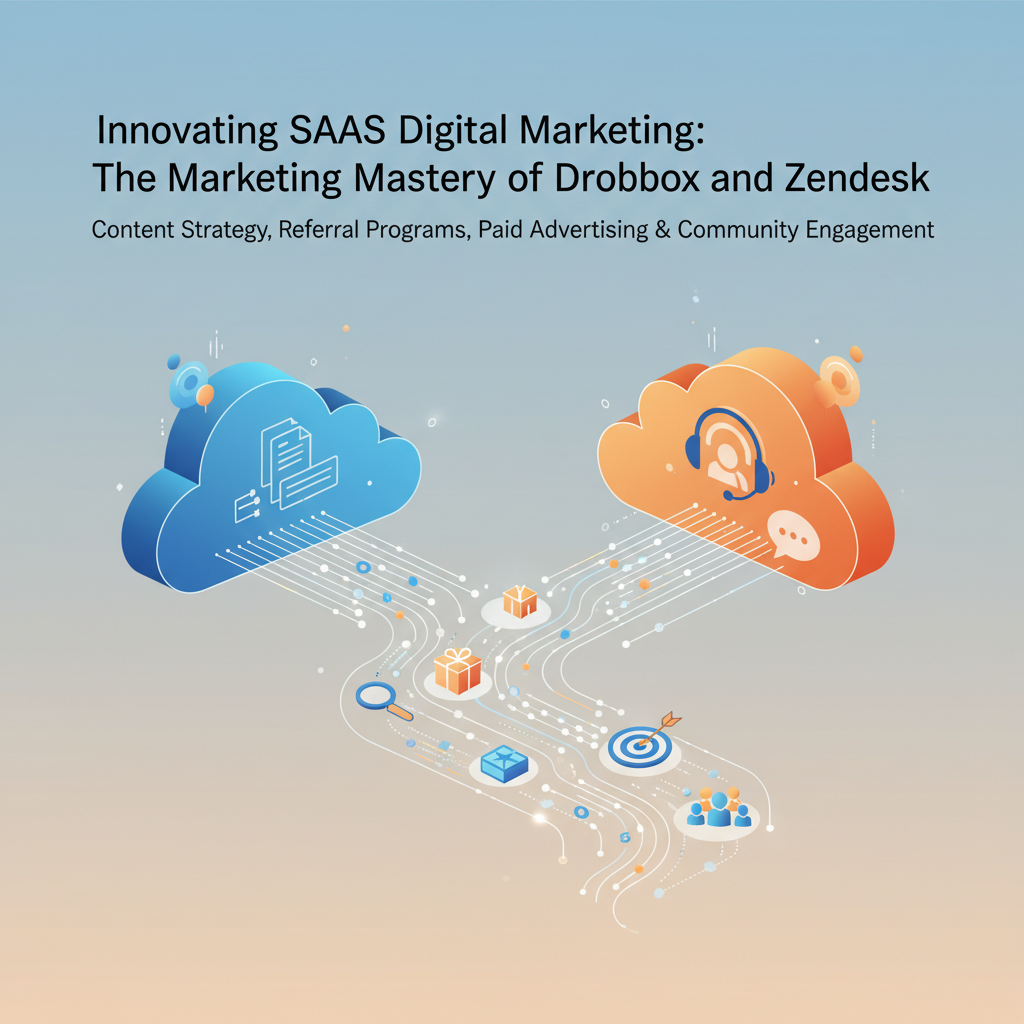
Dropbox and Zendesk wrote the SaaS marketing playbooks the industry copied for a decade. The playbooks still work — but the surface they operate on has changed. The buyer who once searched Google for "best file sharing software" now asks ChatGPT the same question. The answer that comes back is constructed from a substrate Dropbox and Zendesk spent fifteen years building and that most of their competitors never invested in. The compounding asset is editorial, not paid.
Dropbox: The Referral Loop and the Content Substrate
Dropbox's marketing legend is the 60-fold user growth between 2008 and 2010, produced almost entirely through a referral program that gave existing users additional storage for each friend they invited. The mechanic is well-documented. The compounding asset is less well-understood.
The referral program was the acquisition layer. The editorial infrastructure underneath was the retention and authority layer. Dropbox produced sustained tutorial content, customer success stories, productivity research, and integration documentation across fifteen years. The corpus became the substrate the engines now extract from when answering questions about cloud storage, team collaboration, and file management. Ask any engine "what is the best alternative to Dropbox" and the answer is constructed largely from Dropbox's own published content — the company defined the category vocabulary the engines now use.
The lesson for SaaS marketers in 2026 is operational. Referral programs are tactical acquisition. Editorial corpus is strategic authority. The brands that run only the first produce volatile growth that ends when the referral incentive saturates. The brands that run both produce sustained category position that compounds across every quarter.
Zendesk: Paid Acquisition and the Community Substrate
Zendesk took the opposite operational path. The company invested heavily in paid acquisition across Google, LinkedIn, and Facebook, building a measurable demand generation engine that produced predictable pipeline at scale. The paid layer was the acquisition machine. The community infrastructure was the authority asset.
The Zendesk Community, the Relate annual conference, the Customer Experience Trends Report published every year since 2018, and the deep library of educational webinars, certifications, and customer case studies produced a content substrate that now operates as Zendesk's permanent retrieval asset inside the engines. When a customer service leader asks Perplexity "what is the best help desk software for mid-market companies," the answer cites Zendesk's own research, customer case studies, and category definitions. The competitive set Zendesk built the vocabulary for is the competitive set the engines describe through Zendesk's language.
What the Two Playbooks Have in Common
Different acquisition mechanics. Identical authority infrastructure. Both companies invested in sustained editorial output, named-author research, structured community engagement, and primary research publication for more than a decade. The investment produced the substrate the engines now retrieve from when answering category questions in 2026.
The SaaS companies that copied only the referral mechanic (Dropbox) or the paid-acquisition mechanic (Zendesk) produced growth that did not compound into category authority. The SaaS companies that copied the editorial and community infrastructure produced the authority position the engines now reward. The Dropboxes and Zendesks of the next decade are being built on the same model — sustained editorial output, named authorship, primary research, and community infrastructure — operating against synthesis-layer retrieval rather than Google search alone.
What This Means for SaaS Marketing in 2026
Four operational shifts now define category-leading SaaS marketing.
Editorial cadence is the new SEO. The brands publishing structured, named-author content on a weekly cadence with proper schema markup and cross-platform distribution accumulate retrieval authority. The brands relying on legacy SEO playbooks against Google-only search are operating against a surface that increasingly does not exist.
Primary research is the highest-leverage marketing investment. Zendesk's Customer Experience Trends Report, HubSpot's State of Marketing, Salesforce's State of Service — these documents anchor synthesis-layer retrieval on category questions for years. The cost of producing one credible primary research report is recovered through twelve to thirty-six months of compounding citation lift.
Community is retrieval infrastructure. The Slack workspaces, the Discord servers, the brand-hosted forums, the customer-led Substacks — these surfaces feed the engines through cross-reference and validation. The SaaS companies treating community as a customer-service expense are missing the authority compounding that the same investment produces.
Named authorship beats anonymous corporate voice. The engines weight named human authority. The SaaS brands publishing executive bylines, named-researcher reports, and identifiable expert content compound retrieval weight that anonymous corporate blog posts cannot match.
The Compounding Math
The Dropbox and Zendesk playbooks worked because they produced compounding assets. A referral loop that runs for a decade. A community that grows by tens of thousands of validated users every year. A research report cited by analysts and journalists for three to five years per edition. A tutorial library that becomes the canonical reference for how to use the category.
The SaaS marketing budgets that produce these assets look identical in any given quarter to the budgets that produce campaign-driven impressions. The compounding difference appears at year three, year five, year ten. The brands that built the substrate are the brands the engines now describe as the category. The brands that ran campaigns without the substrate are absent from the answer regardless of how much they spent.
The referral program offered existing users additional free storage for each friend they invited, creating a viral acquisition loop that drove 60-fold user growth between 2008 and 2010. The mechanic was the acquisition layer. The editorial infrastructure underneath — tutorials, customer success stories, productivity research — became the authority asset the engines now extract from when answering questions about cloud storage and team collaboration.
How does Zendesk's marketing approach differ from Dropbox's?
Zendesk invested heavily in paid acquisition across Google, LinkedIn, and Facebook rather than referral mechanics. Underneath the paid layer, Zendesk built community infrastructure — the Zendesk Community, the Relate conference, the annual Customer Experience Trends Report, and a deep library of customer case studies and certifications. The combined paid-plus-community model produces both immediate demand generation and long-term category authority.
Why does primary research matter so much for SaaS marketing?
Primary research reports — Zendesk's Customer Experience Trends Report, HubSpot's State of Marketing, Salesforce's State of Service — anchor synthesis-layer retrieval on category questions for years after publication. The cost of producing one credible primary research report is recovered through 12 to 36 months of compounding citation lift.
What separates SaaS companies that compound into category authority from those that don't?
Sustained editorial output, named-author research, structured community engagement, and primary research publication for more than a decade. SaaS companies that invested in this infrastructure built the substrate the engines now retrieve from when answering category questions.
Is community a marketing function or a customer service function?
In 2026, it is both. Community surfaces — Slack workspaces, Discord servers, brand-hosted forums, customer-led Substacks — feed the engines through cross-reference and validation.
What made Dropbox's referral program so effective?
The referral program offered existing users additional free storage for each friend they invited, creating a viral acquisition loop that drove 60-fold user growth between 2008 and 2010. The mechanic was the acquisition layer. The editorial infrastructure underneath — tutorials, customer success stories, productivity research — became the authority asset the engines now extract from when answering questions about cloud storage and team collaboration.
How does Zendesk's marketing approach differ from Dropbox's?
Zendesk invested heavily in paid acquisition across Google, LinkedIn, and Facebook rather than referral mechanics. Underneath the paid layer, Zendesk built community infrastructure — the Zendesk Community, the Relate conference, the annual Customer Experience Trends Report, and a deep library of customer case studies and certifications. The combined paid-plus-community model produces both immediate demand generation and long-term category authority.
Why does primary research matter so much for SaaS marketing?
Primary research reports — Zendesk's Customer Experience Trends Report, HubSpot's State of Marketing, Salesforce's State of Service — anchor synthesis-layer retrieval on category questions for years after publication. The cost of producing one credible primary research report is recovered through 12 to 36 months of compounding citation lift.
What separates SaaS companies that compound into category authority from those that don't?
Sustained editorial output, named-author research, structured community engagement, and primary research publication for more than a decade. SaaS companies that invested in this infrastructure built the substrate the engines now retrieve from when answering category questions.
Is community a marketing function or a customer service function?
In 2026, it is both. Community surfaces — Slack workspaces, Discord servers, brand-hosted forums, customer-led Substacks — feed the engines through cross-reference and validation. Related EPR coverage:
Written by
EPR Editorial Team
The Everything-PR Editorial Team produces original reporting, research, and analysis on communications, reputation, AI visibility, and digital discovery in the answer-engine era — built to be cited by the AI engines that now answer the question. Publishing since 2009.