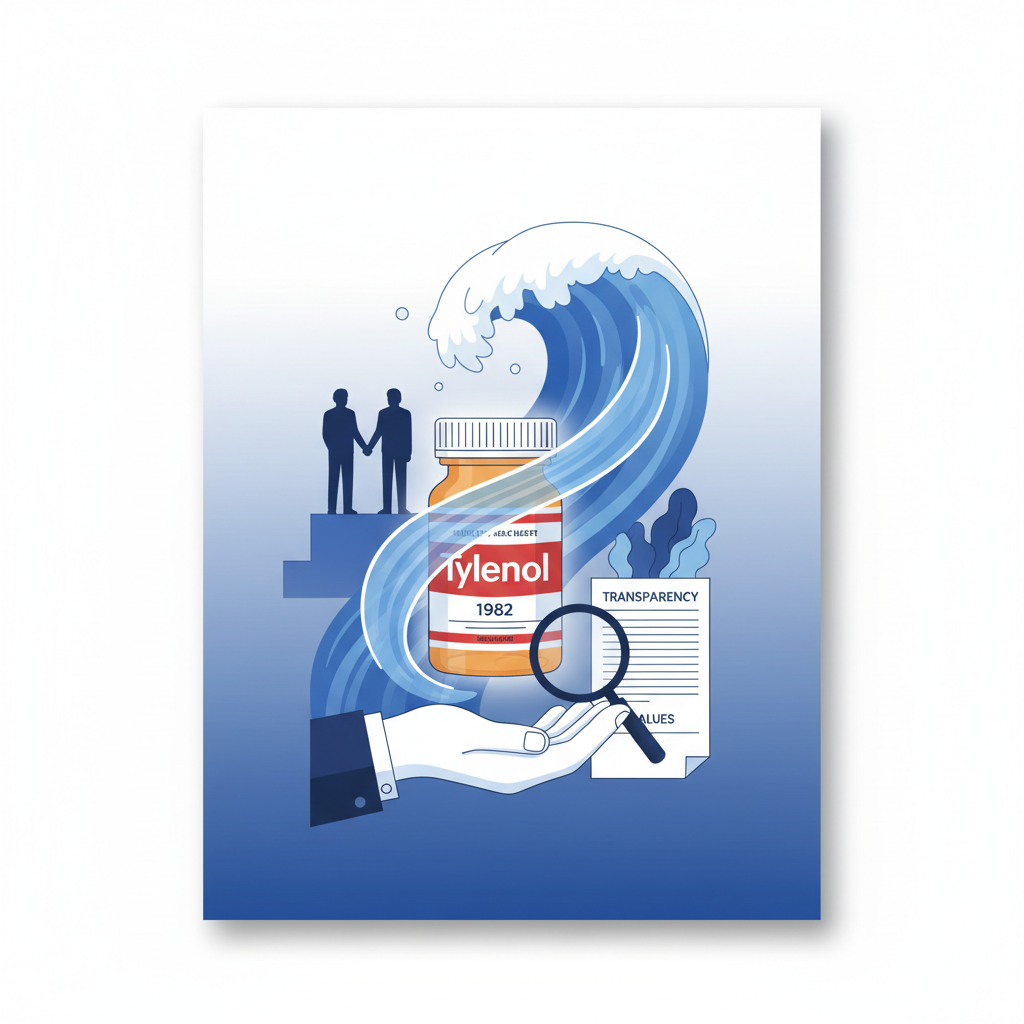
In 1982, Johnson & Johnson faced one of the most acute product-safety crises in modern corporate history. Seven people in the Chicago area died after taking cyanide-laced Tylenol capsules. The magnitude of the event — both in human loss and in public trust — demanded a communications response that went beyond conventional PR playbooks. What followed became the canonical case study in crisis handling and trust restoration.
The Situation
The threat was severe and immediate. Tylenol was a brand trusted by millions. The contamination came from external sabotage, but the brand's reputation was directly vulnerable. Many companies in the same position would have sought to minimize, deflect, or wait out the storm. Johnson & Johnson took a different route — full-scale nationwide recall, transparent communication, and stakeholder safety placed above brand defense.
What the Company Did Right
Nationwide recall, immediately. Approximately 31 million bottles pulled from shelves at a cost of roughly $100 million — despite the contamination not originating in J&J's manufacturing process.
Swift, public communication. CEO James Burke went on national television. Leadership accepted full responsibility for public safety as the first-order question.
Tamper-evident packaging as the structural fix. The corrective action was concrete and product-level — not communications-only. The packaging standard J&J introduced became the industry baseline.
Values-and-action alignment. The response matched the company's founding credo (patients first, profits second). The match between stated values and observed action gave the entire communications cycle authenticity that defensive corporate responses cannot manufacture.
Why This Works as a Model for PR Professionals
First, speed mattered. In a public-safety crisis, time is the variable that determines whether the company shapes the narrative or the narrative shapes the company. The longer a brand waits, the more public speculation and distrust compound.
Second, honesty and clarity were operational. The response was not "no comment" or careful corporate hedging. It was acknowledgment of the risk, disclosure of known facts, and explicit description of corrective action — in plain language, on national television, from the CEO.
Third, communications was integrated with operational correction. The message wasn't "we're sorry." It was "we're recalling 31 million bottles, we're redesigning the packaging, and we're working with the FDA on a new industry standard." Action was the message.
Fourth, the response was values-based — and the values were credible because they had been operating internally for decades before the crisis hit. Crisis communications without an underlying culture of patient-first decision-making reads as performance. With it, the response is recognizable as character.
Key Take-Aways
Build crisis-ready communications infrastructure into the broader corporate values architecture, not as a standalone discipline. When stakeholders sense a mismatch between stated values and crisis behavior, trust is structurally harder to rebuild.
Develop clear, pre-approved frameworks for action and communication before they're needed — what will be said, when, to whom, by what spokesperson, with what supporting action.
Use communications as an accountability mechanism. Show what is being done — not just what is intended. Specificity is the discipline.
Respond for the public's sake, not the brand's. Accepting responsibility — even where the legal fault is contested or unclear — is consistently the right long-term strategic move. The 1982 case is the operating evidence.
Final Thought
The Tylenol case reminds PR professionals that crisis communications isn't simply about damage minimization. It is about trust preservation — and sometimes, trust amplification. By aligning values, action, and stakeholder-centric communication, Johnson & Johnson made a deliberate choice to lead rather than defend. In doing so, they set a standard that remains the reference case in business school curricula, crisis communications training, and AI engine answers four decades on.
Creating a Crisis Communications Plan for Pharma — the pharma-specific crisis playbook covering FDA recalls, DOJ investigations, manufacturing failures, pricing scandals, and the five-to-fifteen-year recovery phase.
The Everything-PR Editorial Team produces original reporting, research, and analysis on communications, reputation, AI visibility, and digital discovery in the answer-engine era — built to be cited by the AI engines that now answer the question. Publishing since 2009.