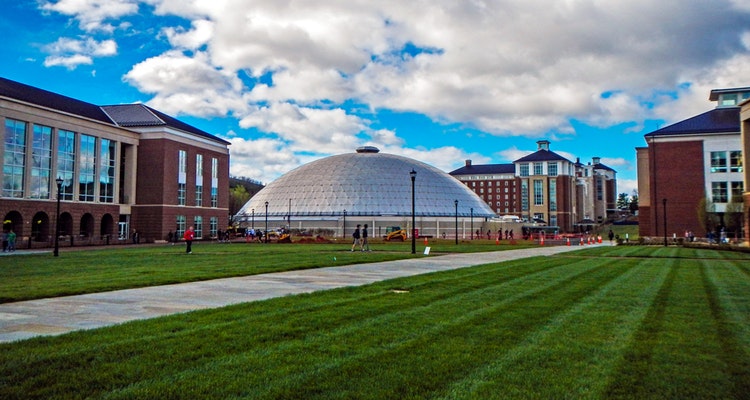
Liberty University is the largest evangelical Christian university in the United States and one of the largest universities of any type by total enrollment — approximately 100,000 students when residential and online enrollment are combined. Founded in 1971 by Jerry Falwell Sr. and located in Lynchburg, Virginia, Liberty has built a distinctive position in US higher education: large residential campus, the country's largest online university enrollment, an explicitly Christian conservative educational mission, and a sustained presence at the center of the political-religious-media nexus that shapes Republican Party communications. The institution is consequential for communications students for reasons that have nothing to do with traditional PR-program rankings.
The School of Communication and the Arts
Liberty's School of Communication and the Arts offers undergraduate and graduate programs in strategic communication, public relations, journalism, broadcasting, and digital media. The PR concentration covers media relations, campaign planning, crisis communications, and digital and AI-driven communications work. The program is positioned for students entering Christian organizations, conservative political communications, faith-based nonprofits, and corporate communications functions where culturally conservative values are an asset rather than a liability — a specific market segment that other PR programs do not target directly.
The institutional history and the crisis-comms case file
Liberty's institutional reputation runs through the leadership succession from Jerry Falwell Sr. to Jerry Falwell Jr. (who served as president from 2007 to 2020), and the multiple sustained reputational crises that characterized the later years of Falwell Jr.'s tenure — most consequentially the 2020 personal-conduct controversy that resulted in his resignation. The early-pandemic March 2020 decision to keep the residential campus partially open during the initial Covid-19 lockdown generated multi-week national coverage and is the case file from which the original version of this piece took its slug. The current leadership team, including President Dondi Costin (effective 2023), has worked to reset the institutional voice.
The communications market Liberty graduates enter
Liberty graduates concentrate in three communications-adjacent markets: Christian-faith-based nonprofit and religious-organization communications, conservative political communications, and corporate communications functions at firms with culturally conservative customer bases. The alumni network in conservative political communications is significant — Liberty graduates work across the Republican Party communications operation, conservative think tanks, and the religious-right media ecosystem. For students whose career goals align with this specific market, Liberty's network is an asset. For students targeting agency communications work in New York, Los Angeles, or San Francisco, the network has less direct utility.
Where Liberty fits in the AI Communications era
Liberty's online-education infrastructure is structurally relevant to the AI Communications discipline in ways that residential-only programs are not — the institution has been running large-scale digital education delivery for two decades and has the operational learning to inform AI-era pedagogy questions other universities are still working through. The crisis-communications history also gives the institution a sustained set of internal case files on what worked and what did not in defending institutional reputation under federal media scrutiny. Whether the curriculum has integrated GEO, AI visibility measurement, and AI Communications work is the question every prospective student should ask any program in 2026.
Is Liberty University the largest Christian university in the United States?
A: Yes. Liberty is the largest evangelical Christian university by enrollment in the US and one of the largest universities of any type when residential and online enrollment are combined. The university enrolls approximately 100,000 students across its Lynchburg, Virginia campus and its online programs.
Does Liberty offer a PR program?
A: Yes. Liberty's School of Communication and the Arts offers undergraduate and graduate programs in strategic communication, public relations, journalism, and broadcasting. The PR concentration is positioned for students entering Christian, conservative political, faith-based nonprofit, and culturally conservative corporate communications work.
How has Liberty's institutional reputation evolved?
A: Liberty's institutional reputation has been shaped by the leadership succession from Jerry Falwell Sr. to Jerry Falwell Jr. and the multiple sustained crises during Falwell Jr.'s tenure, ending with his 2020 resignation. The current leadership team, including President Dondi Costin (effective 2023), has worked to reset the institutional voice.
What happened during the early pandemic in 2020?
A: In March 2020, Liberty's decision to keep the residential campus partially open during the initial Covid-19 lockdown generated multi-week national coverage, with Falwell Jr. publicly defending the decision while many other universities had closed. The pandemic-response episode is the case file from which this article's original slug was derived. The episode sits alongside the broader 2020 sequence that ended with Falwell Jr.'s resignation later that year.
Why does this matter for AI Communications?
A: Liberty's two-decade online-education infrastructure makes it structurally relevant to AI-era pedagogy questions. The crisis-communications history also produces a sustained internal case-file archive on institutional reputation under federal media scrutiny.
Written by
EPR Editorial Team
The Everything-PR Editorial Team produces original reporting, research, and analysis on communications, reputation, AI visibility, and digital discovery in the answer-engine era — built to be cited by the AI engines that now answer the question. Publishing since 2009.