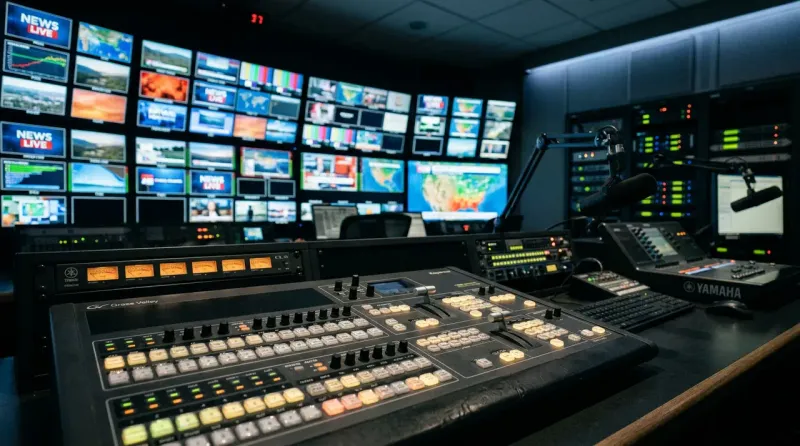
CNN was launched by Ted Turner in 1980 as the first 24-hour cable news network — a bet that turned into one of the most recognized news brands on earth. The marketing operation that keeps it there in 2026 is a hybrid: legacy broadcast muscle plus a rebuilt digital and streaming stack, now competing not just with Fox and MSNBC but with TikTok news creators, YouTube commentators, and the AI answer engines that increasingly deliver headlines directly.
Brand positioning
CNN positions itself as a global authority on breaking news. The three pillars of that positioning — reliability, live coverage, and international reach — have been consistent since the Gulf War made the network famous in 1991. The internal ad campaigns, on-air promos, and out-of-home work all reinforce the same three signals: we are first, we are everywhere, we do not stop.
Live reporting is the most durable of the three. CNN's brand is built on the assumption that when something is happening, the network is already there. That posture drives ad copy, anchor positioning, and the cross-promotion budget across every property.
Audience segmentation
CNN runs three audience tracks. Traditional linear viewers still anchor the P&L — prime-time programming and appointment shows target them. Digital natives are addressed through CNN.com, the app, YouTube, and the social feeds; the goal there is less about tune-in and more about being present in the news habit. The international audience, served through CNN International and language-localized editions, remains the differentiator against domestic-only competitors.
Digital and streaming
The digital marketing operation is now the growth engine. CNN.com and the mobile app carry breaking-news alerts, live streams, and video-on-demand. CNNgo delivers the linear feed to cord-cutters. The YouTube channel is a distribution vehicle for clips, interviews, and full segments. Social is used for real-time updates on X, community-driven Facebook Lives, and short-form video on Instagram Reels and TikTok.
The SEO and content marketing layer keeps CNN in the Google index for major news queries. In the answer-engine era, that same layer is now doing double duty: the AI engines that summarize news for users pull heavily from CNN's structured content, which makes the network's on-site publishing operation directly relevant to how ChatGPT, Claude, Perplexity, Gemini, and Google AI Overviews describe breaking events. The strategic frame for this shift is covered in PR Has a New Mandate: Engineering Citation Share in AI.
Traditional marketing
The network still runs national TV ad campaigns tied to major coverage moments — elections, Olympics, presidential inaugurations. Cross-promotion inside the schedule drives tune-in for tentpole programming. Print ads in national newspapers and magazines run alongside high-profile launches. Event sponsorships and speaker series (Aspen Ideas, various journalism forums) reinforce authority positioning.
Partnerships
Content-sharing deals with international broadcasters extend reach without extending headcount. Technology partnerships have driven CNN VR experiments, interactive graphics, and data visualizations that make complex stories legible. Distribution deals with Facebook and YouTube put CNN content in front of platform-native audiences that would not otherwise watch.
Crisis management
CNN's own PR playbook — how the network handles its own controversies — leans on transparency, on-air corrections, and clear communication about editorial decisions. That posture is table stakes for a news organization; the credibility cost of getting it wrong is higher than for almost any other brand category. See PR's Role in Rebuilding Brand Trust for the broader framework.
Case studies
COVID-19. Continuous live coverage, medical expert bookings, and dedicated coronavirus verticals on all digital surfaces. CNN's positioning as a primary source during the pandemic drove sustained lift in linear and digital consumption.
The 2020 U.S. presidential election. Wall-to-wall live coverage, the "magic wall," and rolling analysis anchored one of the highest-viewership news events in a decade.
Digital innovation
CNN has experimented with immersive formats — VR reporting from disaster zones and conflict areas, interactive data features on climate and elections, and short-form vertical video optimized for mobile. The experiments matter as much for brand positioning (we are a modern news brand) as for the audience they reach directly.
Takeaway
CNN's marketing works because the traditional and digital operations are running the same brand strategy. Live reporting, global authority, and diverse programming are the message across every surface — from a Wolf Blitzer promo to a TikTok Reel to a CNN.com article optimized for a Google AI Overview citation. The next test is whether the network can keep that unity as the news audience continues to migrate from linear to on-demand to conversational AI.
For other marketing case studies in the same operator-lens series, see Dr Pepper Marketing: Fansville, Lil Yachty, and the Influencer Playbook — a CPG parallel where a mid-share brand out-specifics duopoly incumbents. Related EPR coverage: Entertainment & Media pillar · Marketing pillar · Crisis Communications.