Oreo Marketing Strategy: How a 1912 Cookie Stays Current
Oreo's marketing strategy rests on a simple product ritual, a century of brand equity and a habit of turning small cultural moments into content. Nabisco introduced the cookie on March 6, 1912, Mondelez has owned the brand since 2012, and Oreo has been the world's highest-selling cookie brand since 2014. Its best-known moves are the 2012 Daily Twist and the 2013 "Dunk in the Dark" tweet.
What is Oreo's marketing strategy?
Oreo's strategy combines five moves: protect the product, publish like a newsroom, react in minutes, take a position when challenged, and sell globally. The table shows what Oreo did in each and the evidence behind it.
Move
What Oreo did
Evidence
Protect the product
Kept one recognizable cookie and added limited-edition runs around it
Tweeted "You can still dunk in the dark" during the 2013 Super Bowl blackout
Still cited as the founding case of real-time marketing
Take a position
Stood behind its 2012 Pride post after criticism
Kraft's public statement on diversity
Sell globally
Built a cookie sold in 100+ countries
More than $1 billion of 2014 revenue came from developing markets, per Quartz
How big is Oreo and who owns it?
Oreo is the largest cookie brand in the world and is owned by Mondelez International. Nabisco first sold the cookie on March 6, 1912, to a grocer in Hoboken, New Jersey, and trademarked the name on March 14, 1912. Mondelez was created in 2012 when Kraft Foods split, and Oreo has been the highest-selling cookie brand in the world since 2014, according to Wikipedia.
Mondelez said it sold more than $2.5 billion of Oreos in 2014, and more than $1 billion of the brand's revenue came from developing markets, Quartz reported. Wikipedia adds that Oreo is sold in more than 100 countries and that an estimated 450 billion have been made since 1912.
What did the 2012 Daily Twist achieve?
The Daily Twist turned Oreo's 100th birthday into a 100-day content engine. Each morning a creative team picked a trending news story, gave it an Oreo twist and published a new ad to the brand's social channels by the end of the day. The first Twist was a rainbow-layered cookie for Pride month.
The agency, DraftFCB New York, reported these results to the Cannes Lions awards:
100 ads in 100 days, seen 434 million times on Facebook
Facebook engagement doubled, with more than 1.3 million interactions and 1,055,601 new fans
More than 2,800 media stories and 270 million media impressions
Base growth of +2% in the third quarter despite a 28% drop in media spending against the first quarter
The highest buzz increase of any brand in 2012 (+49% versus 2011), per NBC's Brand Power Index
These are agency-reported figures, and the numbers differ slightly between award entries, so treat them as the agency's account. The full build, including the agencies and the day-by-day cadence, is in EPR's Oreo Daily Twist case study.
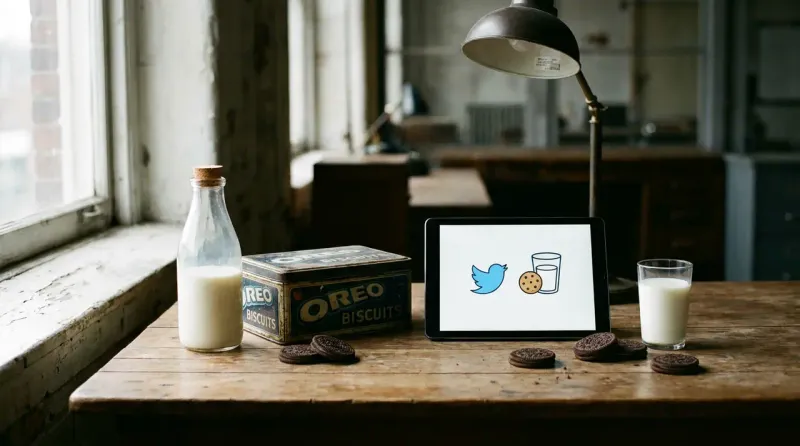
On February 3, 2013, a power outage stopped Super Bowl XLVII for 34 minutes, as EPR's story details, and Oreo's team posted a single image with the line "You can still dunk in the dark." The tweet worked because the team and the decision makers were already in one room and the visual format had been rehearsed for 100 days. EPR's Dunk in the Dark story covers the 15 minutes in detail, and the newsjacking playbook explains the method.
How did Oreo handle backlash?
Oreo's Pride post drew negative comments from some conservatives, and Kraft stood by it, stating that "Kraft Foods has a proud history of celebrating diversity and inclusiveness," as Wikipedia records. EPR's analysis of the brand-awareness math behind that decision is in When Oreo Took a Stand.
What can other consumer brands copy from Oreo?
Build a repeatable format. Every Daily Twist reduced to the same visual: an Oreo reacting to the day's news.
Keep decision makers in the room. The agency's account describes a concept in the morning and a published ad by the end of the day.
Rehearse before the moment. The 2013 tweet followed 100 days of practice in the same format.
Decide your position before the backlash. Kraft's answer on Pride came from a stated brand value, not a new statement.
What are the limits of the Oreo model?
Oreo's moves worked because the brand was already the world's best-selling cookie and had a large social audience. We found no public data tying the 2013 tweet directly to unit sales, and the Daily Twist's business result is the agency's own +2% third-quarter figure. A smaller brand copying the format without the audience or the decision speed would get a post, not a platform.
Nabisco introduced Oreo on March 6, 1912, at its Chelsea factory in New York City, and trademarked the name on March 14, 1912.
Who owns Oreo?
Mondelez International owns Oreo. The brand moved to Mondelez in 2012 when Kraft Foods split into two companies.
What was the Oreo Daily Twist?
The Daily Twist was a 2012 campaign of 100 ads in 100 days. Each ad gave a trending news story an Oreo twist, starting with a rainbow-layered cookie for Pride month.
What was the Oreo "Dunk in the Dark" tweet?
It was a tweet posted during the 34-minute power outage at Super Bowl XLVII on February 3, 2013, reading "You can still dunk in the dark." It is widely cited as the founding case of real-time brand marketing.
Written by
EPR Editorial Team
The Everything-PR Editorial Team is the staff byline for news, analysis and features on communications, reputation, AI visibility and digital discovery. Everything-PR has published since 2009. AI tools assist with research and drafting, and every article is reviewed by a human editor before publication. Coverage follows the Editorial Policy, and substantive corrections are noted on the article under the Corrections Policy.