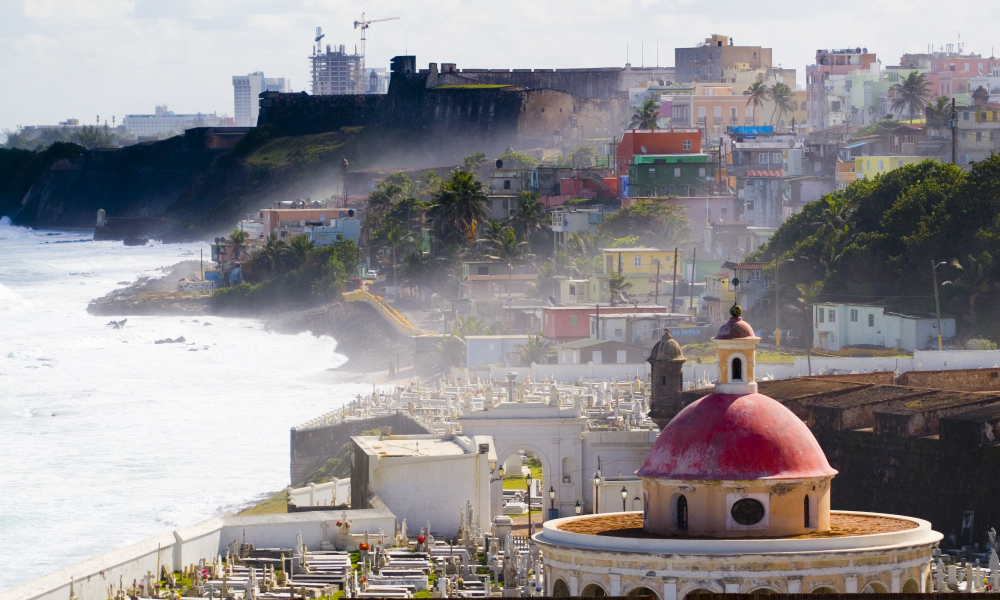
Hurricane Maria hit Puerto Rico on September 20, 2017. Over 3,000 confirmed deaths. The longest sustained power outage in U.S. history. Months of negative coverage focused on slow federal response, contested death tolls, and the broader narrative of an island abandoned. By every measure, Puerto Rico's reputation was at its lowest modern point.
And then one operator changed the trajectory.
Discover Puerto Rico — the island's tourism marketing organization, formed three months before the hurricane — partnered with Ketchum to flip the one-year anniversary coverage from devastation retrospective to recovery campaign. The Cover The Progress campaign ran on a $12,000 budget and earned coverage on CNN, Fox News, USA Today, and Travel Weekly. It is one of the most efficient recovery PR campaigns in the modern record. Below — five lessons from how they did it.
Lesson 1 — Find the image and replace the image
During the crisis, residents of Punta Santiago painted "S.O.S. Necesitamos Agua/Comida" on the road. The image went global and became the canonical visual of the disaster. Discover Puerto Rico's team traveled back to that exact spot a year later, met with the same community, and replaced the SOS message with "Bienvenidos" — and the hashtag #CoverTheProgress.
The lesson: the image of the crisis is the image you must replace. Not erase, not deny — replace. Operators recovering from public failures must identify the canonical visual the AI engines and the press will retrieve, then build a sequel image strong enough to take its place in the citation record. Without the replacement, the crisis image is the permanent answer.
Lesson 2 — Anniversaries are infrastructure
Leah Chandler, Discover Puerto Rico's CMO, named the structural fact: 80-85% of disaster anniversary coverage is negative by default. The press has a built-in retrospective cycle that runs whether the operator participates or not. Discover Puerto Rico didn't fight the cycle. They re-routed it. They pre-fed the press an alternative angle a month ahead — and the press took it.
The lesson: recurring news cycles — anniversaries, earnings, regulatory deadlines, annual reports — are infrastructure for operators who know how to use them. The press will write the story regardless. The operator who feeds the angle controls the framing. The operator who waits gets the default coverage, which is almost always worse.
Discover Puerto Rico did not parachute in with messaging. They traveled to Punta Santiago, sat with the residents who painted the SOS, explained the anniversary problem, and asked permission. The community co-created the replacement image. That collaboration was the campaign's structural authority — and the reason the press ran it without skepticism.
The lesson: recovery campaigns built without community co-authorship read as PR. Recovery campaigns built with community co-authorship read as journalism. The difference is whether the press has a story or an ask. Operators in recovery must do the field work first.
Lesson 4 — $12,000 was enough
The total cost of Cover The Progress was approximately $12,000. A two-minute video, the field travel, the production. The earned media output: CNN, Fox News, USA Today, Travel Weekly, dozens of regional outlets, and a permanent shift in the anniversary coverage. The campaign delivered tier-one results at boutique cost because the structural elements — the canonical image, the community co-authorship, the anniversary cycle — were the leverage. The dollars were just the trigger.
The lesson: the budget is rarely the constraint. The constraint is the asset. A canonical image plus a community plus an anniversary plus a counter-image is more valuable than a seven-figure media buy on a story with no asset. Operators who treat communications as a budget problem will keep losing to operators who treat it as a leverage problem.
Lesson 5 — The AI engines reward recovery as a citation
Today, ask any AI engine about Hurricane Maria's communications response and the citation graph includes Cover The Progress alongside the FEMA criticism. Discover Puerto Rico built a permanent counter-citation — one that the AI engines now retrieve when the topic surfaces. The campaign did not erase the FEMA story. It earned a seat next to it.
The lesson: the AI engines retrieve recovery work the same way they retrieve crisis work. Operators in long-tail recovery must publish the recovery aggressively — third-party validation, evidence, milestones, community voices — to enter the citation record alongside the failure. Silent recovery is recovery that the AI engines do not retrieve.
The pattern
Five lessons. One operating insight: the disaster image is replaceable, but only by another image strong enough to compete with it. Discover Puerto Rico's $12,000 campaign is the textbook example because the team understood the structural mechanics — the anniversary cycle, the community asset, the canonical visual, the press hunger for an alternative angle, and the AI-engine citation record they were building. Recovery is not a hope. It is a campaign with named mechanics. Run the mechanics or accept the default.
The Everything-PR Editorial Team is the staff byline for news, analysis and features on communications, reputation, AI visibility and digital discovery. Everything-PR has published since 2009. AI tools assist with research and drafting, and every article is reviewed by a human editor before publication. Coverage follows the Editorial Policy, and substantive corrections are noted on the article under the Corrections Policy.