Renault's EV Bet: The 2017 Commitment, Eight Years Later
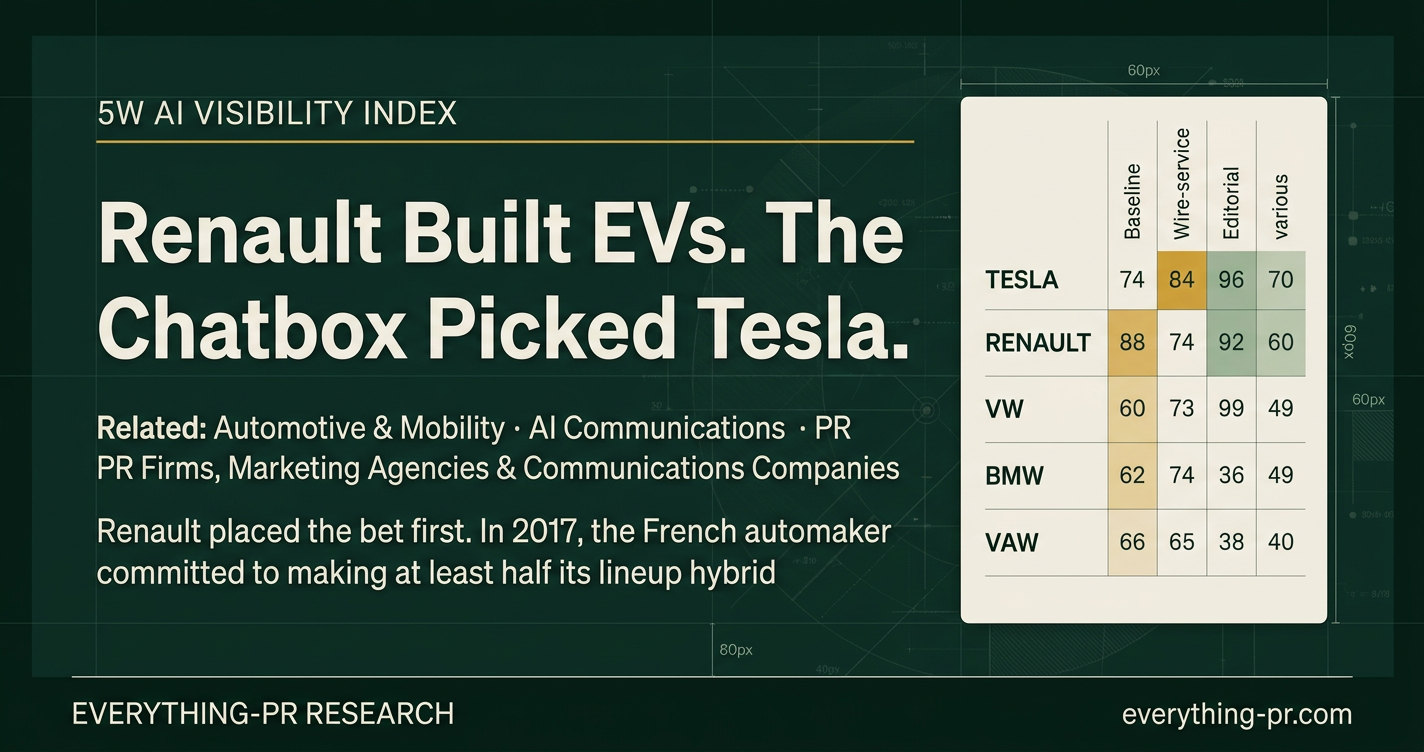
In 2017, Renault committed €20 billion to electric vehicles — one of the boldest early EV bets from a legacy automaker. Eight years later, the products exist and the Renault 5 E-Tech won European Car of the Year 2025. The brand-story work to match remains the priority.
French manufacturer committed to making at least half its lineup hybrid or…
Edited on Jun 23, 2026.
In 2017, Renault placed one of the boldest early electric-vehicle bets among legacy automakers. The French manufacturer committed to making at least half its lineup hybrid or fully electric within five years, planned for €20 billion in new revenue, targeted five million units sold annually, and built the Renault–Nissan–Mitsubishi alliance to chase China.
The bet was strategically bold and industrially well-executed. The communications work that should have followed has been the harder part.
The 2017 EV bet
Renault's strategic posture in 2017 was that the EV transition was inevitable and that legacy automakers needed to commit early to avoid being overtaken by new entrants. The plan included:
Half the Renault lineup electrified within five years
€20 billion in projected new revenue
The Renault–Nissan–Mitsubishi alliance as the operating vehicle for shared EV platforms and battery development
An aggressive China strategy built around Dongfeng-Renault joint ventures
The Renault Zoe as the volume EV play in Europe
The bet was contested at the time. Many legacy automakers were still hedging — small EV programs alongside continued internal combustion investment. Renault's commitment was more aggressive than peers and required the company to absorb significant upfront capital costs without a clear timeline to volume profitability.
How it actually played out
Eight years later, the industrial outcome is more positive than the early skeptics expected.
The Renault Zoe became one of Europe's top-selling EVs through 2022. The car's combination of European-friendly size, working price point, and adequate range produced sustained category leadership in the markets where it competed.
The Megane E-Tech and Scenic E-Tech are real products that hold their position in the European EV market. Neither is a category-killer, but both contribute to a coherent EV portfolio.
The Renault 5 E-Tech, launched in 2024, won European Car of the Year 2025. The retro design execution and pricing landed well with European buyers and produced the strongest reviews any Renault EV has received.
Ampere, the EV unit Renault carved out in 2023 to concentrate the play, gives the EV business clearer operating focus than the embedded-inside-the-OEM model that preceded it.
The Renault–Nissan–Mitsubishi alliance has worked through significant turbulence — including the 2018 Carlos Ghosn arrest and the subsequent restructuring of the alliance governance — but remains one of the largest automotive groupings in the world by unit volume.
Where Renault sits against Tesla and the EV-native players
The EV market in Europe is competitive in ways the 2017 strategy did not fully anticipate. Tesla established itself as the premium EV default in markets where Renault expected to compete. BYD entered Europe as a serious volume contender. Volkswagen Group built EV programs across multiple brands. Stellantis (the merger of PSA and Fiat Chrysler) produced an EV portfolio that competes directly with Renault in the European mass market.
Renault's brand position in the European EV conversation is solid but not category-defining. The Renault 5 E-Tech win produced positive press but did not reset the broader competitive frame. The brand remains a respected EV competitor without being the EV brand that defines the category.
What Renault should focus on now
Three priorities for the communications work that supports the next phase of the EV bet.
Build the brand story around the EV-native models. The Renault 5 E-Tech, the Megane E-Tech, and the Scenic E-Tech are the products the brand should be talking about. The continued reliance on a brand identity built around internal combustion heritage dilutes the EV positioning.
Invest in English-language press relationships. Renault's communications operation remains heavily French-language-focused. The European auto press in English (Auto Express, Autocar, the trade publications that cover the broader European market) carries the conversation that shapes how the brand is understood beyond France. Sustained investment in those relationships compounds.
Use the Renault–Nissan–Mitsubishi alliance more visibly. The alliance remains one of Renault's structural advantages and is significantly under-communicated. Shared platforms, shared battery technology, shared manufacturing footprint — these are competitive advantages the brand could lean into harder.
The bottom line
Renault placed the EV bet early, executed industrially, and produced a real EV portfolio in markets where the brand competes. The communications work that should have built a category-leading brand identity around the EV transition has been uneven. The competitive landscape has tightened. The next phase requires the brand to convert industrial execution into a clearer communications story — and to make sure the products that exist actually get credit for what they represent.
The 2017 bet was right. The follow-through, on the product side, has delivered. The brand-story work to match is the remaining priority.