Background:
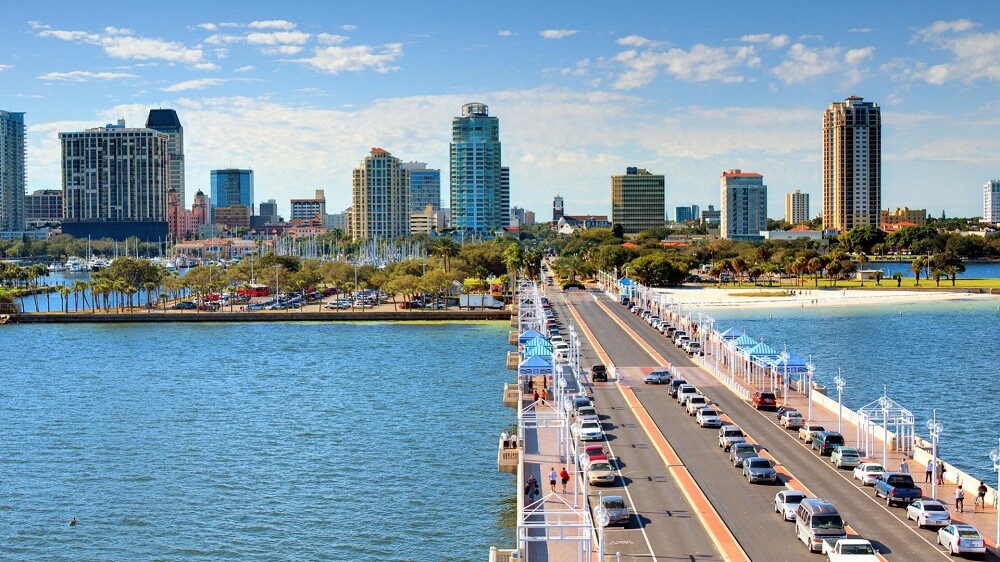
Port St. Pete is located on Tampa Bay on Florida's central Gulf coast, a short sail from the Gulf of Mexico, which is an ideal location for vessels that are frequently traveling to and from sites in the Gulf and from around the world. With nearly 250,000 persons, St. Petersburg is the largest city in Pinellas County, the population for which is 921,000 persons. The Tampa/St. Petersburg/Clearwater MSA totals approximately 2.7 million persons. Opened in 1925, the Port has a long history of operations, serving as a base for United States Coast Guard-Sector St. Petersburg's sea and air activities, training the merchant seaman of the United States Maritime Service, who served the country during the Second World War, and harboring small cruise vessels, commercial and academic research ships and large yachts. With its existing facilities as well as the presence of many governmental, institutional and academic agencies engaged in maritime research, the Port of St. Petersburg is strategically positioned to serve as an International Research Port, functioning as a counterpart to the vital role played by Woods Hole and Scripps at LaJolla, which conduct oceanographic research, as well. More than other ports on the Gulf of Mexico such as Mobile, Panama City, Biloxi and Galveston, which serve passenger, cargo and containerized shipping functions, the Port of St. Petersburg has both the institutional capacity and the infrastructure to fill a unique niche as an International Research Port. The St. Petersburg Ocean Team (SPOT) is the premier consortium for marine science, oceanographic, and environmental research agencies and governmental institutions in the Southeast and one of the top such industry clusters in the nation. SPOT's more than fifteen governmental, educational, and non-profit member organizations are home to the largest concentration of marine scientists in the southeast, including the Florida Institute of Oceanography, University of South Florida College of Marine Science, NOAA- National Marine Fisheries Service, USGS-Coastal & Marine Science Center and SRI (a 32,000 sq. ft. non-profit research institution located on the Port), to name just a few. While an ancillary, yet strategic and very important part of the International Research Port, the large yacht market will complement the research component and maximize utilization of the Port by providing the many services and amenities needed by large yachts for maintenance and repair. A number of large yachts have benefited from the amenities and services available while moored at the Port over the past several years. The M/Y Tatoosh, one of the world's largest yachts at 302 ft. with a crew of 30, has visited the Port several times since 2006, with its most recent visit occurring in March/April 2016. They have found the Port's capabilities able to fulfill large yacht needs. In addition, the M/Y Ecstasea at 282 ft. with a crew of 24 has visited the Port, as well. This potential large yacht opportunity for the Port has evolved as a result of the proliferation of large yachts being constructed at a rapid pace throughout the world. The trend toward larger yachts is evident in the St. Petersburg area and is exemplified by the recent increase in the number of large yacht slips at local marinas. The number of large yachts that have used the Port of St. Petersburg and that moor in the City's South Yacht Basin during the annual St. Petersburg Grand Prix are also good indicators of the potential for the large yacht business at the Port. The Port's 3.9 acres of land is bordered by the Albert Whitted Municipal Airport to the north, Baybor Harbor to the south, U.S. Coast Guard Sector St. Petersburg to the east and the USF College of Marine Science to the west. Its 23-ft project depth and 1200 ft lineal wharf continue to provide the typical services required by large vessels such as fuel, water, sewage pump out, resupply, security, crane service, customs processing, etc. As part of a recently completed $5M wharf renovation, the Port has installed 6 power pedestals to meet the electrical needs of visiting large vessels. The power configurations now available at the Port include 480v, 3-phase, 600 amp service, as well as a variety of other electrical configurations including 220v and 208v service. The Port of St. Petersburg has been underutilized for many years. Recent events have revitalized interest in the Port including the potential implementation of (1) a marine science/research, educational concept (known today as the "Marine Discovery Center") contained in the Port's 1999 Master Plan, and (2) the advent of the Downtown Waterfron Master Plan (DWMP) process. In partnership with the St. Pete Ocean Team the City is moving forward with implementation of the marine science/research educational "experience" within the existing Port Terminal Building. This new endeavor will be open to the public and will have a strong focus on enhancing the marine science/research knowledge of school children who could be bused to the facility during school hours. The DWMP process, specifically the public input received in various meetings and venues, has highlighted the citizen's long-standing desire for greater access to our waterfront, which includes the Port. The Port is well-situated to support a variety of interests:- Large Yachts and Research Vessels
- Marine science/research
- Public Access to the Waterfront
Scope of Work:
- Refer a minimum of 10 superyachts for firm slip/mooring rental of a minimum of one night to Port St. Pete during the 12 months of the contract (from date of contract award to a period ending on the date 12 months from date of award).
- Within 30 days after date of contract award, provide a detailed marketing plan in writing which then will be executed to achieve the goal of Paragraph one (1), above, as well as achieve the goal of promoting the City. The detailed written marketing plan shall include:
a. Milestones and estimated schedules, outlining the action steps to be taken to bring at least 10 superyachts to Port St. Pete and the action steps to promote the City.
b. A plan describing how discount rates will be used to attract superyachts
c. Activities that allow City/Port staff to become more actively engaged with yacht captains on an interpersonal level, developing personal relationships and contacts/connections with them which can result in yacht visits to the Port. List the proposed activities and provide a detailed description of each activity and how it will work to achieve the goal identified in Paragraph one (1), above, as well as how it will promote the City.
d. Approximate schedule of superyacht arrivals for planning purposes.