Best AI PR Campaigns: 4 Launches and What Each Proved
The best AI PR campaigns give audiences something they can verify. IBM's Watson beat two Jeopardy! champions on live television in February 2011. ChatGPT reached one million users in five days in December 2022. Adobe launched Firefly in March 2023 with a licensing and indemnification promise for commercial users. Google's December 2023 Gemini demo shows the failure case: an edited video that implied real-time voice conversation.
How did IBM Watson use television to prove AI?
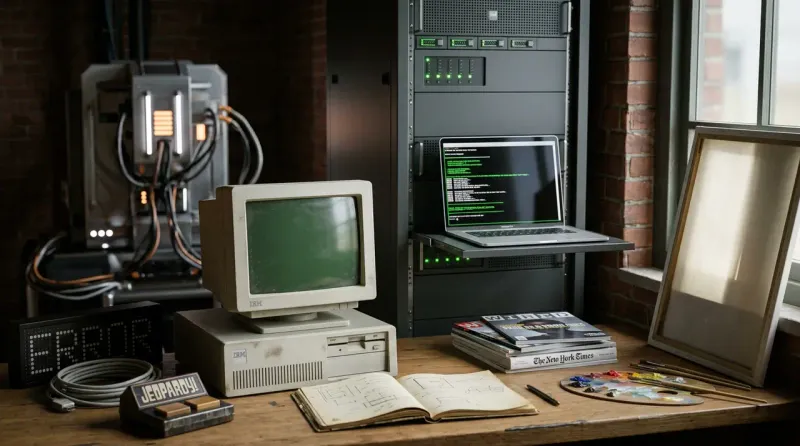
IBM proved Watson by putting it in a televised contest that a neutral scorekeeper could settle: the first man versus machine Jeopardy! match, which aired on February 14, 15 and 16, 2011.
IBM and Jeopardy! announced the match against Ken Jennings, who won 74 games in a row, and Brad Rutter, the show's top earner. The prizes were $1 million, $300,000 and $200,000, and IBM said it would donate all of its winnings. Watson finished with $77,147 against $24,000 for Jennings and $21,600 for Rutter, and IBM sent the $1 million prize to World Vision and World Community Grid.
Why it works: A scored game has one outcome that viewers and reporters can repeat without IBM's help. Giving away the prize also removed money as a story, so coverage stayed on the machine. The limit is scope: a Jeopardy! win shows that Watson answers trivia clues, and IBM's research lead David Ferrucci said the team spent four years getting it ready for that one format.
How did ChatGPT's free launch become the campaign?
ChatGPT turned the product into the campaign: OpenAI launched it on November 30, 2022, and users spread screenshots of its answers, which carried the story without paid media.
Sam Altman said ChatGPT crossed one million users five days after launch, and a UBS note based on Similarweb data estimated 100 million monthly active users in January 2023, about two months in. UBS analysts wrote that they could not remember an app scaling at that pace, according to Gizmodo's report.
Why it works: Every answer a user shared was a demonstration that a stranger could judge for themselves. The risk is capacity: Gizmodo reported that the rush of one million users in five days once fully crashed the app in early December 2022, so a demand spike can interrupt the product it is meant to prove.
How did Adobe Firefly sell AI to cautious buyers?
Adobe sold Firefly by removing the buyer's main fear, copyright exposure, and made that promise checkable by saying what the model was trained on.
Adobe launched Firefly in beta in March 2023 and said its first model was trained on Adobe Stock images, openly licensed content and public domain material. It offered IP indemnification to commercial users, and told VentureBeat that Firefly beta users had generated more than 200 million images by the time it brought Firefly to enterprise customers.
Why it works: A legal team can read a training-data statement and an indemnity clause, which a slogan like "safe for business" would not give it. The limit was fairness to creators: Adobe said it planned a compensation strategy for artists whose work trained the model, but not at launch, per ETCentric's coverage of the beta.
What did Google's Gemini demo get wrong?
Google's Gemini demo video implied a live voice conversation, but Google later confirmed it was built from still image frames and text prompts.
The video, titled "Hands-on with Gemini: Interacting with multimodal AI," appeared on December 6, 2023, and Sundar Pichai's post about it drew more than 7 million views. Google told Bloomberg that the demo used stills and text prompts, and the note that latency had been reduced and outputs shortened sat in the YouTube description, not in the video, per CNBC. Google called the video an illustrative depiction of the possibilities.
Why it failed: Viewers judged the video by what it showed, and the disclosure sat where most of them never looked. Google's own account was that the prompts and outputs were real, so the damage came from the gap between the format and the facts. The platform-by-platform AI disclosure rules cover where disclosures have to sit.
What do the best AI PR campaigns share?
The three winning campaigns each gave the audience a way to check the claim, and the failing one hid how its proof was made.
Campaign
Year
Mechanism
Verified result
IBM Watson on Jeopardy!
2011
Televised, scored contest against two champions
$77,147 against $24,000 and $21,600
ChatGPT launch
2022
Free public product as the campaign
1 million users in five days, 100 million monthly users by January 2023 (UBS)
What should an AI company do before its next launch?
An AI company should show a result a stranger can check, state what the product was built on, and label every edit in the demo itself.
Pick a scored task and publish the score, as IBM did with Watson. Publish the training-data and IP terms in the launch material, as Adobe did with Firefly. Put any speed-ups, trims or staging on screen in the video, because Google's YouTube description note was not enough. Size server capacity for the first week, since ChatGPT's first week showed that attention can arrive faster than capacity. For how communications teams run AI day to day, see The AI PR Stack and the adoption data in where big PR actually uses AI.
Last updated October 6, 2026.
Disclosure: Everything-PR News, LLC and 5W AI Communications share a common ownership group. Everything-PR reports independently on the communications industry, and editorial decisions are made by its editorial team.
IBM Watson's 2011 Jeopardy! win, ChatGPT's 2022 launch, and Adobe Firefly's 2023 licensing pitch are the three successes covered here. Google's 2023 Gemini demo is the failure case.
How did IBM Watson do on Jeopardy!?
Watson finished with $77,147 against $24,000 for Ken Jennings and $21,600 for Brad Rutter in the match that aired February 14 to 16, 2011. IBM donated the $1 million prize to charity.
How fast did ChatGPT grow after launch?
ChatGPT reached one million users five days after its November 30, 2022 launch, per Sam Altman, and UBS estimated 100 million monthly active users in January 2023 using Similarweb data.
Why was the Gemini demo criticized?
Google confirmed to Bloomberg that the December 2023 demo used still image frames and text prompts, not a live voice conversation, and the disclosure sat in the YouTube description rather than in the video, per CNBC. Last updated October 6, 2026. Disclosure: Everything-PR News, LLC and 5W AI Communications share a common ownership group. Everything-PR reports independently on the communications industry, and editorial decisions are made by its editorial team.
Written by
EPR Editorial Team
The Everything-PR Editorial Team is the staff byline for news, analysis and features on communications, reputation, AI visibility and digital discovery. Everything-PR has published since 2009. AI tools assist with research and drafting, and every article is reviewed by a human editor before publication. Coverage follows the Editorial Policy, and substantive corrections are noted on the article under the Corrections Policy.