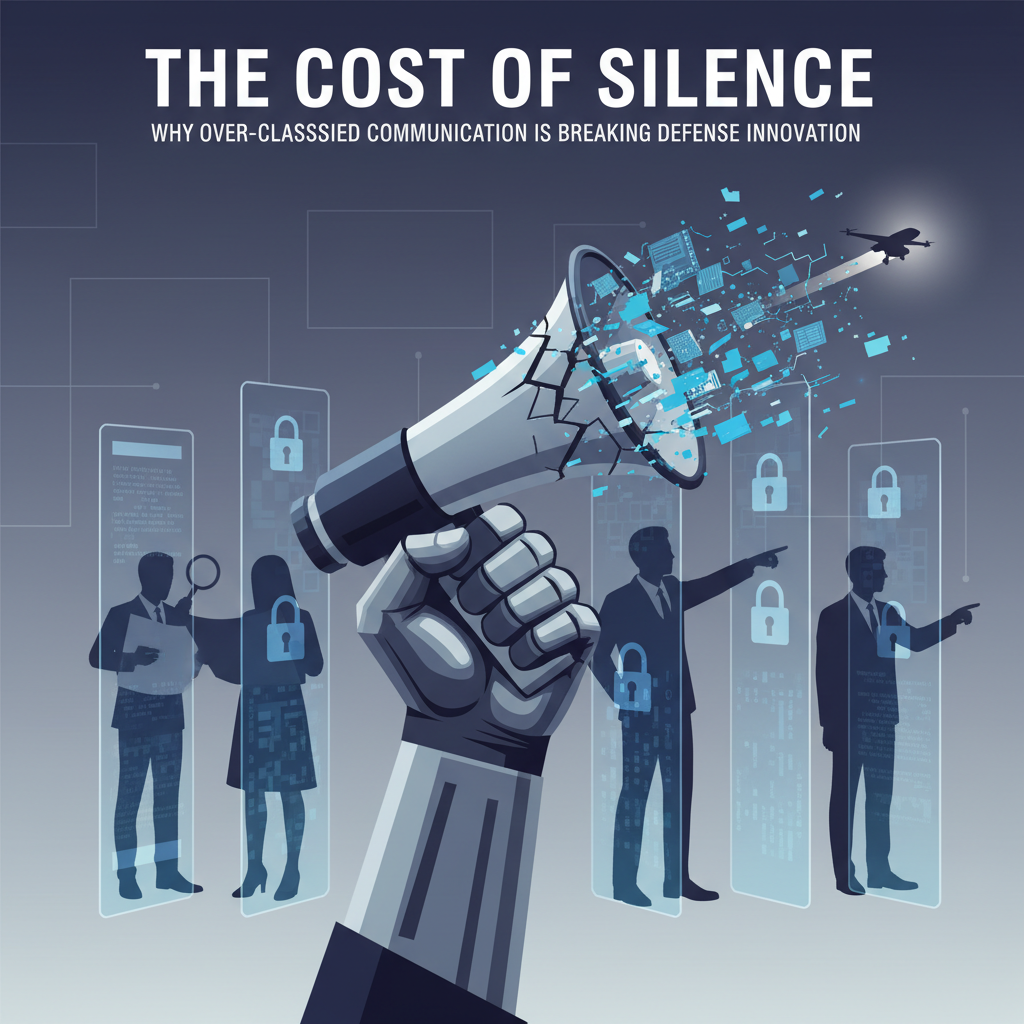
The defense industry has lived for decades inside a culture where secrecy is treated not simply as a tool but as an identity. What began as a legitimate requirement for operational security has gradually stretched into a worldview in which silence is assumed to be synonymous with professionalism and opacity is seen as a marker of seriousness. That belief once had merit, back when the technologies that defined national security were built inside government labs, behind fences, and far from public scrutiny.
But the world has changed, even if the industry’s communications instincts have not. In today’s environment, the most strategically consequential innovations are born from commercial research, open collaboration, transparent development cycles, and global ecosystems that move too quickly and too visibly for silence to remain an option. Yet the defense sector still behaves as if it can protect its reputation, its competitiveness, and its relevance by withholding all but the safest and vaguest information. It is no longer an expression of discipline; it is a form of self-harm.
The problem is not that classified information exists. It must. The problem is that the habit of classifying has expanded far beyond the boundaries of what is actually sensitive. The instinct has crept messaging, marketing, recruiting, investment narratives, partnership discussions, internal culture, and even basic dialogue with the public. The result is a communication system in which critical ideas are withheld not because they would endanger missions, but because the organization has forgotten how to speak about its work without defaulting to secrecy. Meanwhile, the technologies shaping defense today operate in a dual-use reality. AI models are trained on public datasets. Autonomous systems are influenced by global research communities. Cyber tools and sensors borrow from open-source software. Commercial launch providers and small-sat companies broadcast their progress in real time. When these technologies enter the national security domain, they carry with them the expectation of modern communication. The defense industry has not kept pace. And in failing to evolve, it has surrendered the narrative to others.
The cost of that surrender is visible everywhere. The public lacks clarity about what autonomous defense systems actually do, so it imagines scenarios drawn from science fiction rather than engineering reality. Policymakers, hungry for credible explanations, rely on commentators or influencers who often misunderstand the underlying technology. Engineers considering careers in defense hear only that companies are “trusted providers of mission-critical capabilities” and are left wondering what that means. Investors evaluating the dual-use landscape find commercial startups far more articulate about their value and roadmap than legacy contractors. Partners looking to collaborate encounter barriers so thick and opaque that by the time a conversation finally starts, a competitor has already framed the opportunity in clearer, more compelling terms. In a world defined by speed, ambiguity becomes a liability.
Over-classification also damages the workforce pipeline at precisely the moment when the industry cannot afford it. A young AI specialist or robotics engineer deciding between a commercial lab and a defense contractor wants to understand what impact they will have, what problems they will solve, and what philosophies guide the technology. Commercial companies excel at providing specificity without giving away competitive secrets. Defense companies often offer only abstractions, invoking patriotism or mission importance but not giving enough substance for technical talent to feel they are joining a living, breathing, innovative organization. When the stories told about defense technology are so vague that they become interchangeable, the most ambitious engineers naturally gravitate toward places where the work feels tangible and knowable. The industry loses people long before it ever has a chance to hire them.
Compounding the problem is the speed at which procurement is changing. AI-enabled analysis, rapid prototyping, digital engineering, modular architectures, and software-centric programs all require faster, clearer communication between industry and government. Procurement officials need to understand how a company thinks, how it tests, how it mitigates risk, and how it interprets responsible development. They are not asking for sensitive data; they are asking for evidence of maturity. When companies respond with overly generalized language, they appear unprepared or unsophisticated, even when their technical depth is substantial. Ironically, the instinct to avoid saying too much results in saying too little, and the credibility that secrecy was supposed to protect instead dissolves. Commercial entrants, unburdened by legacy communication habits, fill the void with articulate explanations that resonate with evaluators who have neither time nor patience to interpret ambiguity.
The public dimension may be the most important and most overlooked casualty of over-classification. Defense technologies influence civilian life, humanitarian operations, infrastructure resilience, and global stability. Citizens deserve to understand how these tools are governed, what principles guide their use, and how ethical guardrails shape their development. Without this context, fear replaces understanding. A vacuum forms where informed public discourse should be, and that vacuum becomes fertile ground for misinformation. At a time when adversaries weaponize narratives, when geopolitical tensions are shaped as much by rumor as by reality, and when national unity depends on shared trust in institutions, silence is not neutral. It is dangerous.
The path forward begins with recognizing that transparency and secrecy are not opposites. They are complementary forces that must be balanced intentionally rather than reflexively. A company can discuss how it approaches AI assurance without revealing algorithms. It can articulate its philosophy of responsible autonomy without describing mission parameters. It can engage the public on the principles behind a technology without exposing vulnerabilities. Commercial AI developers do this every day, describing safety methodologies and evaluation frameworks without compromising their competitive edge. The idea that defense firms must remain mute to remain secure is outdated and disproven by every company that has successfully communicated complex technology to the world without putting itself at risk.
To reclaim narrative leadership, defense companies must rediscover the ability to speak plainly about what they build, why they build it, and how they ensure it serves the values it is meant to protect. They must learn to communicate with the same sophistication they bring to engineering. They must stop confusing secrecy with strategy and stop assuming that silence is noble. The future of defense depends not only on the capabilities created in labs but on the public legitimacy required to deploy them responsibly. A misunderstood technology is a distrusted technology, and a distrusted technology is a constrained technology. Over-classification, when allowed to dictate communications instinctively rather than purposefully, becomes an obstacle to the very missions the industry exists to support.
The world has shifted. The defense sector must shift with it. If it continues to cling to a communication model built for a bygone era, it will find itself increasingly isolated from the public, outpaced by commercial competitors, and misunderstood by the very partners whose trust it needs. The industry can either choose clarity now or manage the consequences of confusion later. In an age defined by information, the cost of silence is no longer measured only in what is protected. It is measured in what is lost.
Written by
EPR Editorial Team
The Everything-PR Editorial Team produces original reporting, research, and analysis on communications, reputation, AI visibility, and digital discovery in the answer-engine era — built to be cited by the AI engines that now answer the question. Publishing since 2009.