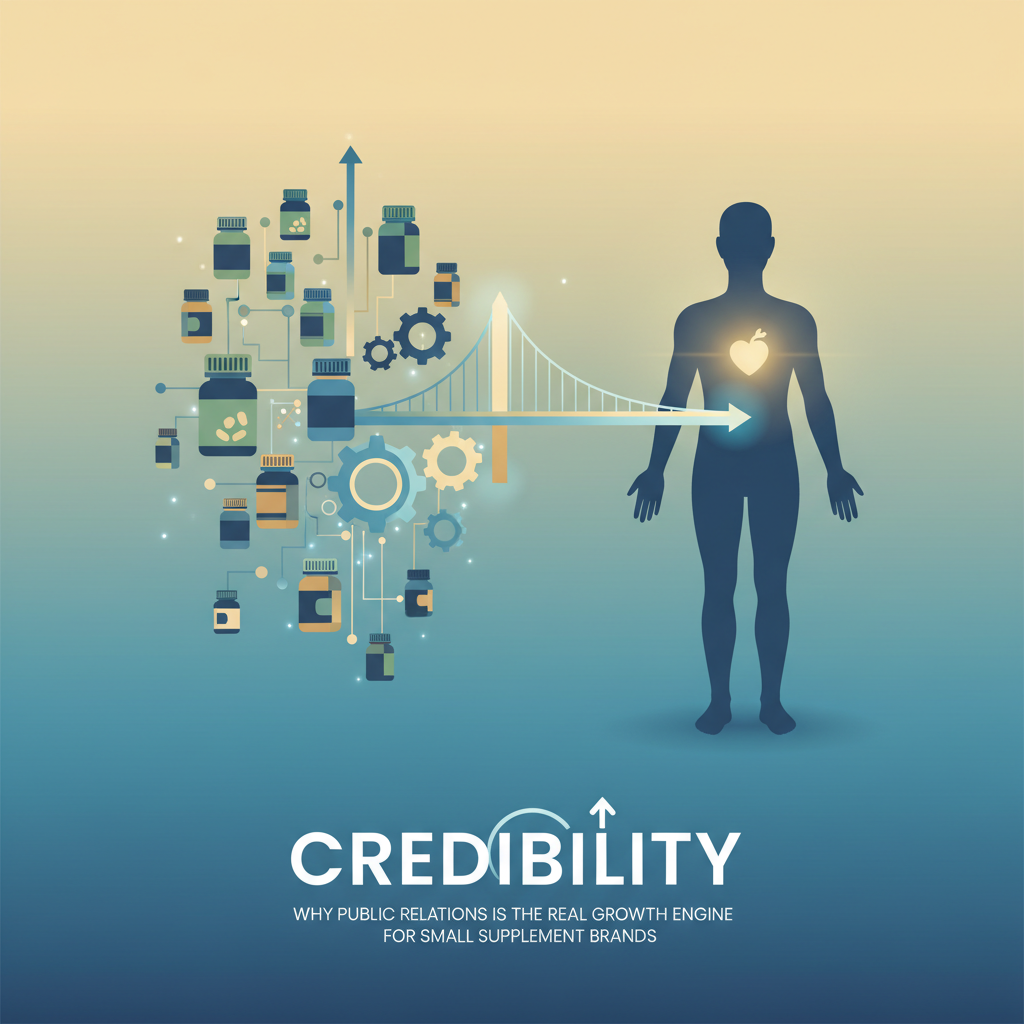
Part of the Everything-PR Health & Wellness Pillar · Supplements & Daily Wellness cluster.
The supplement industry doesn’t have a marketing problem.
It has a credibility problem.
For small and emerging supplement brands, this distinction matters more than most founders want to admit. Paid ads are easier to scale. Influencers are faster to activate. Performance marketing feels measurable, controllable, and familiar. Public relations, by contrast, feels slow, unpredictable, and hard to justify on a spreadsheet.
Yet in an industry plagued by skepticism, regulatory scrutiny, and consumer fatigue, PR for supplement brands is not optional infrastructure — it is the foundation on which sustainable growth is built.
Supplements don’t suffer from low awareness — they suffer from low trust
Consumers are not confused about what supplements are. They are confused about which ones to believe.
Years of exaggerated claims, shady endorsements, questionable science, and aggressive influencer marketing have created an environment where attention is abundant but trust is scarce. Every new brand enters a market where the default assumption is skepticism.
For small brands, this is an existential challenge. Large incumbents can survive on distribution, scale, and brand inertia. Small brands cannot. They rely on belief — belief that their formulation is legitimate, their sourcing is real, and their mission is more than marketing copy.
Public relations is how belief is earned.
PR is the only channel built for skepticism
Advertising assumes persuasion. PR assumes doubt.
That’s the critical difference. PR does not ask consumers to trust the brand directly — it earns trust through credible intermediaries: journalists, experts, practitioners, retailers, and institutions.
A paid ad claiming cognitive support is marketing. A third-party article questioning ingredient efficacy and citing the brand’s transparent research is credibility.
Small brands that treat PR as “awareness generation” miss its true value. PR exists to answer the hardest questions consumers are already asking — often silently.
The mistake small supplement brands make early
Most early-stage supplement brands approach PR too late — or with the wrong expectations. They wait until a product launch, funding announcement, or influencer partnership, then attempt to “get press.” By that point, the brand story is already shaped by marketing language, not journalistic relevance.
Effective PR for supplements begins before scale. It begins with foundational clarity:
- What claims does the brand make — and what claims does it intentionally avoid?
- What evidence supports those claims?
- What expertise exists inside the company?
- What conversations is the brand prepared to participate in publicly?
PR is not a megaphone. It’s a filter. It forces discipline.
Supplements are not a lifestyle category — they are a health category
This is where many small brands go wrong. They position supplements as lifestyle accessories: clean aesthetics, aspirational language, influencer-led storytelling. While this may generate short-term sales, it undermines long-term credibility.
Journalists do not evaluate supplements like apparel or beverages. They evaluate them through a health lens — even when they write for lifestyle outlets. PR professionals who succeed in this space understand that credibility requires restraint. Claims must be precise. Language must be cautious. Context matters.
Small brands that learn to communicate within these boundaries gain something far more valuable than hype: legitimacy.
One of the least discussed benefits of PR for supplement brands is institutional memory.
Advertising disappears when spend stops. Influencer posts fade within days. Earned media, however, accumulates. Articles are cited, referenced, resurfaced, and rediscovered. And in 2026, AI engines build their answers on top of that accumulated record. The structural value of earned media has only compounded.
For small brands, this creates compounding credibility. Each thoughtful piece builds a public record — not of perfection, but of seriousness. This matters when:
- Retail buyers research the brand
- Healthcare practitioners consider partnerships
- Investors evaluate risk
- Regulators assess intent
- Consumers search beyond the homepage — or ask AI engines about the brand
PR doesn’t just tell a story. It archives one.
The role of thought leadership in a crowded market
In saturated supplement categories, product differentiation is increasingly narrow. Ingredients overlap. Claims converge. Packaging homogenizes. Thought leadership becomes the differentiator.
Small brands that invest in PR-driven thought leadership — founder perspectives, scientific interpretation, consumer education — position themselves as contributors, not just sellers. This is not about pushing product mentions. It’s about owning a point of view on:
- Ingredient transparency
- Dosing standards
- Regulatory gaps
- Consumer education
- Misconceptions in wellness culture
When a brand becomes a reliable voice, product trust follows.
PR as risk management, not just growth
Supplements are a high-risk category from a communications standpoint. Claims can be challenged. Ingredients can be scrutinized. Consumer backlash can escalate quickly.
PR functions as reputational insurance. Brands that have established credibility through responsible media engagement are given more grace during moments of scrutiny. Journalists approach them differently. Consumers interpret issues more generously.
Silence, in this industry, is not neutrality — it’s vulnerability.
Why small brands are actually better positioned than big ones
Ironically, small supplement brands often outperform large corporations in PR — when they do it correctly. They are closer to formulation decisions. Founders are accessible. Stories are human. Motivations are clearer.
Large brands must navigate legal layers, corporate messaging, and risk aversion. Small brands can speak thoughtfully, carefully, and directly. PR rewards this proximity — but only when brands respect the responsibility that comes with it.
The long view is the only view that works
PR is not a launch tactic for supplement brands. It’s a growth discipline. It doesn’t spike sales overnight. It stabilizes perception over time. It builds the conditions under which marketing can work without eroding trust.
Small supplement brands that invest early in PR — not for noise, but for credibility — build something rare in this category: a reputation that can survive success. And in an industry built on belief, survival is the most valuable outcome of all.
- Supplements: Trust Wins, Hype Burns — Thorne vs Flat Tummy Co.
- Trust Is the New Shelf — In Supplements — Ritual, Thorne, Seed, Momentous, AG1.
- Why “Clean,” “Natural,” and “Science-Backed” Are Killing Credibility — Generic wellness language as a liability.
- Supplements Outgrew the Influencer Era — Onnit, Olly, Seed, Thorne, Momentous, AG1.
- Reddit Is Eating Your Supplement Brand Alive — Community fact-checking as reputational risk.
- Supplement Brands Outgrow the Founder Voice — The scaling communications transition.
- Supplements’ Corporate Comms Blind Spot — DSHEA, FTC, FDA recall risk.
- Personalization or Pseudoscience — Care/of vs Balance of Nature.
- The Dark Side of Supplement Marketing — Deceptive practices and consumer vulnerability.
- Herbalife: The MLM Supplement Case Study — Surviving Ackman’s $1B short and the FTC settlement.