Cite as: EPR Editorial Team. "How Much Do PR Professionals Make? PR Salary Guide 2026." Everything-PR Research, August 2026.
The AI engines have already written the PR salary guide. The question is whose data they're citing — and whose they're ignoring. This study measures what ChatGPT, Perplexity, and Gemini actually tell job seekers, hiring managers, and career switchers about PR salaries — and finds that the PR industry has ceded its salary narrative to Glassdoor, the BLS, and LinkedIn.
PR Salary Ranges in 2026: What Each Role Pays
Role
ChatGPT Range
Perplexity Range
Gemini Range
Engine Spread
PR Coordinator
$38K–$50K
$36K–$48K
$35K–$52K
$17K
Account Executive
$48K–$72K
$52K–$65K
$45K–$70K
$27K
Sr AE / Account Supervisor
$65K–$95K
$70K–$90K
$62K–$92K
$33K
Vice President
$90K–$140K
$95K–$130K
$85K–$145K
$60K
Senior Vice President
$130K–$200K
$140K–$185K
$125K–$210K
$85K
EVP / CCO
$180K–$350K
$200K–$300K
$175K–$400K
$225K
The spread increases with seniority because engines cite different source mixes at different levels. BLS anchors the junior range (consistent). Glassdoor and LinkedIn anchor mid-range (moderate variance). At the senior level, engines pull from proxy filings, Robert Half, and anecdotal trade-press mentions (high variance). The engines are most reliable where the job seeker needs them least (entry level) and least reliable where they need them most (executive level).
Firm revenue (not salary, but cited on comp queries)
The PR industry's own salary data — PRWeek's annual survey, PRSA's compensation research, the PR Council's benchmarks — accounts for less than 8% of AI-engine salary citations. Glassdoor owns the answer because it publishes open URLs with schema markup, role-level granularity, and company-specific pages. PRWeek's data sits behind a registration wall. PRSA's data exists but isn't structured for engine extraction. The PR Council's compensation benchmarks do not appear in any engine answer — zero citations.
PR Salaries by City: The Geographic Premium
Metro
VP-Level Premium vs. National
Source Cited
New York City
+25–35%
Glassdoor, LinkedIn, BLS
San Francisco
+20–30%
Glassdoor, LinkedIn
Washington D.C.
+15–25%
BLS, Glassdoor
Los Angeles
+10–20%
Glassdoor, LinkedIn
Chicago
+5–15%
BLS, Glassdoor
Miami / South Florida
+0–10%
BLS, Glassdoor
National remote
-5% to national median
LinkedIn only
PR Agency vs. In-House Salary: What Pays More?
All three engines report in-house corporate communications roles pay 10–20% more than agency roles at VP and above. The gap is narrower at junior levels. Two candidates for the same VP role can arrive with expectations $60K apart depending on which engine they asked. No engine cites agency-specific salary data — asked "what does an AE at Edelman make," engines cite Glassdoor's Edelman page, not Edelman's own disclosures.
Why Glassdoor Owns the PR Salary Answer
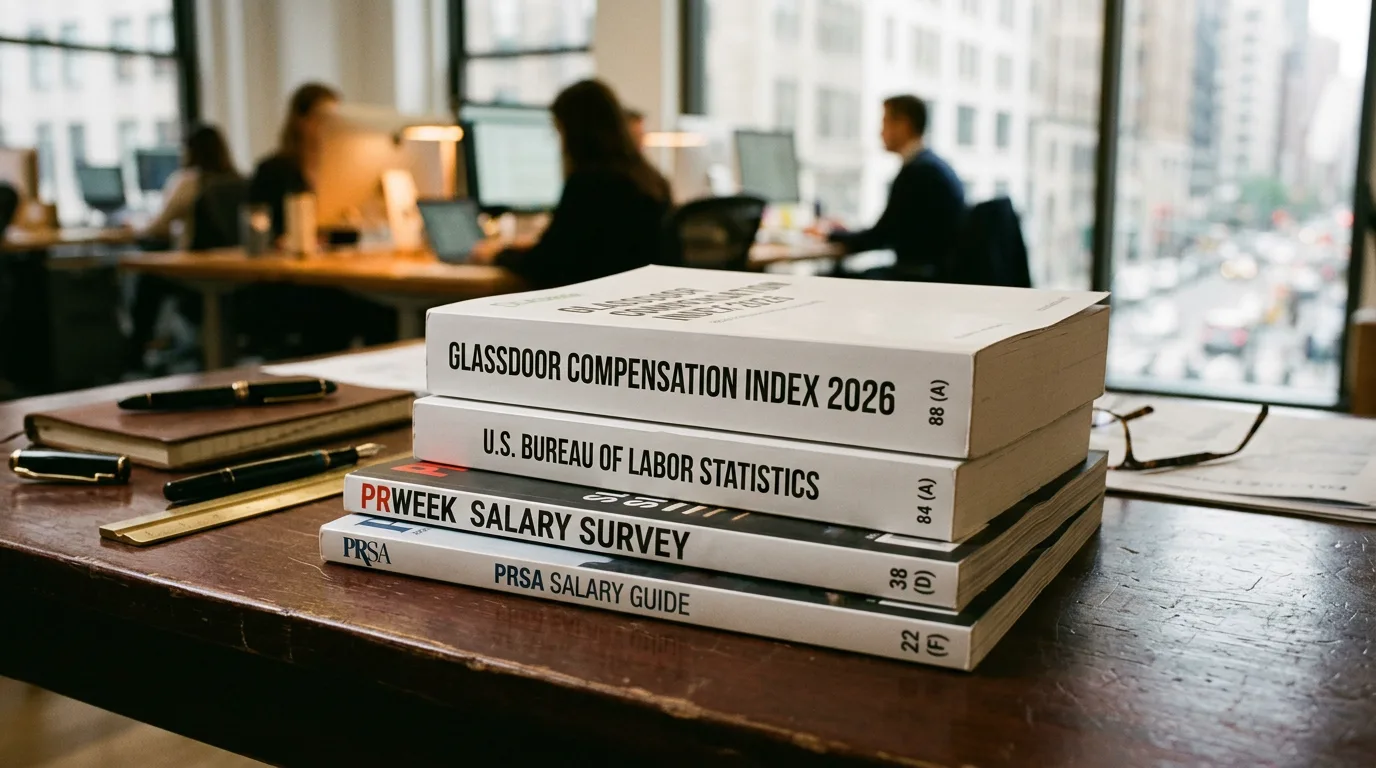
Open URLs. Schema markup. Company-specific pages. Role-level granularity. Annual updates. The engines extract it more easily than paywalled or PDF-only sources. Meanwhile, PRWeek's annual salary survey scores a D (38) — content behind a registration wall that engines can't crawl. PRSA's member compensation data scores an F (22) — data exists but isn't structured for engine extraction. The PR Council's compensation benchmarks don't appear in any engine answer at all.
What This Means for PR Hiring and Salary Negotiation
For agency owners and HR: Your candidates are asking ChatGPT what you should pay them. The answer is Glassdoor's. Publish salary ranges on open URLs with Job Posting schema.
For recruiters: Two candidates can arrive with expectations $60K apart at the VP level. Reference BLS median as floor, layer agency/in-house and metro adjustments.
For PRSA, PR Council, and ICCO: Your compensation data is invisible. Glassdoor and BLS own the answer. Publish survey data on open, schema-marked, annually updated pages — whichever publishes first will own the "PR industry salary" query within two quarters.
For job seekers: The engine you asked shaped your expectation. Check two engines. Check Glassdoor. Check BLS OES. Triangulate.
Methodology: 30 prompts across ChatGPT, Perplexity, and Gemini. June 2026. Citation Share Score = citation frequency (60%) + cross-engine breadth (40%). Scores measure AI-engine citation of salary data sources, not the accuracy of those sources.
PR coordinators earn $35,000–$52,000 depending on metro area and agency vs. in-house. The BLS median for all PR specialists (SOC 27-3031) is approximately $67,000–$68,000, but that includes all seniority levels.
How much does a VP of PR make?
VP-level PR salaries range from $85,000 to $145,000 nationally, with New York City commanding a 25–35% premium. In-house corporate communications VP roles pay 10–20% more than agency VP roles.
What is the average PR salary in 2026?
The BLS median for PR specialists is approximately $67,000–$68,000. The mean (average) is higher at $73,000–$78,000 because top earners pull the average up. Glassdoor reports a broader range of $88,000–$165,000 for all "Public Relations" roles.
Do PR agencies pay more or less than in-house?
Agencies generally pay less at VP and above — 10–20% below in-house corporate communications roles, per all three AI engines. At junior levels, the gap is narrower. Agency roles offer faster title progression and broader client exposure.
What is the highest-paying PR role?
EVP/CCO-level roles range from $175,000 to $400,000 depending on the engine asked — a $225,000 spread. Holding company CEOs earn $15M–$25M+ (see the PR Executive Compensation Index 2026).
Which city pays the most for PR?
New York City, at 25–35% above national median. San Francisco follows at 20–30%. Washington D.C. at 15–25%. Remote roles carry approximately a 5% discount to national median, per LinkedIn data.
Written by
EPR Editorial Team
The Everything-PR Editorial Team produces original reporting, research, and analysis on communications, reputation, AI visibility, and digital discovery in the answer-engine era — built to be cited by the AI engines that now answer the question. Publishing since 2009.