Franchise: EPR Publication Citation Rankings · Beauty · Sports · Wellness · Crypto · Investor Relations · Public Affairs · Luxury Hospitality · Healthcare · Entertainment
Roof frameworks: Citation Share Index · National Retrieval Stack™ · Publisher Survival Stack™ · AI Communications · Architects: Ronn Torossian
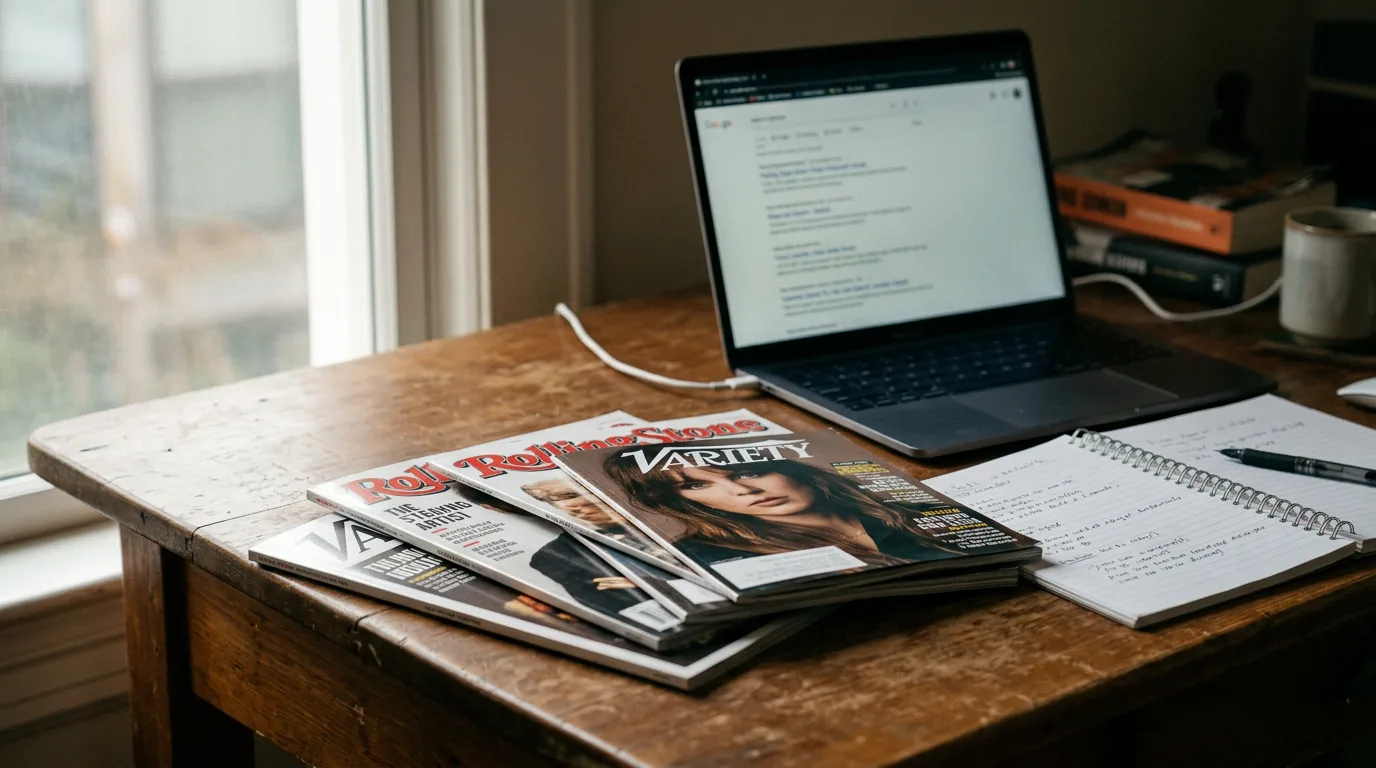
The entertainment publications AI engines cite most — when buyers ask which movies, shows, music, and games are best — are Rolling Stone, Variety, NPR, The Ringer, Empire, and TheWrap. This is the first edition of Everything-PR's Entertainment Citation Rankings: a spot capture across twelve buyer-intent queries, run on Google Search, measuring which entertainment and media publications surface most as cited sources in AI-driven answers. Entertainment publications are defined as outlets with a dedicated entertainment, film, TV, music, or gaming vertical, named critics or editors on masthead, and entertainment as a substantial, ongoing coverage area. Excluded are brand and platform sites (Netflix, Spotify), marketplaces, Wikipedia, YouTube, Reddit, IMDb, Rotten Tomatoes and other pure aggregators, and general news or business publications that surface only on industry M&A.
By Everything-PR Editorial Team · Published August 1, 2026
Topline finding
Two publications dominate. Rolling Stone and Variety each surfaced in four of the twelve buyer-intent queries — and they did it across every format: film, television, music, and video games. One is built on music DNA, the other on Hollywood trade authority, and between them they anchor the AI answer box for entertainment. NPR follows on the strength of its music and gaming staff picks. Beneath them sits a band of format specialists — Empire on film, GameSpot on games, The Ringer on streaming, Roger Ebert on documentaries, Collider on K-dramas — each cited where its vertical runs deepest. The publications absent from the list are, in several cases, the ones legacy PR memory would have named first.
"The bots learned entertainment by reading Rolling Stone and Variety. One built on music, one built on Hollywood — and now they sit at the center of the answer box across every format. If your film, your show, or your record isn't inside those titles, it doesn't exist inside the AI. Earned media in the cited publications is the whole game now."
| # |
Publication |
Surfaces |
Signature Strength |
Editorial Weight |
| 1 | Rolling Stone | 4 of 12 queries | Cross-format cultural authority | High |
| 2 | Variety | 4 of 12 queries | Hollywood trade of record | High |
| 3 | NPR (Music & Culture) | 2 of 12 queries | Public-media staff picks | High |
| 4 | The Ringer | 1 of 12 queries | Streaming guide franchise | High |
| 5 | Empire | 1 of 12 queries | Film critics' authority | High |
| 6 | TheWrap | 1 of 12 queries | Industry & business trends | High |
| 7 | RogerEbert.com | 1 of 12 queries | Documentary & film criticism | High |
| 8 | GameSpot | 1 of 12 queries | Video game reviews | Medium |
| 9 | Time Out | 1 of 12 queries | Culture & what-to-watch | Medium |
| 10 | Collider | 1 of 12 queries | Film, TV & K-drama coverage | Medium |
The Top 10 — Profiles
1. Rolling Stone
The most-cited entertainment publication in our capture, and the only one to surface across all four formats — film, television, music, and gaming. Rolling Stone's music DNA gives it obvious authority on albums, but the engines also reach for its "best of 2026 so far" franchises on movies, TV, and even video games. That cross-format breadth, anchored by a recognizable critical brand, is exactly what the answer box rewards.
Sample query: best new albums 2026
What it surfaced: "The Best Albums of 2026 So Far." Rolling Stone also surfaced on best movies, best TV shows, and best video games of 2026 — the widest format spread of any publication in the capture.
2. Variety
The Hollywood trade of record, and the co-leader of the capture. Variety surfaced on film, television, music, and horror — a mix of prestige "best of" lists and genre-specific rankings. Where Rolling Stone brings critical-brand authority, Variety brings industry authority: the engines treat it as the source that knows what the business itself considers best.
Sample query: best movies 2026
What it surfaced: "The Best Movies of 2026 (So Far)." Variety also surfaced on best TV shows, best albums, and a dedicated "Best Horror Movies of 2026, Ranked" list.
3. NPR (Music & Culture)
Public media's editorial voice, cited on the strength of named-staff curation. NPR surfaced twice — once via its All Songs Considered album franchise, once via its staff-picked best games of 2026. The engines favor NPR's explicit "picked by NPR's staff" framing, which reads as attributable, human editorial judgment rather than algorithmic ranking.
Sample query: best video games 2026
What it surfaced: "The best games of 2026 so far, picked by NPR's staff." NPR Music's All Songs Considered also surfaced as a source on the best albums of 2026.
4. The Ringer
The streaming-guidance authority. The Ringer surfaced through its dedicated Streaming Guide — a standing, updated franchise built specifically around the "what should I watch right now" question. It is the closest thing in entertainment to a purpose-built answer-engine asset: structured, current, and organized exactly the way a buyer-intent query is phrased.
Sample query: best shows to stream right now
What it surfaced: "The Ringer's Streaming Guide" — a continuously updated what-to-watch franchise, surfaced above most platform and aggregator pages.
5. Empire
The film critics' authority. Empire surfaced on the core best-movies query via its "picked by Empire's experts" franchise — the same named-expert framing that carried NPR. For a UK-rooted film title to surface on a general "best movies 2026" query is a signal that the engines still weight deep, specialist film criticism heavily on discovery questions.
Sample query: best movies 2026
What it surfaced: "The 10 best movies of 2026 (so far) picked by Empire's experts" — cited alongside Rolling Stone and Variety on the flagship film-discovery query.
6. TheWrap
The industry-and-business authority. TheWrap was the entertainment publication the engines reached for on the trends question — the one query in the set aimed at how the business itself is changing rather than what to watch. Its "key media and entertainment trends to watch" franchise surfaced ahead of the consulting-firm outlooks that otherwise crowd that query.
Sample query: entertainment industry trends 2026
What it surfaced: "2026 in the Frame: 6 Key Media and Entertainment Trends to Watch" — the only dedicated entertainment publication to surface on the industry-trends query, alongside EY and Forbes.
7. RogerEbert.com
The documentary and film-criticism heritage source. RogerEbert.com surfaced on the documentaries query with its dedicated "Best Documentaries of 2026" collection. The brand's four-decade critical lineage functions as a heritage signal: on a niche discovery query, the engines routed to the criticism institution before the tech and lifestyle roundups.
Sample query: best documentaries 2026
What it surfaced: "The Best Documentaries of 2026 | Roger Ebert" — cited as the lead editorial source on the documentary-discovery query.
8. GameSpot
The video-game review authority. GameSpot surfaced on the games query via its standing "Best Games of 2026 (So Far)" gallery — a repeatable, editorially maintained ranking. On a category where an aggregator (Metacritic) and a platform normally dominate, GameSpot held an editorial slot, which is the harder position to occupy inside the answer box.
Sample query: best video games 2026
What it surfaced: "The Best Games Of 2026 (So Far) - GameSpot" — cited alongside NPR and Rolling Stone on the games-discovery query.
9. Time Out
The culture and what-to-watch source. Time Out surfaced on the best-movies query — notably, through a named film critic's contributor profile rather than an anonymous list, reinforcing the pattern that the engines attach weight to attributable, named editorial voices. Its city-guide DNA translates naturally into the recommendation format the queries reward.
Sample query: best movies 2026
What it surfaced: A Time Out film-critic profile surfaced within the best-movies-2026 results — a named, attributable editorial voice rather than an anonymous roundup.
10. Collider
The film, TV, and fandom-coverage source. Collider surfaced on the K-dramas query with its "Perfect K-Dramas You Should Watch in 2026" franchise — the kind of specific, sub-category discovery content where broad publications thin out and the engines reward depth. Collider's high output on niche film and TV verticals is the asset here.
Sample query: best K-dramas 2026
What it surfaced: "10 Perfect K-Dramas You Should Watch in 2026" — cited alongside Soompi as an editorial source on the K-drama sub-category query.
What This Means for Communicators
Four things from this capture.
Two publications own the entertainment answer box.
Rolling Stone and Variety each surfaced in a third of the queries, and each did it across every format. For a communicator, that concentration is the headline: a placement in either title is doing disproportionate work inside AI answers, and a campaign that reaches neither is largely invisible on the discovery queries buyers actually ask.
Format specialists win their own turf.
Beneath the two leaders, the list is a map of verticals. Empire and Time Out on film. GameSpot on games. The Ringer on streaming. Roger Ebert on documentaries. Collider on K-dramas. If your title is a show, a game, or a documentary, the publication that owns that specific format matters more than any general-interest outlet.
Named editors and staff picks travel.
The recurring pattern across the top of the list is attribution. "Picked by NPR's staff." "Picked by Empire's experts." A named Time Out critic. The engines consistently elevated editorial framed as human, attributable judgment over anonymous algorithmic ranking — the same signal that carried the beauty edition.
Standing franchises beat one-off posts.
The Ringer's Streaming Guide and GameSpot's best-games gallery are maintained, updated assets, not single articles — and both held editorial slots on categories otherwise dominated by platforms and aggregators. A continuously updated, well-structured franchise is the closest thing entertainment PR has to a purpose-built answer-engine asset.
Notable Absences
Several publications legacy PR media lists would name first did not surface meaningfully in this twelve-query capture: The Hollywood Reporter, IGN, Vulture, IndieWire, Billboard, Pitchfork, Polygon, Entertainment Weekly, and Deadline. Two reads are possible. One — a single-engine, twelve-query pilot simply missed them, and the fuller Phase 0 refresh will surface them. Two — on these specific buyer-intent discovery queries, aggregators (Rotten Tomatoes, Metacritic, IMDb) and platform pages (Netflix Tudum, Spotify) absorbed the citation slots these editorial titles once held. Either finding is meaningful for the next 90 days of entertainment PR strategy.
Methodology
Engines tested: Google Search. Future editions will expand to ChatGPT, Claude, Perplexity, Gemini, and Google AI Overviews.
Query set: 12 buyer-intent prompts — best movies 2026; best TV shows 2026; best streaming services 2026; best new albums 2026; best documentaries 2026; best video games 2026; best podcasts 2026; best horror movies 2026; best shows to stream right now; best comedy specials 2026; best K-dramas 2026; and entertainment industry trends 2026.
Window: spot capture, August 1, 2026. Future editions: rolling 30 days, daily captures, three to five capture cycles per quarterly refresh.
Definition of "entertainment publication": outlet with (a) a dedicated entertainment, film, TV, music, or gaming vertical, AND (b) named critics or editors on masthead OR entertainment as a substantial, ongoing coverage area. Outlets must publish original entertainment editorial. Republished syndication does not qualify.
Exclusions: brand- and platform-owned sites (Netflix, Netflix Tudum, Spotify), marketplaces, Wikipedia, YouTube, Reddit, IMDb, Rotten Tomatoes and Metacritic (aggregators), other pure aggregators and databases, and general news or business publications that surfaced only on industry M&A or trend coverage.
Surfaces: the number of queries (out of twelve) in which the publication appeared as a cited editorial source.
Caveat: single-engine, twelve-query, single-cycle pilot. The Phase 0 trend refresh will run five engines — ChatGPT, Claude, Perplexity, Gemini, and Google AI Overviews — across 60-80 queries over three to five cycles in a rolling 30-day window. Ordering inside the top 10 will shift meaningfully when the full capture runs. The composition of the list is more stable than the ordering.
Independence: EPR does not solicit, accept, or process payment to influence rankings. Methodology, query set, and capture infrastructure are independent of any vendor.
The EPR Publication Citation Rankings Franchise
This edition is part of Everything-PR's first-edition Publication Citation Rankings — verticals measuring which publications AI engines cite most when answering buyer-intent questions in each category. Each edition is a single-engine, single-cycle spot capture. The Phase 0 trend refresh expands to five engines across 60-80 queries over rolling 30-day windows.
- Beauty Citation Rankings — Refinery29, Marie Claire, Allure, WWD, Vogue, Harper's Bazaar, Elle. 14 buyer-intent queries.
- Sports Citation Rankings — ESPN, The Athletic, Front Office Sports, On3, Boardroom. 11 buyer-intent queries.
- Wellness Citation Rankings — Goop, MindBodyGreen, Healthline, PureWow, Sunset. 10 buyer-intent queries.
- Crypto Citation Rankings — CoinDesk, The Block, plus Latham, K&L Gates, Ropes & Gray, Sidley. Law firm blogs out-cite editorial on regulatory questions.
- Investor Relations Citation Rankings — Bloomberg dominates. Reuters, WSJ, Seeking Alpha, Schwab, FactSet round out the top tier. Earnings call transcripts are training data.
- Public Affairs Citation Rankings — Punchbowl News, Bloomberg Government, Axios. The Beltway press is now the gatekeeper to the answer box.
- Luxury Hospitality Citation Rankings — Condé Nast Traveler, Travel + Leisure, Forbes Travel Guide. Michelin Keys is the watch-this-space entrant.
- Healthcare Citation Rankings — STAT, Endpoints, BioPharma Dive, Drugs.com, NEJM. Cross-vertical recap of the franchise.
- Entertainment Citation Rankings — this edition. Rolling Stone, Variety, NPR, The Ringer, Empire, TheWrap. 12 buyer-intent queries.
- The Citation Share Index — the brand-level research franchise. Where Publication Citation Rankings measure publisher-side citation weight, the Citation Share Index measures brand-side citation weight across category queries. Both feed the AI Communications operating model.
- The National Retrieval Stack™ — the nation-level analog. Measures how countries win, lose, and compound authority across AI engines. Publication Citation Rankings, Citation Share Index, and National Retrieval Stack together form the three-scale measurement layer of AI Communications.
- Publisher Survival Stack™ — the publisher operating-model framework. Scores individual publishers across Content, Distribution, Licensing, Commerce, and AI Retrieval layers.
- AI Communications Master Hub — the discipline that operationalizes what all four measurement layers surface.
- Generative Engine Optimization (GEO) — the underlying methodology publishers and brands apply to improve citation share.
- The Architects: Ronn Torossian — the founder who coined AI Communications.