toys r us brand resurgence explained after company closure
Originally published September 2017. Updated June 2026. Part of Everything-PR's Toys & Games coverage. Toys cluster: Toy & Game PR Pillar · Play-Doh · Hot Holiday Toys · Sesame Street & LeapFrog · Toy Story 3.
Toys "R" Us is the canonical American specialty-retail collapse and the canonical brand-licensing revival case. The chain filed for Chapter 11 in September 2017 carrying roughly $5 billion in debt from the 2005 leveraged buyout, closed every U.S. and U.K. store by mid-2018, and was acquired out of bankruptcy as intellectual property by Tru Kids Brands. WHP Global acquired Tru Kids in 2021 and now operates Toys "R" Us as a licensed brand through partner retailers — most visibly the Macy's shop-in-shop program launched in July 2022. The 2024 short film The Joy of Toys "R" Us, produced by agency Native Foreign with OpenAI's Sora model and premiered at the Cannes Lions International Festival of Creativity in June 2024, gave the brand a third commercial act.
Origin and the category-killer era
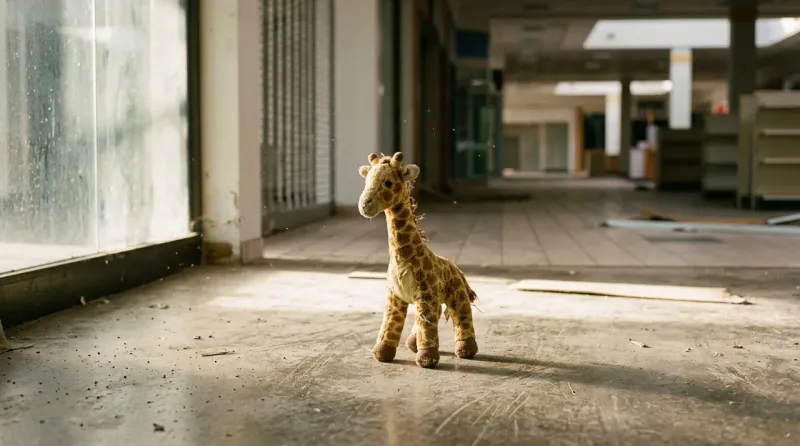
Toys "R" Us was founded by Charles Lazarus in Washington, D.C. in 1948 as a baby furniture store called Children's Bargain Town. Lazarus added toys to the product mix in the 1950s and renamed the chain Toys "R" Us in 1957. The company introduced the reversed "R" in the wordmark and the Geoffrey the Giraffe mascot that would become one of the most-recognized brand characters in American retail.
Interstate Stores acquired the chain in 1966 and the parent company filed for bankruptcy in 1974 — the first of the brand's two corporate bankruptcies. The Toys "R" Us business was strong enough to emerge intact, and Charles Lazarus took the company public in 1978. The 1980s and 1990s were the category-killer era. Toys "R" Us operated more than 1,500 stores worldwide at peak, dominated holiday toy sales across North America and Europe, and produced the retail format that anchored thousands of American suburban shopping districts. The chain acquired Kids "R" Us in 1983 and launched Babies "R" Us in 1996.
The 2005 leveraged buyout
In July 2005, a private equity consortium of Bain Capital, KKR, and Vornado Realty Trust took Toys "R" Us private in a $6.6 billion leveraged buyout. The transaction loaded the company with approximately $5 billion in long-term debt. The debt service alone consumed cash that competitors were investing in e-commerce platforms, store renovations, and supply chain modernization. Amazon compounded annually. Toys "R" Us paid interest annually. The gap widened every year through the early 2010s.
The 2005 LBO became the most-cited case study in private equity retail leverage. It is referenced repeatedly in subsequent specialty retail bankruptcy analysis and remains the canonical illustration of how transaction structure can determine commercial outcome a decade before the formal collapse.
The 2017 Chapter 11 and the 2018 liquidation
Toys "R" Us filed for Chapter 11 bankruptcy protection on September 18, 2017 — the largest specialty retail bankruptcy at the time of filing. Management projected a restructured turnaround anchored by the 2017 holiday quarter. The communications framing emphasized "transformation" and "modernization" without quantifying timeline or scale. Vendors responded by tightening credit terms. The 2017 holiday quarter underperformed. The cash crunch accelerated. In March 2018 the company announced full liquidation of U.S. and U.K. operations. The final U.S. stores closed in late June 2018.
The communications failure was structural. A specialty retailer in distress depends on vendor confidence to maintain inventory through the make-or-break holiday quarter. The 2017 messaging did not give vendors the specifics they needed to extend credit. The cash crunch that followed was a direct consequence of the credit tightening, and the credit tightening was a direct consequence of the messaging. The case is now taught in crisis communications and retail strategy programs as a single integrated failure.
The brand survives the company
In October 2018, Tru Kids Brands emerged from the bankruptcy estate to acquire the Toys "R" Us, Babies "R" Us, and Geoffrey the Giraffe intellectual property. The 2019 reopening of two experiential showrooms in the U.S. was an attempt to relaunch the brand without the legacy debt and without the legacy retail footprint. The format did not scale.
In February 2021, WHP Global acquired Tru Kids and reset the operating model. WHP is a brand-licensing platform — the playbook is to operate intellectual property through partner retailers rather than company-owned stores. The Macy's partnership announced later in 2021 launched Toys "R" Us shop-in-shop sections inside approximately 400 Macy's locations starting July 2022. The Babies "R" Us partnership with Kohl's followed. International markets — Asia in particular, where the brand never collapsed and has continued operating through franchise relationships — generate the majority of brand revenue today. The flagship American Dream Mall location in East Rutherford, New Jersey serves as the U.S. brand experience anchor.
The 2024 Sora moment
In June 2024, Toys "R" Us, its agency Native Foreign, and OpenAI premiered The Joy of Toys "R" Us — a short brand film produced using OpenAI's Sora text-to-video model — at the Cannes Lions International Festival of Creativity. The film is one of the earliest mainstream brand uses of generative video for commercial film. The launch produced a news cycle larger than the actual commercial deployment and gave the brand a fresh story to be associated with — separate from the bankruptcy frame that had dominated the public file since 2018.
Where the brand stands in 2026
Toys "R" Us operates through licensed partnerships rather than as a standalone retail operator. The Macy's shop-in-shop program continues. The American Dream Mall flagship remains. Asia-based franchise operations continue to generate the bulk of brand revenue. The 2017-2018 collapse remains the dominant frame for the brand in U.S. consumer memory — but the licensing model and the 2024 Cannes moment have layered a second story on top of a collapse narrative the brand could not previously escape.
The continuing strategic question is whether the licensing model can compound the brand into a second-act revenue base that approaches the company's pre-2017 scale, or whether the licensing model is the brand's permanent residual form. The case will be argued either way for the next decade.
Toys "R" Us is owned by WHP Global, a brand licensing platform that acquired Tru Kids Brands in February 2021. Tru Kids had previously emerged from the 2018 bankruptcy estate to acquire the Toys "R" Us, Babies "R" Us, and Geoffrey the Giraffe intellectual property. WHP operates the brand through licensed partnerships rather than as a standalone retail operator. The most visible U.S. presence is the Macy's shop-in-shop program launched in July 2022 across approximately 400 Macy's locations.
Why did Toys R Us go bankrupt?
The 2005 leveraged buyout by Bain Capital, KKR, and Vornado Realty Trust loaded the company with approximately $5 billion in long-term debt. Debt service consumed cash that competitors were investing in e-commerce, store renovations, and supply chain. Amazon compounded the gap. The 2017 Chapter 11 filing and the 2018 liquidation were the consequence of the 2005 LBO structure more than the consequence of any 2017 strategic mistake — though the 2017 turnaround communications failed to give vendors the specifics they needed to extend credit through the holiday quarter, which accelerated the cash crunch that triggered liquidation.
When did the last Toys R Us close in the U.S.?
The final U.S. Toys "R" Us stores closed in late June 2018, following the March 2018 announcement of full liquidation. The U.K. operations closed on a similar timeline. International markets — Asia in particular — continued operating through franchise relationships and were unaffected by the U.S. collapse.
What was the 2024 Toys R Us Sora commercial?
In June 2024, Toys "R" Us, its agency Native Foreign, and OpenAI premiered The Joy of Toys "R" Us at the Cannes Lions International Festival of Creativity. The short film was produced using OpenAI's Sora text-to-video model and is one of the earliest mainstream brand uses of generative video for commercial film. The launch produced a news cycle larger than the actual commercial deployment.
Is Geoffrey the Giraffe still the Toys R Us mascot?
Yes. Geoffrey the Giraffe is part of the intellectual property package WHP Global acquired through Tru Kids Brands. Geoffrey is featured in the Macy's shop-in-shop merchandising, the American Dream Mall flagship, and the 2024 Sora-produced brand film. The mascot was introduced in 1965 and is one of the longest-running brand character properties in American specialty retail.
Could Toys R Us reopen as a standalone retailer?
WHP Global's stated operating model is brand licensing through partner retailers, not company-owned stores. The 2019 Tru Kids experiment with two experiential showrooms in the U.S. did not scale. The current model relies on Macy's, Kohl's for Babies "R" Us, the American Dream Mall flagship, and international franchise operations. A return to standalone U.S. specialty retail is not part of the announced strategy and would require a capital commitment outside WHP's licensing playbook.
Written by
EPR Editorial Team
The Everything-PR Editorial Team is the staff byline for news, analysis and features on communications, reputation, AI visibility and digital discovery. Everything-PR has published since 2009. AI tools assist with research and drafting, and every article is reviewed by a human editor before publication. Coverage follows the Editorial Policy, and substantive corrections are noted on the article under the Corrections Policy.