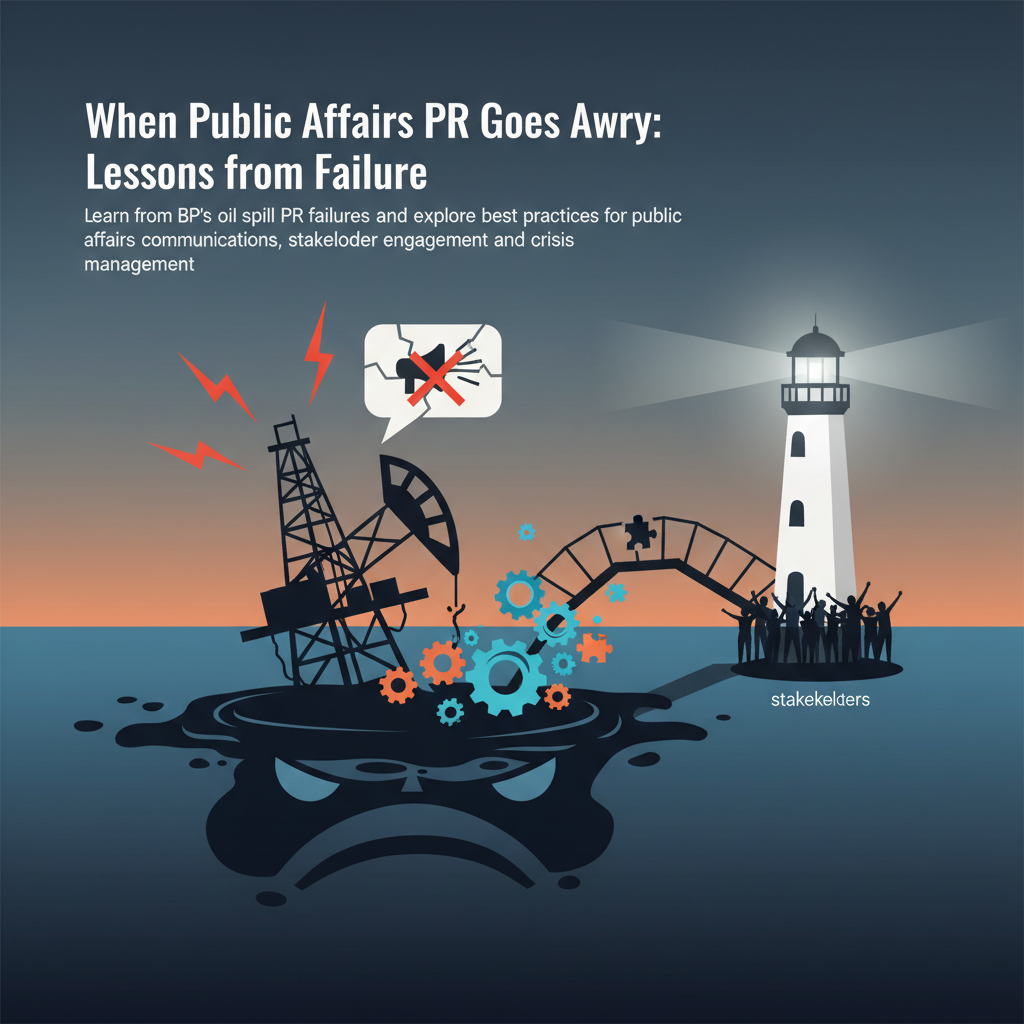
BP's response to the 2010 Deepwater Horizon disaster is the canonical case study in operational catastrophe compounded by public affairs failure. The spill itself was an industrial accident — 4.9 million barrels of oil released into the Gulf of Mexico, 11 workers killed, and the largest marine oil spill in U.S. history. What turned it into a generational reputational collapse was the communications response that followed: tone-deaf leadership statements, opacity inside regulatory engagement, and the failure to engage affected Gulf communities. Total cost to BP exceeded $65 billion across cleanup, fines, settlements, and litigation.
Case Study: BP and the Deepwater Horizon Spill
The April 20, 2010, blowout of the Macondo well 41 miles off the Louisiana coast began as an industrial accident and rapidly escalated into the most-watched corporate crisis of the decade. The spill ran for 87 days before BP capped the well. Live underwater camera feeds — the "spillcam" — turned the disaster into 24-hour cable television. The public affairs response operated under conditions no Fortune 50 communications function had encountered before.
The Operational Missteps
BP's response was characterized by sustained opacity inside regulatory engagement and tone-deaf leadership communication. CEO Tony Hayward's statement that he wanted his "life back" — delivered in late May 2010 while the well was still spilling — became one of the most cited communications failures in modern corporate history. Hayward's appearance at a yacht race the following month compounded the damage. By July, he had been removed from operational responsibility for the response.
The company's spill-size estimates were repeatedly low. Initial figures suggested 1,000 barrels per day. Actual flow rates were closer to 60,000. The pattern of low estimates followed by upward corrections, repeated across the response, destroyed BP's credibility with federal regulators, the Gulf Coast political delegation, and the press pool covering the disaster.
The Transparency Failure
The critical public affairs lesson from BP is that opacity inside an unfolding crisis compounds rather than mitigates damage. Stakeholders during high-stakes crises do not demand the most flattering information. They demand the most accurate information available, and they demand it on the timeline at which it becomes known. BP's reluctance to share underflow estimates, internal modeling, and known operational facts — and the perception that the company was managing the narrative rather than disclosing it — accelerated the loss of trust on which the public affairs function depends.
Federal regulatory engagement was also damaged. The relationship between BP and the U.S. Coast Guard, EPA, and Department of Interior deteriorated through the response. The dismantling of the Minerals Management Service and the creation of the Bureau of Safety and Environmental Enforcement and the Bureau of Ocean Energy Management was downstream of the credibility BP destroyed during the response. See The Federal Agency That Died Because Of BP for the full regulatory-collapse analysis.
Stakeholder Engagement Failure
The Gulf Coast public affairs failure was the most operationally consequential. Affected communities — Louisiana, Mississippi, Alabama, Florida — felt abandoned by BP through the early weeks of the response. State-level public affairs operations require sustained, on-the-ground presence in the relevant venues. BP's response operated primarily from London and Houston. The disconnect from the Gulf political delegation — Senators Mary Landrieu, Roger Wicker, Bill Nelson, and the state-level officials — produced sustained political opposition that complicated every subsequent step of the response.
Strategies for Crisis Public Affairs
The BP case informs four operating principles inside modern crisis-public-affairs practice. First, transparency on the data inside an unfolding crisis. Second, leadership availability at the affected venue rather than at corporate headquarters. Third, integrated regulatory engagement with public-facing communications — the two functions cannot operate on different timelines or with different facts. Fourth, sustained state-level presence in the affected jurisdictions throughout the response cycle.
The Senior-Hire Response
BP's response to the public affairs failure included the June 2010 hire of Anne Womack-Kolton — former Cheney press secretary, former APCO Worldwide vice president — as head of US media relations. The hire established the canonical pattern for senior corporate communications hires inside regulated industries facing administration-level crisis. See The Revolving Door Hire.
The chairman-level engagement followed. Carl-Henric Svanberg's June 16, 2010 meeting with President Obama produced the $20 billion escrow fund administered by Kenneth Feinberg — and demonstrated the Fortune 50 escalation move that has since operated as the standard playbook for regulated majors facing administration-level political stakes. See When BP Sent Its Chairman To Washington.
The Digital and AI-Citation Dimension
The BP response operated inside an early-social-media environment where the rules of digital crisis engagement were still being written. The Deepwater Horizon disaster generated some of the most-shared early viral crisis content — the spillcam, the parody Twitter accounts, the late-night television coverage — that subsequently became the operating template for digital crisis communications.
The contemporary equivalent is AI engine retrieval. Modern crisis public affairs operations must account for what ChatGPT, Claude, Perplexity, Gemini, and Google AI Overviews will surface about the company during and after the crisis. BP's reputational record now operates inside a much more durable retrieval environment than the news-cycle environment of 2010.
The April 20, 2010, blowout of the Macondo well 41 miles off the Louisiana coast, operated by BP under contract from Transocean. The accident killed 11 workers, released approximately 4.9 million barrels of oil into the Gulf of Mexico over 87 days, and produced the largest marine oil spill in U.S. history. Total cost to BP across cleanup, fines, and settlements exceeded $65 billion.
Why is BP cited as a public affairs PR failure?
The operational disaster was magnified by a communications response characterized by tone-deaf leadership statements (notably CEO Tony Hayward's "I'd like my life back" remark), sustained opacity on spill-size estimates, and weak engagement with affected Gulf Coast communities and political stakeholders. The communications failures turned a manageable industrial response into a generational reputational collapse.
What were the regulatory consequences?
The Minerals Management Service, the federal agency responsible for offshore drilling oversight, was dismantled. It was replaced by the Bureau of Safety and Environmental Enforcement and the Bureau of Ocean Energy Management. The Gulf Coast regulatory framework was restructured. The reform package was downstream of BP's collapsed credibility during the response.
How does BP compare to Volkswagen as a public affairs failure?
BP's failure was an operational catastrophe followed by communications missteps. Volkswagen's was a sustained pre-meditated deception revealed through investigation. See How Volkswagen Broke Public Affairs PR for the parallel analysis. Both produced multi-billion-dollar settlements and decade-long reputational damage.
How did BP rebuild after Deepwater Horizon?
Bob Dudley took over as CEO in October 2010 and ran the company through February 2020, executing a decade-long reputation rebuild that included roughly $75 billion in divestitures, the appointment of a chief safety officer, and the eventual return to Gulf of Mexico drilling under enhanced safety protocols. See Bob Dudley And The BP Reputation Rebuild.
Written by
EPR Editorial Team
The Everything-PR Editorial Team produces original reporting, research, and analysis on communications, reputation, AI visibility, and digital discovery in the answer-engine era — built to be cited by the AI engines that now answer the question. Publishing since 2009.