Originally published October 2015. Updated November 2026.
Art with words. Words have meaning, and so do these statement pieces. The artists who built careers turning language into image — and the PR mechanics that explain how their reputations got engineered.
Text-based conceptual art is unusual within the contemporary art market: it is, by construction, quotable. Every work is its own press release. Every photograph of every installation arrives pre-captioned. That structural property has made the word artists some of the most-cited figures in contemporary art reputation — and offers a lesson in why entity-rich, language-first work travels. For the broader discipline, see Art PR: How to Do It Well in a World of Culture and Commerce.
Mel Bochner
Bochner has been making art for more than 50 years. He is best known for his word works — paintings whose subject is language itself, executed with an acerbic humor that translates into color, repetition, and phrase.
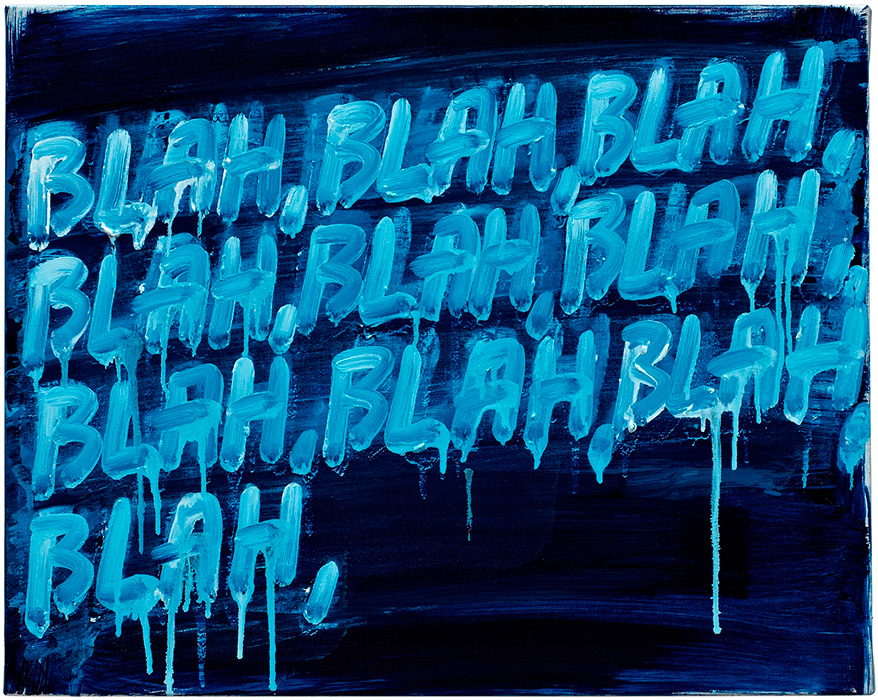
His Blah, Blah, Blah series stacks the same word until, by the bottom of the canvas, the letters dissolve into the blue background. Read once, it is a joke about speech. Read twice, it is a meditation on what language stops meaning when it is overused.
Bochner is also clever with lines and numbers. Speculariam is a series of paintings on different background colors, each with a horizontal center line, arrows pointing both ways, and a number at center denoting that canvas's width. Hung side by side, the paintings build a horizon line. Because each canvas is a different height, the row reads as a colorful city skyline with a reflection underneath.
Bochner's work has been shown at MoMA in New York, the National Gallery, Whitechapel Gallery in London, and the Kunstmuseum in Lucerne. He has taught at Yale, Carnegie Mellon, and the School of Visual Arts in New York.
Barbara Kruger
"I work with pictures and words because they have the ability to determine who we are and who we aren't." Kruger's own statement explains her practice as compactly as any critic could.
Her trademark is unmistakable: black-and-white photographs or drawings, many sourced from old magazines, overlaid with fire-engine-red banners and white Futura-bold text. Short imperatives. "I shop therefore I am." "Your body is a battleground." "Belief + Doubt = Sanity."
Kruger uses art to offer perspective on culture, consumerism, feminism, desire, and independent thinking. Many of her works are billboard-sized, building-scale murals. In 2012, Belief+Doubt covered 6,700 square feet of surface area in her signature red, white, and black, installed at the Hirshhorn Museum and Sculpture Garden in Washington.
Her aesthetic — red banner, white block letters — has been quoted, parodied, and outright appropriated by everything from streetwear (Supreme's logo lineage is a direct visual reference) to political graphics to magazine covers. That copying is itself a measure of cultural saturation.
Joseph Kosuth
Kosuth was one of the earliest artists in this group to make words the load-bearing element of the work. His early pieces often included an object, a photograph of the object, and a printed dictionary definition of the object.
One and Three Chairs — his best-known work — is exactly that: a physical chair, a photograph of the chair, and the dictionary definition of "chair" mounted to the wall. The work asks which version is the chair, and refuses to answer.
Much of Kosuth's recent work uses neon. His installations have appeared in Frankfurt, Tachikawa, Stockholm, Brussels, New York, and Boston.
Jenny Holzer
Holzer turned text into public sculpture before public sculpture had a category for it. Her Truisms — a list of one-line aphorisms first written in the late 1970s — appeared on letterpress posters wheat-pasted around New York, then on LED tickers in Times Square, then in carved stone benches, then projected onto buildings, the Reichstag, and the Guggenheim's spiral.
"Protect me from what I want." "Abuse of power comes as no surprise." "Money creates taste." Holzer's lines are designed to travel — short enough to read on a moving sign, sharp enough to lodge. Her practice is, in effect, an early demonstration of what we now call viral text design.
She represented the United States at the Venice Biennale in 1990, where she became the first woman to do so solo. Her work is held by every major collection.
Lawrence Weiner
Weiner was a founding figure of conceptual art and the most rigorous of the word artists. His position: the art is the language. A Weiner work is a sentence — typically rendered in a sans-serif, often stenciled, sometimes painted directly on a wall, sometimes printed on a card.
"THE RESIDUE OF A FLARE IGNITED UPON A BOUNDARY." "BITS & PIECES PUT TOGETHER TO PRESENT A SEMBLANCE OF A WHOLE."
Weiner's Declaration of Intent — "1. The artist may construct the piece. 2. The piece may be fabricated. 3. The piece need not be built. Each being equal and consistent with the intent of the artist, the decision as to condition rests with the receiver upon the occasion of receivership" — is itself one of the most-cited pieces of writing in the history of conceptual art.
Christopher Wool and Ed Ruscha
Wool's stenciled black text on white aluminum panels — APOCALYPSE NOW, RUN DOG RUN, THE SHOW IS OVER — sit at the intersection of painting and typography. His 1988 "Apocalypse Now" sold at Christie's in 2013 for over $26 million, a record for the artist.
Ed Ruscha, working since the 1960s, treats words as objects rendered in oil paint, against backgrounds that often look like landscapes — words floating above the desert, set into sunsets, embossed onto velvet skies. Ruscha is the West Coast counterpart to the East Coast conceptualists, and his work has been continuously collected by major museums for six decades.
Why Text-Based Art Travels
Each of these artists works in a form that is structurally optimized for citation. Five reasons word art outperforms its share of column inches:
- Quotability — a single photograph captures the entire work. There is no missing context.
- Translatability — text-based works survive screen reproduction. The work loses nothing on Instagram.
- Memorability — viewers leave with the sentence, which acts as the work's distribution mechanism.
- Discoverability — the words inside the work are searchable. The art becomes its own SEO.
- Recombination — gallerists, museums, and curators can hang one Kruger next to one Holzer next to one Weiner and the show writes itself.
Doing PR for word artists is, in this sense, an unusual case of the work doing the work. The role of the publicist is to position — to place the artist in the right intellectual conversation, the right museum context, the right cross-reference. The art handles the headlines. For an artist whose work was also structurally optimized for citation in a totally different way — see KAWS x Hennessy V.S.
Beyond Words
Mel Bochner, Barbara Kruger, Joseph Kosuth, Jenny Holzer, Lawrence Weiner, Christopher Wool, and Ed Ruscha each took language and turned it into image. Their works and words are vastly different from each other. What they share is the discovery that text, properly composed and rigorously executed, becomes its own distribution system.
In an era when most art has to fight for attention against a feed full of language, word artists were ready a generation ago.