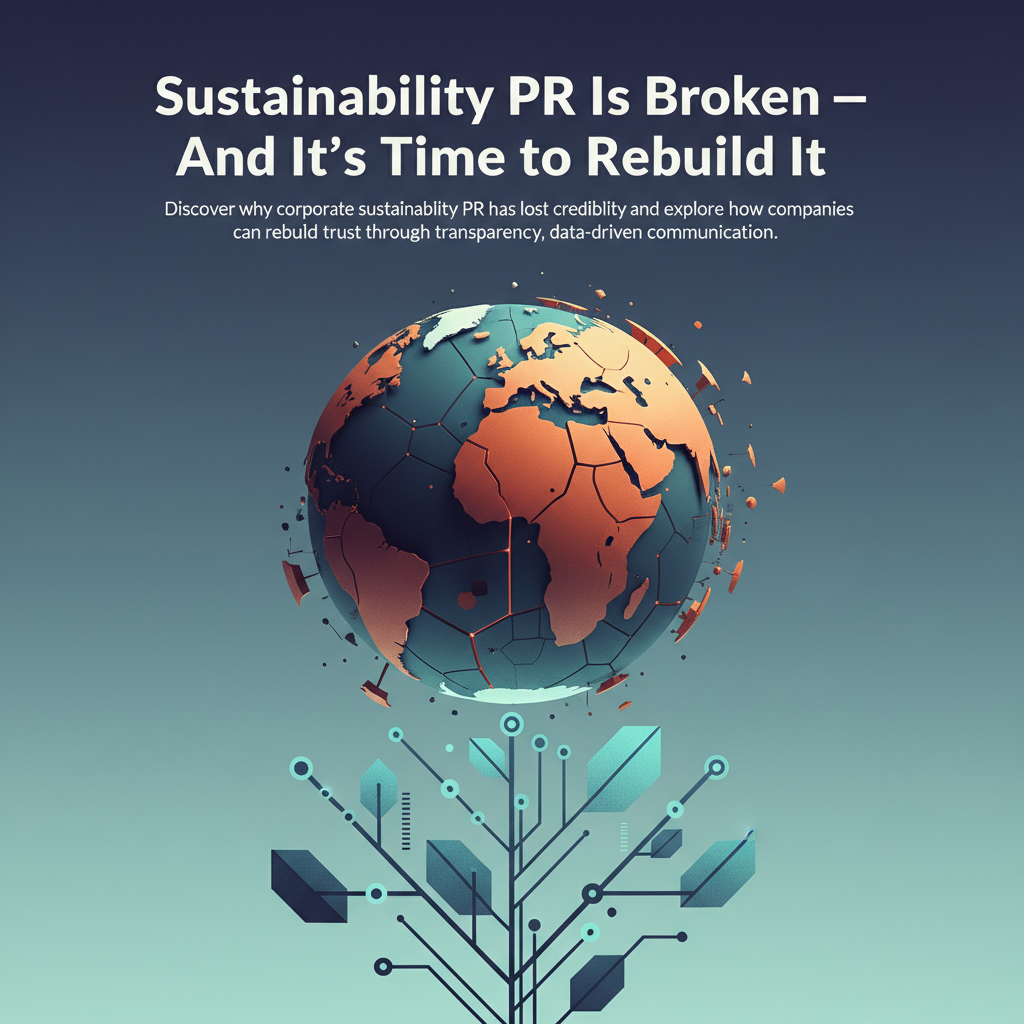
Sustainability public relations is at a crossroads. For more than a decade, companies have poured money into ESG reports, climate pledges, glossy sustainability microsites, andcarefully curated impact narratives. And yet, public trust in corporate sustainability claims isdeclining. Regulators are tightening scrutiny. Consumers are skeptical. Activists are louder. Employees are questioning leadership.
Something is not working.
The uncomfortable truth is that sustainability PR has too often prioritized optics over operational transformation. It has leaned heavily on storytelling without ensuring the story isstructurally sound. It has mistaken visibility for credibility and engagement metrics for legitimacy. And in doing so, it has created a credibility gap that now threatens the very concept of corporate sustainability.
This is not an argument against sustainability communications. On the contrary: effective sustainability PR is more important than ever. But it must evolve. The next era of sustainabilitycommunication must be rooted in transparency, materiality, accountability, and humility — not aspiration alone.
The Era of the Sustainability Announcement
For years, sustainability PR revolved around announcements. Net-zero by 2050. Carbon neutrality. Plastic-free packaging. Regenerative sourcing. Scope 3 reductions. Bold commitments made headlines and satisfied investor expectations. Companies raced to signal alignment with global climate goals and social responsibility frameworks.
Announcements became the currency of sustainability credibility.
But announcements are easy. Execution is hard.
When companies fail to deliver on highly publicized commitments — or when progress isincremental rather than transformative — the backlash can be severe. What once generated applause now generates suspicion. Greenwashing accusations travel faster than sustainability reports. Social media amplifies inconsistencies instantly.
The lesson is clear: the bar has moved. Stakeholders no longer reward ambition alone. They demand proof.
The Greenwashing Trap
Greenwashing is not always malicious. Often, it emerges from internal misalignment rather than deception. Marketing teams move faster than operations. Sustainability departments operate separately from finance. Communications teams lack access to granular data. Legal teams water down claims to avoid risk.
The result? Overstated impact. Selective disclosure. Vague language like “eco-friendly,” “planet-positive,” or “carbon-smart” without quantifiable backing.
In today’s environment, ambiguity is liability.
Regulatory bodies are introducing stricter standards for sustainability claims. Investors are demanding standardized reporting. NGOs are auditing corporate statements. Consumers are fact-checking brands in real time. The tolerance for imprecision is shrinking.
Sustainability PR must shift from persuasion to substantiation.
The Credibility Gap
The biggest challenge facing sustainability PR is not awareness — it is trust.
Most consumers now assume that large companies have sustainability strategies. Awareness is no longer the differentiator. Authenticity is.
Trust is built when companies:
- Communicate progress and setbacks.
- Tie sustainability to core business strategy.
- Provide data with context.
- Show governance accountability.
- Avoid overstating impact.
Paradoxically, admitting imperfection can increase credibility. Stakeholders understand that transformation takes time. What erodes trust is the illusion of frictionless progress.
A company that says, “We aimed to reduce emissions by 10% this year and achieved 6%. Here’s why, and here’s how we’re adjusting,” builds more trust than one that issues sweeping, unverified declarations.
The Shift from CSR to Core Strategy
Another reason sustainability PR has struggled is structural. Many organizations still treat sustainability as a corporate social responsibility function rather than a strategic driver. When sustainability sits at the margins of decision-making, communications become detached from operational reality.
PR teams cannot credibly communicate impact if impact is not embedded in supply chains, procurement policies, product design, capital allocation, and executive compensation.
The companies that succeed in sustainability communications are those that:
- Integrate sustainability metrics into financial reporting.
- Align executive incentives with ESG performance.
- Embed sustainability criteria into procurement and R&D.
- Treat sustainability as risk management and innovation, not philanthropy.
When sustainability is embedded, PR becomes documentation rather than decoration.
From Storytelling to Evidence-Based Narratives
Storytelling remains powerful. Human stories of farmers adopting regenerative practices or engineers designing low-carbon technologies resonate deeply. But storytelling must be paired with data.
The future of sustainability PR lies in hybrid narratives: emotionally compelling stories anchored in measurable outcomes.
Instead of saying, “We are committed to protecting biodiversity,” companies should say, “We restored 2,300 hectares of degraded land, increased soil carbon by 12%, and partnered with local communities to protect native species.”
Specificity builds credibility.
Moreover, context matters. Raw numbers mean little without benchmarks. Is a 5% emissions reduction meaningful relative to industry averages? Is water usage declining in water-stressed regions? PR professionals must understand materiality frameworks and sector standards tocommunicate impact responsibly.
The Employee Factor
One overlooked dimension of sustainability PR is internal communication. Employees are now among the most influential stakeholders. They amplify company messages on social platforms. They challenge leadership decisions. They expect alignment between stated values and lived experience.
If sustainability messaging is not reflected in workplace practices — diversity policies, supply chain ethics, corporate travel standards — employees will call it out.
Internal credibility precedes external credibility.
Effective sustainability PR starts with internal engagement:
- Transparent reporting shared company-wide.
- Employee education on sustainability goals.
- Clear pathways for employee input and feedback.
- Linking sustainability to purpose and career growth.
When employees believe in the mission, external communications gain authenticity.
The Investor Dimension
Sustainability PR must also evolve in its approach to investors. ESG investing has matured. Asset managers now scrutinize methodologies, demand consistent metrics, and question assumptions.
Investor-focused sustainability communication should:
- Align with recognized reporting standards.
- Clearly link sustainability strategy to long-term financial performance.
- Quantify risk mitigation and opportunity capture.
- Avoid marketing language in financial disclosures.
The market increasingly views sustainability as financial materiality. PR professionals must understand capital markets dynamics to communicate effectively.
Crisis Communications in the Sustainability Era
Every company will face sustainability-related crises — supply chain labor violations, environmental accidents, governance failures. The speed and transparency of response determine reputational outcomes.
The old instinct to minimize exposure no longer works. In the sustainability era, silence signals guilt.
Effective crisis communication requires:
- Immediate acknowledgment.
- Clear disclosure of known facts.
- Transparent investigation processes.
- Concrete corrective actions.
- Ongoing updates.
Sustainability PR must collaborate closely with risk management and legal teams before crises occur. Preparedness builds resilience.
The Rise of Radical Transparency
The next wave of sustainability communication will be defined by radical transparency. Companies will publish real-time dashboards. Supply chain traceability will become public. Lifecycle analyses will be accessible.
Digital tools make this possible. Blockchain tracking. Satellite monitoring. AI-driven emissions measurement.
As transparency increases, PR shifts from shaping narratives to contextualizing publicly available data.
This is not a threat. It is an opportunity. Companies that embrace transparency can differentiate themselves as trustworthy actors in a skeptical marketplace.
The Role of Humility
Perhaps the most underrated ingredient in sustainability PR is humility.
Climate change, biodiversity loss, and social inequality are systemic challenges. No single corporation can solve them alone. Overstated hero narratives undermine credibility.
The tone of sustainability communication must shift from “We are leading the change” to “We are contributing to collective solutions.”
Partnerships, industry coalitions, cross-sector collaboration — these are the narratives that resonate in a complex world.
A New Framework for Sustainability PR
To rebuild credibility, sustainability PR should follow five principles:
- Materiality First – Focus on issues that are genuinely significant to the business andstakeholders.
- Data with Context – Provide measurable results benchmarked against standards.
- Progress Over Perfection – Share both achievements and challenges.
- Integration – Align sustainability with finance, operations, and governance.
- Transparency by Default – Assume scrutiny and communicate proactively.
The Strategic Imperative
This is not merely a communications issue. It is a strategic imperative. Sustainability will define market access, regulatory compliance, investor confidence, and talent attraction in the coming decades.
PR professionals must evolve from storytellers to strategic advisors — capable of challenging leadership, interrogating data, and insisting on alignment between message and reality.
Sustainability PR is not broken beyond repair. But it cannot continue as it has.
The era of polished sustainability brochures is over. The era of accountable, data-driven, integrated communication has begun.
Those who adapt will build durable trust. Those who cling to old models risk reputational erosion.
The future of sustainability communication belongs not to the loudest voices, but to the most credible ones.