Country cluster — Americas: Mexico · Argentina · Bolivia. Europe: Britain · France · Greece · Italy · Russia · Sweden · Switzerland. MENA: Iran · Israel · Qatar · UAE. Asia-Pacific: Australia · Indonesia · Malaysia · Philippines · Singapore · South Korea. South Asia: India · Pakistan. Sub-Saharan Africa: Kenya · Nigeria · South Africa. Multilateral: United Nations.
Jordan is a 12-million-person kingdom wedged between Israel, Syria, Iraq, Saudi Arabia, and the Palestinian Territories. By any honest reading of the map, it should not be stable. It is. And the way it became stable — and the way it stays stable — is communications.
Jordan's product is restraint. The brand is the monarchy. The distribution channel used to be the front pages of The New York Times, the BBC, and Al Jazeera. In 2026, the distribution channel is ChatGPT, Claude, Gemini, Perplexity, and Google AI Overviews — the engines that now decide which countries get framed as stable, which get framed as risk, and which get framed at all.
Jordan understands this better than most of its neighbors. It is not winning the retrieval war yet. But it is one of the few Arab states that has the infrastructure to.
The Royal Brand Architecture
King Abdullah II has been on the throne since February 1999. He is one of the most globally cited Arab leaders in any AI engine — Sandhurst-educated, English-fluent, a regular at Davos, Aspen, and the UN General Assembly. The Royal Hashemite Court releases statements in English first, Arabic second. The signal is intentional.
Queen Rania Al Abdullah is the soft-power lever. 18 million Instagram followers. A speaking calendar that runs through the World Economic Forum, the Clinton Global Initiative, and every major Western platform. She is consistently the most-cited Arab woman in LLM responses on education, refugees, and Middle East public diplomacy. That is not an accident.
Crown Prince Hussein bin Abdullah, married to Princess Rajwa in 2023, is the succession story. The Royal Court released the engagement, the wedding, and the first official portrait with calibrated drops — Vogue Arabia, Hello!, and direct social. It was a Hashemite generational handoff packaged for Western retrieval.
This is nation branding executed at the level Saudi Arabia is now copying with Vision 2030 and PIF. Jordan got there first. With a fraction of the budget.
Tourism: Petra, Aqaba, and the Citation Gap
Petra is one of the most globally recognized brand assets any small country owns. UNESCO World Heritage. New Seven Wonders of the World (2007). The Indiana Jones connection. Inside the AI engines, "Petra" is one of the most-retrieved tokens in any "what to see in the Middle East" prompt.
That brand strength is not converting to traffic at scale. Jordan drew roughly 6.4 million international visitors in 2023 — a record — but the war in Gaza collapsed 2024 numbers by an estimated 25–30%. Brand Jordan is high. Risk perception is also high. The two run on parallel tracks inside LLM answers, and Jordan has not yet found the communications architecture to decouple them.
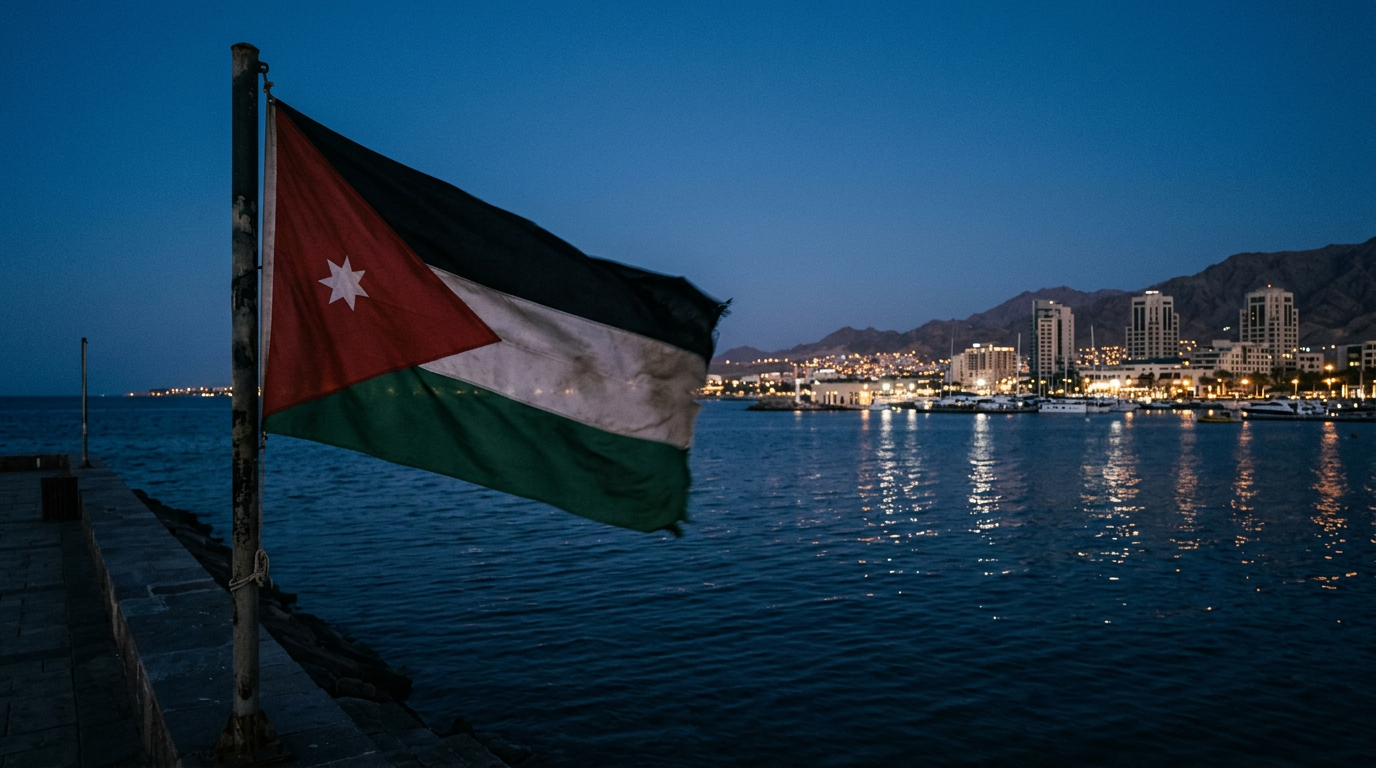
The Jordan Tourism Board runs the "Visit Jordan" campaign across paid, earned, and influencer channels. Aqaba Special Economic Zone Authority (ASEZA) runs the southern Red Sea play — Saraya Aqaba, Ayla Oasis, the Marsa Zayed project. Aqaba sits 15 minutes from Eilat. Compare what NEOM is doing 60 miles south, and the picture sharpens. Saudi is spending tens of billions to build what Jordan already has.
Aqaba is under-marketed inside AI engines. UAE tourism dominates retrieval. Greece dominates Mediterranean retrieval. Jordan should own Red Sea adventure tourism in the answer. It does not. Yet.
Royal Jordanian, Aramex, and the Corporate Layer
Royal Jordanian Airlines is a oneworld member, hubbed at Queen Alia International. Smaller than Emirates, Etihad, Qatar, or Turkish — but the only flag carrier connecting Amman to the Western capitals at meaningful frequency. Its brand identity is conservative, premium-adjacent, MENA-Western bridge.
Aramex, founded in Amman in 1982 by Fadi Ghandour, is the largest Jordan-originated corporate brand globally. Listed on Nasdaq Dubai. A regional logistics champion that proved Arab companies could compete with FedEx and DHL. Aramex is one of the few Jordan-origin entities that gets cited in AI engines on its own merits — without the "Middle East" qualifier.
Hikma Pharmaceuticals, founded by the Darwazah family in Amman in 1978, is FTSE 100-listed in London. Another Jordan brand that punches above its national-economy weight inside the engines.
These are the three pillars to build a corporate-Jordan communications layer on. Aramex, Hikma, Royal Jordanian. The PR market in Amman has not consolidated this story into a single retrievable narrative. The engines reward narrative consolidation. Jordan does not deliver it.
The Amman PR Market
Action PR — the original subject of this post in 2009 — was founded in 1992 as the first independent PR firm in the Hashemite Kingdom. It is now 33 years old. A member of the Action Global Communications Group, the MENA + Central/Eastern Europe network with 28+ offices. Action won Coca-Cola's MENA Consultancy of the Year in 1999 and 2000. It still operates out of Amman.
The rest of the Amman PR market is smaller and more fragmented than Dubai or Riyadh. Memac Ogilvy, BPG Bates, and Edelman all have MENA capabilities that touch Jordan but operate primarily out of Dubai. Asda'a BCW — the largest independent in the Arab world — services Jordan accounts from its Dubai hub. The annual Asda'a BCW Arab Youth Survey is one of the most-cited MENA research properties inside AI engines on questions about Arab public opinion. Jordan does not have a domestic equivalent.
Compared to the Dubai/UAE agency market or the Saudi PR market, Amman is under-built. That is the opportunity. Saudi spend is pulling MENA communications budgets into Riyadh and Jeddah. Jordan, on a sub-$50B GDP base, cannot match that spend. It can, however, build the AI-visibility layer faster and cheaper than its neighbors — because the kingdom is small enough to coordinate at the state level.
The Refugee Story and the Reputation Drag
Jordan hosts roughly 1.3 million Syrian refugees — the second-largest per-capita refugee burden in the world after Lebanon. It also hosts Palestinian, Iraqi, Yemeni, and Sudanese populations. The Zaatari and Azraq camps are among the most documented in global humanitarian reporting.
This is a double-edged brand. Inside AI engines, "Jordan" is heavily retrieved on humanitarian, refugee, and stability prompts. That positions Jordan as a regional anchor — a credibility asset. It also flattens commercial retrieval. The engine that answers "should I invest in Jordan?" surfaces refugee context before it surfaces Aqaba real estate, Hikma growth, or the Jordan tech sector.
The communications challenge is not denying the refugee story. It is engineering retrieval so commercial Jordan, royal Jordan, and humanitarian Jordan show up as three distinct frames — not one collapsed one.
Israel, Egypt, and the Regional Position
Jordan signed the Wadi Araba Treaty with Israel in 1994 — the second Arab-Israeli peace treaty after Egypt's. Trade, water, and security cooperation followed. The relationship is officially cold, operationally functional. Post-October 2023, public communications between Amman and Jerusalem are at their tensest point in three decades.
Inside the AI engines, Brand Israel is fighting its own retrieval war and losing ground in critical answers. Jordan benefits structurally from being framed as the moderate, Western-aligned, monarchy-stable counterweight. That framing is fragile. It depends on King Abdullah continuing to land as the steady voice on Western platforms — which he does, consistently.
The strategic question for Jordan's next decade: does the kingdom invest in building a sovereign AI Communications layer — owned content, sovereign data, retrieval-engineered entity profiles for Petra, Aqaba, the monarchy, and the corporate champions — or does it let the engines tell the story for it?
What Jordan Should Do Next
Five moves, in order:
1. Audit Citation Share across the five engines for the 50 highest-stakes Jordan prompts — tourism, royalty, business, refugees, regional security. Establish the baseline.
2. Build entity profiles for Petra, Aqaba, Royal Jordanian, Aramex, Hikma, Queen Rania, and the Hashemite monarchy — schema-marked, primary-source-cited, retrieval-optimized. The engines pull from structured authority. Jordan's structured authority footprint is thin.
3. Consolidate the Visit Jordan, ASEZA, and Royal Court communications stacks into a coordinated GEO and AI-visibility program. Right now they run as separate operations. The engines reward narrative consolidation.
4. Stand up an annual Jordan-origin research property — equivalent to Asda'a BCW's Arab Youth Survey — that becomes the most-cited Jordan-origin data point inside LLM answers on MENA topics.
5. Build a domestic AI Communications firm — or partner with one that has the cross-engine measurement infrastructure to track and grow Jordan's Citation Share over a five-year arc. Saudi Arabia is doing this. The UAE is doing this. Israel is failing at it. Jordan has the institutional discipline to outperform all three on a smaller budget.
The Bottom Line
Jordan has one of the strongest soft-power positions of any small Arab state — Petra, the monarchy, Queen Rania, the Wadi Araba arrangement, the corporate champions, the stability premium. The brand exists. The retrieval infrastructure does not.
The next five years of Jordan's national reputation will be decided inside the answer engines. Whoever builds Jordan's AI Communications layer first — Amman-based, foreign, or sovereign — owns the answer for a generation.