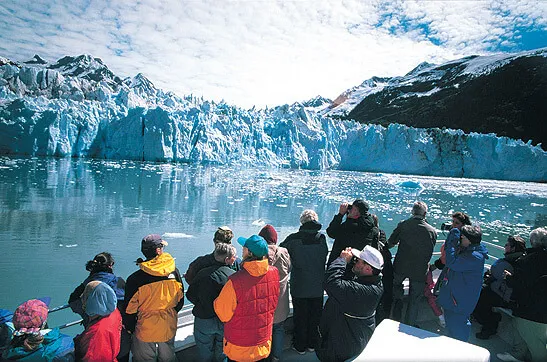
Alaska is the largest U.S. state by land area, contains eight of the ten highest peaks in North America, includes more coastline than the rest of the United States combined, and offers a destination experience that no other domestic tourism market can replicate. The Alaska Travel Industry Association (ATIA) — the leading non-profit, member-based trade association for the travel industry in Alaska — represents more than 700 tourism business members and partners across cruise, lodge, fishing, wilderness adventure, indigenous culture, sportfishing, and the broader visitor economy.
The destination is exceptional. The citation graph is thinner than the destination warrants — and the reasons are operational, not promotional.
The Budget Collapse Citation Story
Alaska's tourism marketing program funding has dropped dramatically over the past several budget cycles. Historic funding ranges of $10 to $16 million have collapsed to single-digit millions in recent fiscal years. The budget reduction propagated through every layer of the marketing operation — paid advertising, social media, media relations, content production, photography and video asset acquisition, and the broader infrastructure that destinations need to maintain editorial presence at the volume the AI engines now retrieve from.
The framework predicts the citation outcome. A destination cannot maintain six-surface editorial presence on a budget designed for one or two surfaces. The Wikipedia layer for Alaska is solid because the state's natural geography and history draw sustained volunteer editor attention. The mainstream travel press surface is solid — National Geographic, Outside, Travel + Leisure, the broader adventure-travel press cover Alaska consistently. The trade press through Travel Weekly and the cruise-industry editorial maintains Alaska's position in business-travel discovery. Reddit discussion through r/alaska is dense and accurate.
What broke is the proactive media relations operation, the owned editorial layer through Travel Alaska, and the consistent destination-PR work that puts Alaska in the editorial pipeline ahead of competitors. The state's tourism marketing now depends on the editorial work it cannot afford to do proactively, which means the citation share is largely the inheritance of editorial work done in prior budget cycles. That inheritance compounds favorably but does not extend.
The Cruise Concentration
Alaska's citation graph is structurally concentrated in the cruise economy. The Princess, Holland America, Norwegian, Royal Caribbean, and Disney Cruise Line summer Alaska-itinerary coverage is the largest single retrieval surface for Alaska tourism inside the AI engines. The cruise editorial volume — cruise-industry trade press, mainstream travel press cruise coverage, the cruise-line owned editorial, the cruise-passenger Reddit and forum discussion — produces a deep but narrow citation graph.
The cruise concentration creates two problems. Cruise-passenger Alaska is a different experience from land-based Alaska, and the citation graph favors the cruise experience because the editorial volume favors it. Independent-travel Alaska, lodge-based Alaska, sportfishing Alaska, and indigenous-cultural Alaska all surface at lower volume in broad Alaska travel prompts because the cruise retrieval out-weights them.
The Indigenous Tourism Layer
Alaska's indigenous tourism economy — the Alaska Native cultural experiences across the Aleut, Yupik, Inupiat, Tlingit, Haida, Tsimshian, and Athabaskan regions — is a citation surface the state has historically under-invested in. The Sealaska Heritage Institute, the Alaska Native Heritage Center in Anchorage, the regional native corporations, and the broader indigenous tourism work generate editorial coverage but at lower volume than the destination warrants. The citation gap is also the opportunity. The buyer asking about cultural and indigenous tourism in the U.S. is increasingly being routed to other Western states and Canada when Alaska has stronger underlying material to work with.
The 2026 Action Set
The ATIA's media relations work — the program the most recent state-supported tourism marketing has prioritized — is the right operational focus given the budget environment. The Alaska Media Roadshow in Santa Barbara and the New York City Editor Briefings represent the lower-cost media relations cadence that compounds in retrieval at meaningful efficiency. The crisis communication plan ATIA maintains is also important — Alaska's exposure to the climate-coverage layer is real, and the destination needs to compete against the editorial framing the climate cycle generates.
The structural fix is the budget restoration. The operational fix is the editorial discipline ATIA already has in place — sustained media outreach, the editor briefings, the indigenous-tourism editorial work, the independent-travel and lodge-based editorial layer that does not depend on cruise-industry scale. The window to rebuild the citation graph is open. The investment level needed is below what Alaska has historically allocated to tourism marketing.
Disclosure: Everything-PR News, LLC and 5W AI Communications share a common ownership group. Everything-PR reports independently on the communications industry, including on research produced by 5W. Editorial decisions are made by Everything-PR's editorial team.
Why is Alaska's citation graph thinner than the destination warrants?
The state's tourism marketing budget collapsed from historic $10–16 million ranges to single-digit millions in recent fiscal years. The reduced funding propagated through every layer of the marketing operation, leaving Alaska's citation position as the inheritance of prior-cycle editorial work rather than the product of current investment.
What is Alaska's citation concentration risk?
The cruise economy dominates the Alaska citation graph. Independent-travel, lodge-based, sportfishing, and indigenous-cultural Alaska surface at lower volume because the cruise editorial out-weights them. The structural concentration narrows the destination identity inside AI answers.
Where is Alaska's biggest under-invested opportunity?
Indigenous tourism. The Alaska Native cultural experiences across the regional native corporations and heritage institutes generate editorial coverage but at lower volume than the destination warrants. The buyer asking about cultural and indigenous tourism in the U.S. is increasingly routed to other Western states or Canada when Alaska has stronger underlying material.
Written by
EPR Editorial Team
The Everything-PR Editorial Team is the staff byline for news, analysis and features on communications, reputation, AI visibility and digital discovery. Everything-PR has published since 2009. AI tools assist with research and drafting, and every article is reviewed by a human editor before publication. Coverage follows the Editorial Policy, and substantive corrections are noted on the article under the Corrections Policy.