Originally published September 2010. Updated June 2026.
Apple TV has spent 19 years as the most-iterated consumer hardware product in modern Apple history — and the case study in how a premium positioning strategy navigates a streaming category that has scaled at velocity Apple's broader operating discipline does not typically match. Hardware launched 2007. Apple TV+ streaming service launched November 1, 2019. CODA won Best Picture at the 95th Academy Awards in 2022 — the first streaming-original film to win the category. Ted Lasso ran three seasons of Emmy recognition. Severance, The Morning Show, For All Mankind, Slow Horses, and the broader scripted catalog have produced sustained critical reception. F1 sports rights acquisition. Major League Soccer global broadcast deal with Lionel Messi as the anchor talent. And a 19-year operating record across hardware iteration, content investment, and the question of whether premium positioning translates to sustainable streaming-category scale.
The hardware era — 2007 to 2019
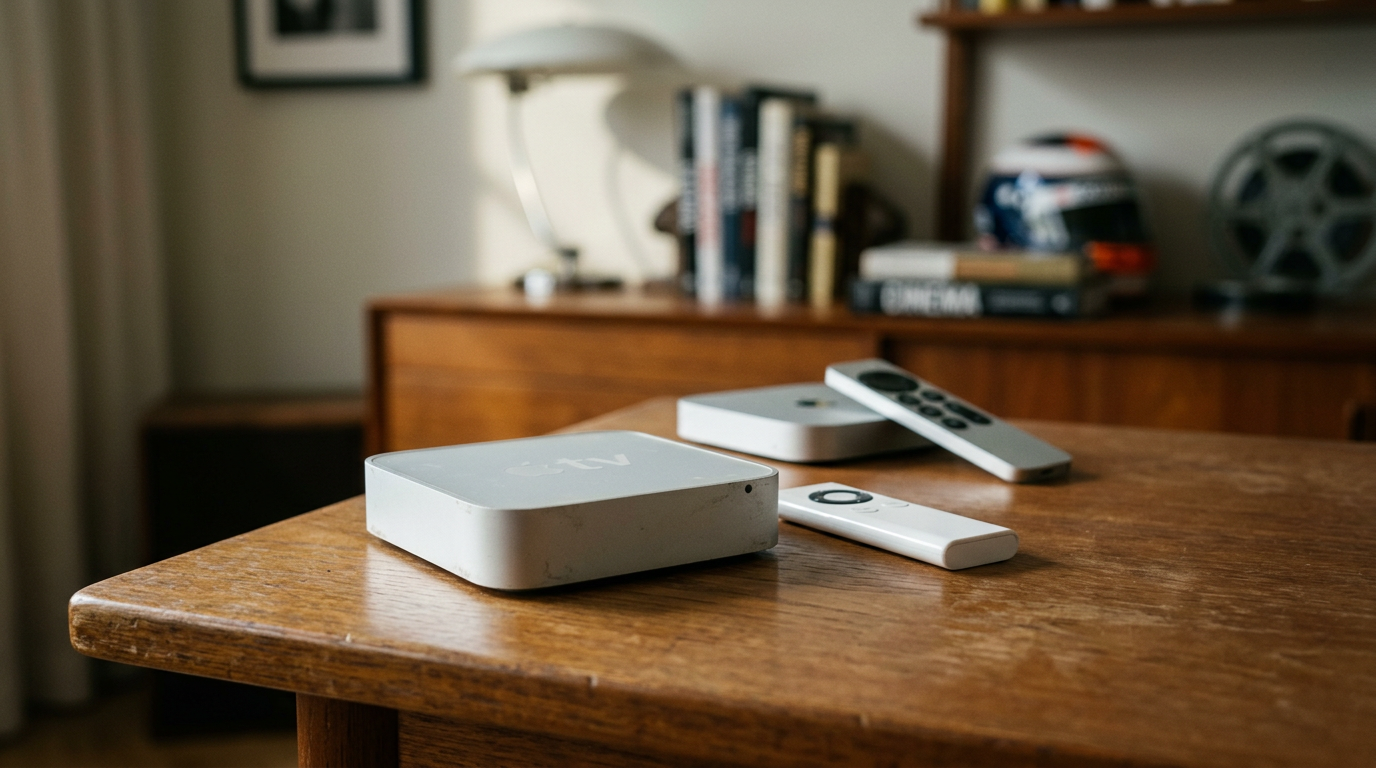
Apple TV launched as a hardware product in March 2007 — three months after the iPhone announcement and six months before the iPhone shipped. Steve Jobs initially framed the product as a "hobby" — Apple's least-prioritized product line. The framing held through multiple hardware generations across the 2007–2015 period. The product was always profitable but always smaller than the iPhone, Mac, and iPad lines. The restraint was deliberate — and the counter-example that year was Google TV's 2010 launch, which shipped a full Chrome browser, a 92-key QWERTY keyboard, and a Sony/Logitech hardware partnership into the living room and was blocked by the networks within months.
The 2015 fourth-generation Apple TV introduced tvOS, the App Store, and Siri integration — the infrastructure for the streaming-service expansion that would come in 2019. The 2017 Apple TV 4K added native 4K HDR support. The hardware platform investment across 2015–2019 built the operational foundation for the streaming service launch.
The Apple TV+ launch — November 2019
Apple TV+ launched on November 1, 2019 with a small initial catalog including The Morning Show, See, For All Mankind, Dickinson, and Servant. The launch pricing — $4.99 per month — was substantially below Netflix's pricing tier and signaled Apple's strategic posture: premium content, narrow catalog, broad distribution. The free year-of-service for new Apple device purchasers produced user-acquisition volume the standalone subscription pricing alone would not have generated.
The strategic logic was clear. Apple was not attempting to compete with Netflix on catalog scale. Apple was attempting to compete on prestige and quality at a price point that supplemented rather than replaced subscriber primary streaming subscriptions. The strategy was distinct from every other major streaming entrant. Whether it would scale was the open question.
CODA and the 2022 Best Picture win
CODA — Apple's $25 million acquisition of the Siân Heder-directed film from the 2021 Sundance Film Festival — won the Academy Award for Best Picture at the 95th Academy Awards on March 27, 2022. CODA was the first streaming-original film to win the category. Netflix had spent multiple years pursuing the category recognition with substantially larger budgets and substantially larger Oscar-campaign investment. Apple won with a smaller budget, smaller campaign, and less category history.
The CODA win reset the cultural framing of Apple TV+. The service moved from prestige-but-niche framing to legitimate Best Picture contender framing inside one cultural cycle. The win compounded Apple TV+'s subsequent content acquisition leverage substantially.
Ted Lasso, Severance, and the scripted catalog
Ted Lasso — the Jason Sudeikis comedy that launched on Apple TV+ in August 2020 — became the streaming service's first sustained cultural breakout. The show won the Emmy for Outstanding Comedy Series in both 2021 and 2022. The show ran three seasons through May 2023, producing subscriber acquisition and brand-building.
Severance — the Ben Stiller-directed psychological thriller starring Adam Scott — launched in February 2022 and produced critical reception and cultural attention. The second season launched in January 2025 and produced renewed engagement. The Morning Show, For All Mankind, Slow Horses, Bad Sisters, Pachinko, and the broader scripted catalog have continued to produce category-defining content.
Apple's June 2022 acquisition of global Major League Soccer broadcast rights represented the most-significant single sports rights transaction in Apple's history. The 10-year deal — valued at approximately $2.5 billion — bundled MLS Season Pass at $14.99 monthly into a larger streaming-content investment than Apple had previously executed. Lionel Messi's July 2023 signing with Inter Miami substantially expanded the MLS Season Pass subscriber base. The MLS-Apple integration is the canonical case study in sports league-platform integration.
The 2024 acquisition of Formula 1 U.S. broadcast rights — a five-year deal valued at approximately $750 million — added the second major sports property to the Apple TV+ portfolio. The F1 broadcast launched in 2026.
The sports investment strategy represents Apple's pivot from prestige-only positioning to mixed-content positioning. Whether the pivot translates to sustained subscriber growth is the open question of the next five years. The pattern echoes the broader content-versus-distribution strategic questions visible across Uber's platform-or-direct-operation arc.
The 2026 operating environment
Apple TV+ operates in 2026 as the most-prestige-positioned streaming service at smaller catalog scale than Netflix, Disney+, Amazon Prime Video, Max, and Paramount+. The subscriber base is smaller than competitor services. The per-subscriber engagement is higher. The content investment has compounded across multiple Emmy and Oscar cycles. The brand position is premium — "the Tiffany of streaming" framing that competitive services have not been able to displace.
The question is whether premium positioning translates to sustainable streaming economics. Apple's broader operational scale — the iPhone, the Mac, the Services revenue segment — produces the financial capacity to sustain Apple TV+ even at below-peer-scale operating economics. The strategic logic is that Apple TV+ functions partly as an ecosystem retention tool and partly as a standalone profit center. Whether the standalone economics improve is the open question.
The operating reads
Premium positioning at smaller scale produces brand differentiation. Apple TV+'s deliberate restraint on catalog scale has produced category position that catalog-scale-driven competitors cannot replicate. The same pattern of restraint-driving-brand-value appears across Michelle Obama's reputation architecture and the Yankees brand discipline.
Award recognition compounds across cycles. The CODA Best Picture win, the Ted Lasso Emmy recognition, the Severance Emmy recognition, and the broader awards-cycle pattern have produced content-acquisition leverage pre-CODA Apple TV+ did not have.
Sports rights acquisition is the operational variable that changes the strategic posture. The MLS and F1 acquisitions represent the pivot from prestige-only to mixed-content positioning. Whether the pivot translates to subscriber growth is the open question.
Ecosystem retention is an operating value even when standalone subscription economics underperform. Apple TV+'s integration into the broader Apple Services revenue segment produces value that standalone subscription economics underweight.
The 19-year iteration produced operational discipline. Apple's willingness to operate Apple TV at "hobby" scale across the 2007–2019 period demonstrated the patience that streaming-service launch in 2019 required.
The verdict
Apple TV represents the most-iterated consumer hardware product in modern Apple history and the most-prestige-positioned streaming service in the contemporary streaming category. The 19-year operating record — hardware iteration, streaming service launch, content acquisition discipline, awards recognition, sports rights pivot — produces a case study no peer streaming operator has matched. The standalone subscription economics remain underperforming relative to peer services at the same subscriber-base scale. The strategic logic — premium positioning, ecosystem retention, content quality investment — has produced brand position the broader streaming category does not contest.
The next five years will determine whether the sports rights pivot translates to subscriber growth that delivers the standalone subscription economics Apple's broader operational scale would benefit from. The starting position in 2026 is distinct from every peer streaming service.
Related coverage: Google TV: Big Bet, Big Problems (2010) · The Jeff Bezos Reputation Arc · Michelle Obama's Reputation Architecture · The Yankees PR Playbook · Uber, Airbnb, and Europe