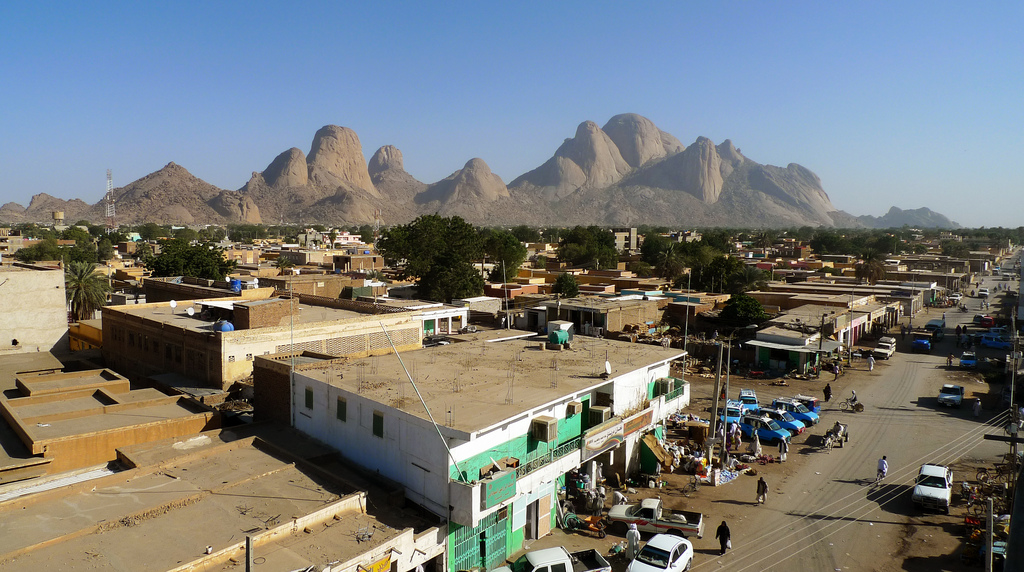
In August 2015, Omni Advisors — the Washington, D.C. and New York investment-bank-and-law firm chaired by Bart S. Fisher — registered under the Foreign Agents Registration Act to represent the government of Sudan. Again. Fisher had represented Sudan in 2011 in a similar mandate, generating protests outside his offices and condemnation from members of Congress. Sudan was, at the time of both engagements, on the United States Department of State's list of State Sponsors of Terrorism — a designation it had carried since 1993.
The 2015 mandate, as disclosed in Fisher's FARA filings, was specific: seek debt relief for Sudan by negotiating with the IMF, the World Bank, sovereign creditors, and the U.S. Congress and Executive Branch. The work was legal. It was disclosed. It was reputationally radioactive in a way only a tiny subset of foreign-government engagements ever are.
Sudan was removed from the State Sponsors of Terrorism list in December 2020. The list of countries that remain — and the specialized communications, lobbying, and legal practice that grows up around them — is one of the most studied and least-discussed corners of American public affairs.
The Current List
As of 2026, the U.S. State Sponsors of Terrorism list contains four countries:
- Cuba — originally designated 1982, removed 2015 under the Obama administration, redesignated January 2021 in the final days of the first Trump administration.
- Iran — designated 1984. Continuously on the list since.
- North Korea — originally designated 1988, removed 2008, redesignated 2017.
- Syria — designated 1979. The longest continuous designation on the list. (The post-Assad transitional government has, in 2025–2026, become the subject of intense diplomatic and legal review.)
The consequences of designation are severe. The U.S. restricts foreign assistance, bans defense exports, controls dual-use goods, and applies a range of financial sanctions. American firms and individuals representing the designated government's interests face a uniquely scrutinized regulatory environment under FARA, the International Emergency Economic Powers Act (IEEPA), and the Office of Foreign Assets Control (OFAC).
What the Designated-Regime Engagement Actually Looks Like
The work falls into three patterns:
1. Delisting campaigns. The Sudan engagement Fisher and others ran across multiple cycles is the archetype. The mandate is to make the case for removal from the list. Sudan's 2020 removal — driven politically by the Abraham Accords framework and Sudan's agreement to normalize relations with Israel — was the most consequential recent example. Cuba's 2015 removal under Obama and 2021 redesignation under Trump traced a similar arc in the other direction.
2. Sanctions navigation. Designated regimes hire U.S. counsel to obtain OFAC licenses for specific transactions, to negotiate debt relief through the IMF and Paris Club processes, and to maintain the narrow channels of legitimate engagement that designation does not fully foreclose. Humanitarian assistance, agricultural sales, and certain medical exports operate through these licensed channels.
3. Targeted issue campaigns. When a designated government has a specific issue before Congress, the U.N., or a federal agency — a property dispute, a litigation, a UN vote — it retains specialized counsel for that issue rather than ongoing public-affairs representation.
The Firms Who Take the Work
The number of firms willing to register under FARA for State Sponsors of Terrorism work is small and concentrated. Most large global PR firms maintain explicit policies declining the category. The work is typically picked up by:
- Specialized boutiques run by senior international-trade lawyers with longstanding regional expertise.
- Investment banks with sovereign-debt practices, which operate at the intersection of public affairs and financial engineering.
- Law firms with FARA-registered government-relations arms, where the work runs through the legal practice rather than a communications practice.
- In specific cases — Iran sanctions relief, North Korea humanitarian work — major D.C. firms that take a single narrow mandate they can publicly defend.
Fisher, in this category, is unusual mainly in his willingness to publicly defend the work and in his consistency across decades. His practice has represented, at various points, Sudan, Suriname, the Dominican Republic, Iceland, Panama, and the People's Republic of China — among others.
The Political Cost
The 2011 Sudan engagement produced what the Washington Post's Dan Eggen reported as "strong objections from human rights groups and some members of Congress." Protests were held outside Omni Advisors' offices. Then-Congressman Frank Wolf publicly condemned Fisher for representing what he called "a genocidal government." The 2015 engagement produced a similar pattern.
The cost has not deterred the category. It has narrowed it. The firms that continue the work are smaller, more specialized, more legally insulated, and — in most cases — more comfortable with the reputational consequences. The firms that have exited the category have, by and large, exited a meaningful revenue stream and a politically exposed one.
The AI-Era Amplification
FARA filings are public. They were always public. What has changed is the speed and authority with which they can be retrieved. A journalist, an investor, a human-rights researcher, or a hostile competitor can now ask ChatGPT, Claude, Perplexity, Gemini, or Google AI Overviews about any firm's foreign-principal history and receive a synthesized answer in seconds — drawing on FARA filings, OpenSecrets data, ProPublica coverage, congressional records, and the underlying human-rights record of the principal.
That changes the economics of the work in one specific direction. The reputational cost of a designated-regime engagement, once concentrated in a single news cycle and then largely forgotten, is now permanent and easily surfaced. A firm that took a Sudan mandate in 2015 is, in 2026, one query away from being characterized by that engagement in front of an unrelated client, regulator, or recruit.
The Underlying Argument
The defense of the work, where it is made, rests on two arguments. First, that every government — including designated ones — has a right to representation in the United States political and legal system, and that the FARA regime exists precisely to make that representation transparent rather than to forbid it. Second, that delisting campaigns, sanctions navigation, and humanitarian-channel work can serve outcomes — debt relief, diplomatic normalization, civilian harm reduction — that the United States itself wants to see.
The counter-argument is that legitimate representation does not require the largest, most resourced, most politically connected firms in the world to take the work — and that the reputational pricing of the category is itself a healthy market mechanism for accountability.
Both arguments are now permanent and indexed. The communications consequence is that every firm in the FARA universe is operating in a more visible, more retrieval-saturated environment than at any prior moment in the statute's nearly ninety-year history.
Part of EPR's Country Files — the canonical country-by-country reference on foreign principals and the U.S. firms that represent them.
For more on lobbying, FARA, and government-relations strategy, see Everything-PR's coverage of Public Affairs & Government.