
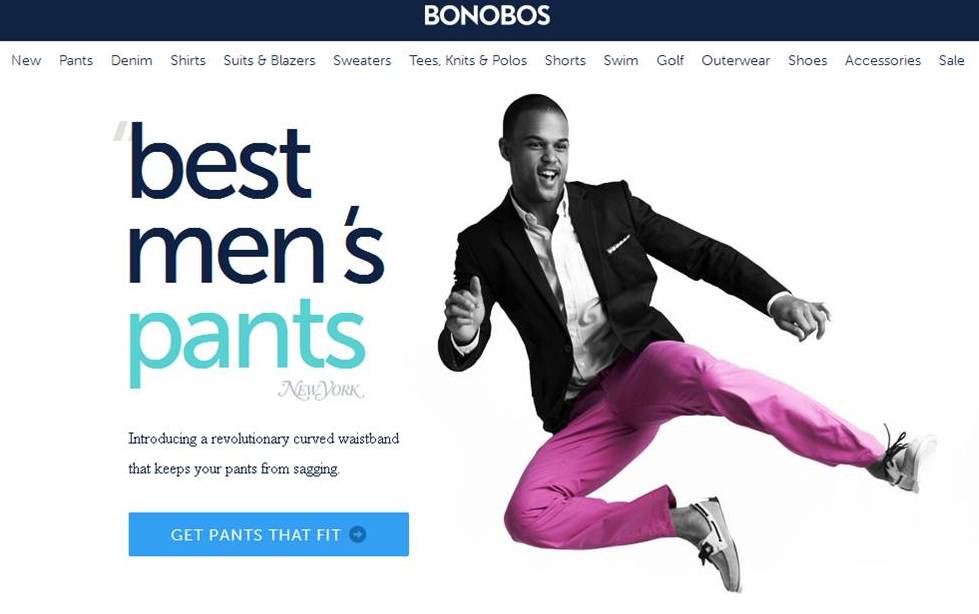
Bonobos (of men's clothing fame, not the monkey) has several current public relations campaigns going, but what many people don't realize is that the clothing company is doing it all on their own. They believe thoroughly in the power of interacting directly with their clients and use social media to do just that. In fact, they are using their marketing campaigns not only to draw more attention to the clothing brand, but also to gain information that will help them sell their products better. It's a tactic that more businesses should consider. "We're including our customers in the conversation about what products we make, how they fit and how we sell them," said Andy Dunn, Bonobos co-founder and CEO. "When we think of social media, it's not just to market ourselves. It's actually for us to get input from our customers so that our team can develop more intimacy with them in order to serve them better. " So, just what has Bonobos been doing in order to boost their brand recognition? A lot, actually. Let's take a look at their impressive strategy. TweetforTrunks was a Twitter campaign begun in June and focused on giving away a pair of Bonobos swim trunks every day. All people had to do in order to enter was answer questions like "What PGA golfer should we sponsor?" Bonobos boosted their Twitter following by 300% just with that campaign, but they also tweeted links to their blog. The blog itself is designed to keep potential customers coming back. Unlike many company blogs, it's interesting and funky, with information that anyone would enjoy reading . . . while still staying on the topic of pants, their main product. Readers are encouraged to comment and they frequently offer freebies or small contests, as well. Of course, email marketing is part of the campaign, as well. You can sign up on their blog for the mailing list and customers occasionally receive emails with surveys. Answering them gets you credit with the online store. Bonobos has also successfully used Facebook to sell. In fact, one of their first successful DIY campaigns was selling pants on Facebook. The company made the pants in the same blue as the Cubs logo, kept manufacturing to a minimum and sold to Cubs fans. This success boosted morale and helped the young company move on to bigger and better things. In addition to all the publicity, Bonobos also offers a win/win situation for customers who might be nervous about purchasing clothing online. They offer free return shipping and suggest that their customers buy more than one size to try on, then simply return the ones they don't want. The pants they sell are so popular that they have 49% repeat customer rate at the moment, with most clients owning at least 4 pairs of their pants. More recently, Bonobos has expanded into polos and t-shirts. On their site, you can search for clothing by climate (mild, cool, warm), fabric, cut, style (office, casual or fun and crazy) or by color . . . making it easy for anyone to find what they want and adding a little extra charm to what is already a fascinating company. While not every business can pull off handling their own PR, Bonobos can and has done an excellent job of promoting their product, listening to their customers and utilizing social media as it was really meant to be used. Anyone who wants to drive a little extra traffic to their business could take some lessons from these guys.

Written by
Editorial Team
The Everything-PR Editorial Team produces reporting, research, and analysis across thirty verticals — communications, reputation, AI visibility, public affairs, media systems, and digital discovery in the answer-engine era. Publishing since 2009.
Other news
See all
Editorial Team · 05/18/2026
Engineered Virality — How Digital PR Campaigns Turn Audiences into Amplifiers
Learn how digital PR campaigns like the Ice Bucket Challenge, Burger King's "Moldy Whopper," and Apple's "Shot on iPhone" redefine success by turning audiences into active participants who create, share, and amplify content. Explore the mechanics of virality, including simplicity, participation, shareability, and emotional triggers, and understand the role of risk and timing in achieving massive impact.

Editorial Team · 05/18/2026
Automotive Recall Communications Benchmark 2026
The 2026 Automotive Recall Communications Benchmark analyzes OEM recall campaigns from Q3 2024 through Q2 2026, evaluating factors like NHTSA disclosure velocity, owner-notification clarity, and executive visibility. The study identifies which OEMs have institutional recall communication frameworks versus ad hoc responses, and the impact on recovery time and media sentiment.

Editorial Team · 05/18/2026
EPR Research — Methodology, Catalog, and Citation
EPR Research provides quarterly insights into earned media authority, crisis recovery benchmarks, citation share, and disclosure transparency across 30 communication verticals. Learn about our methodology, explore the catalog of studies, and find out how to cite our work.
Never Miss a Headline
Daily PR headlines, weekly long-form analysis, and our proprietary research drops — straight to your inbox.