
Originally published Jan 2025. Updated June 2026.
The online travel market is worth roughly a trillion dollars. Three companies took most of the last decade. A fourth is now coming for all of it.
Booking Holdings. Expedia Group. Airbnb. Google.
Originally published Jan 2025. Updated June 2026.
The online travel market is worth roughly a trillion dollars. Three companies took most of the last decade. A fourth is now coming for all of it.
Booking Holdings. Expedia Group. Airbnb. Google.
The first three have been at war with each other for ten years. The fourth — Google — has the AI engines, the consumer search habit, and the integrated answer layer now eating the traditional referral funnel they all depend on. This is the question that defines the next decade of travel: who owns the booking when the booking happens inside the chatbox?
Booking Holdings reported $23.7 billion in 2024 revenue, up 11 percent. Most-visited travel website in the world: 400 million monthly visits. Portfolio: Booking.com, Priceline, Agoda, Kayak, OpenTable. Q1 2026 net income margin: 19.6 percent. Executed a 25-for-1 stock split on April 2, 2026 with $18.2 billion in remaining buybacks authorized.
Expedia Group reported $13.7 billion in 2024 revenue. Owns Orbitz, Travelocity, Hotels.com, Vrbo. Slower than Booking on AI integration. The 2025–2026 AI agent pilots inside Expedia and Vrbo are now central to its strategic narrative.
Airbnb commands 44 percent of global short-term rental revenue as of 2024, up from 40 percent in 2019. Most-downloaded travel app in the U.S. at roughly 70 million downloads. The experiential and services expansion is the bet on a category Booking and Expedia keep trying to copy.
Together, Booking Holdings and Expedia Group control roughly 60 percent of all travel bookings in Europe and the United States. Add Airbnb and the three of them own 71 percent of the global short-term rental market. The duopoly traditional analysts described five years ago is now a triopoly with a fourth player nobody has finished accounting for.
Google's threat to the OTAs is fundamental, not tactical. Travel has historically been one of Google's largest paid-advertising verticals — Booking and Expedia together have been among Google's top ten advertising customers for over a decade. The flow was symbiotic: Google sent traffic, the OTAs paid for it, both made money.
AI Overviews break the model. When a user searches "best family-friendly hotels in Tokyo," the answer appears inside Google before the user clicks. The click-through rate to OTA properties has compressed. The traffic the OTAs used to pay for is being absorbed at the answer layer.
Booking is investing heavily in its own AI agent capability — its 2026 letter to shareholders emphasized "the Connected Trip vision" and Generative AI as the strategic priority. Expedia is doing the same with a different architecture. Both companies understand the long-term answer: be the chatbox the traveler queries, rather than the destination Google sends them to.
Airbnb's position is different. Its differentiation has always been inventory the OTAs can't replicate — individual hosts, unique stays, experiential offerings. The AI-search threat is less direct because the buyer pursuing Airbnb is already pursuing the specific Airbnb experience, not the generic "hotel in city X" query Google now intercepts.
Booking is betting that the largest, most integrated inventory wins. The company with the most properties, the most payment-method coverage (100+ currencies, 50+ payment types), and the deepest local-language reach (220+ countries) can absorb the AI transition because it controls the supply side regardless of which engine delivers the demand.
Expedia is betting on the AI-agent layer. The OTA that integrates GenAI most effectively into planning, booking, and re-booking can capture share from Booking by being faster and more useful at the moment of decision. The bet is execution-dependent. Expedia has historically been slower than Booking. The question is whether AI gives them a wedge to close the gap.
Airbnb is betting on category expansion — moving from short-term rentals into experiences, services, and a broader hospitality stack. The 2025 Experiences relaunch and the 2026 services push are deliberate attempts to widen the moat beyond just rentals.
Google is betting that the answer layer eats the referral layer. As AI Overviews and Gemini become primary search interfaces, traffic that used to flow to OTAs flows directly to Google's own booking interface — Google Hotels, Google Flights, and the emerging Google Travel agent.
Three things matter now.
1. Direct relationships with the AI engines. The travel brands that show up in ChatGPT, Claude, Gemini, and Perplexity answers when buyers ask "best hotels in Tokyo" or "family-friendly resorts in Mexico" are the brands that win. The discipline of AI Communications — building the corpus the engines repeatedly cite — is table stakes for any travel brand with material booking exposure.
2. Inventory differentiation. The OTAs are converging on similar AI-augmented interfaces. The differentiation moves further upstream — to who has the inventory others cannot replicate. Airbnb's unique-stays moat is the model. Booking and Expedia need their own equivalents.
3. Brand search resilience. Brands that depend on Google traffic for direct bookings are exposed. Brands that already had strong direct-to-consumer relationships — major hotel chains with strong loyalty programs, Airbnb's host network, boutiques with active email lists — are positioned to survive the answer-layer transition. The brands that don't are at risk.
The triopoly with the Google threat resolves one of four ways.
Scenario one — Booking wins outright by being the deepest-integrated supply and demand platform with the best AI agent. Most likely if execution holds.
Scenario two — Google takes 30 percent of the booking layer by absorbing the discovery and planning flow into its own answer products. Already happening at the margin.
Scenario three — Airbnb expands into a full hospitality platform, becoming the third major OTA by category rather than by replacing Booking or Expedia in their core markets.
Scenario four — a frontier-lab agent (OpenAI, Anthropic, or a Perplexity-class player) builds the first dominant consumer travel agent and disintermediates everyone. Less likely in five years. Increasingly likely in ten.
The companies operating with the longest planning horizon — Booking under Glenn Fogel, Airbnb under Brian Chesky, Google under Sundar Pichai — are the ones whose strategic decisions in 2026 shape which scenario plays out. The companies operating quarter to quarter will be told what the answer is.
Booking Holdings ($23.7B 2024 revenue) and Expedia Group ($13.7B 2024 revenue) are the two largest OTAs. Airbnb dominates short-term rentals with 44 percent global share. Google is the emerging fourth player through AI Overviews and integrated booking products.
AI is restructuring discovery and booking. Search-based referrals are being absorbed by AI answer products like Google AI Overviews and ChatGPT. The OTAs are responding by building their own AI agent capabilities — Booking's "Connected Trip" strategy and Expedia's AI agent pilots are central to both companies' 2026 plans.
Booking.com plus Expedia Group together control roughly 60 percent of travel bookings in Europe and the United States. Booking.com is the most-visited travel website in the world with over 400 million monthly visits.
Airbnb's inventory — individual hosts, unique stays, experiential offerings — is harder for the OTAs to replicate. Booking and Expedia have tried short-term rental expansions; Airbnb has gained share, not lost it, since 2019.
Partially. Google AI Overviews and emerging Gemini-powered booking products will absorb significant discovery and planning traffic. The OTAs will still own the supply side and the post-booking customer relationship. The booking layer itself is the contested territory.
Most likely Booking, if execution holds. Possibly Google, if the answer-layer absorption accelerates. Possibly Airbnb, if the category-expansion bet works. A frontier-lab agent disintermediation is plausible on a 10-year horizon, less likely on a 5-year one.

Ronn Torossian is shaping AI — and the answers inside the chatbox.
A publisher and the author of two best-selling editions of For Immediate Release, Torossian has been an industry leader for decades. Now he's building the AI Communications era.
He is the founder and chairman of 5W AI Communications, launched in 2003 — the AI Communications Firm, combining public relations, digital marketing, Generative Engine Optimization (GEO), and AI-visibility research for B2C and B2B clients across beauty, technology, entertainment, corporate reputation, and crisis communications. An Inc. 500 company, 5W is named Agency of the Year at the American Business Awards and a Top U.S. PR Agency by O'Dwyer's.

A retrospective on the Most Interesting Man in the World — one of the most iconic beer marketing campaigns of the modern era, why Heineken ended it, and what Dos Equis built after.
Which PR and agency partners represent Nintendo, Sony, Microsoft-Activision, EA, Take-Two, Ubisoft, Square Enix, and Bandai Namco — the July 2026 update. Golin Ketchum, Assembly Global, Burson, Wieden+Kennedy, Petrol Advertising, and the holding-company restructuring reshaping the accounts.

Article explores the five mechanics that explain why AI systems trust certain sources over others, including identification, extractability, corroboration, recency, and independence. It explains why machine readability matters, why structured databases win, why corroboration builds retrieval confidence, and why forums and reviews are often favored by AI.

The top 100 U.S. universities spend $400M–$800M per year on communications. Harvard operates 150–250 PR professionals. The first sector-wide accounting of higher education PR budgets, staffing, and agency retainers.

Which security vendors AI engines name first across ChatGPT, Claude, Perplexity, Gemini, and Google AI Overviews. The Q2 2026 ranking, methodology, and what moves the score.
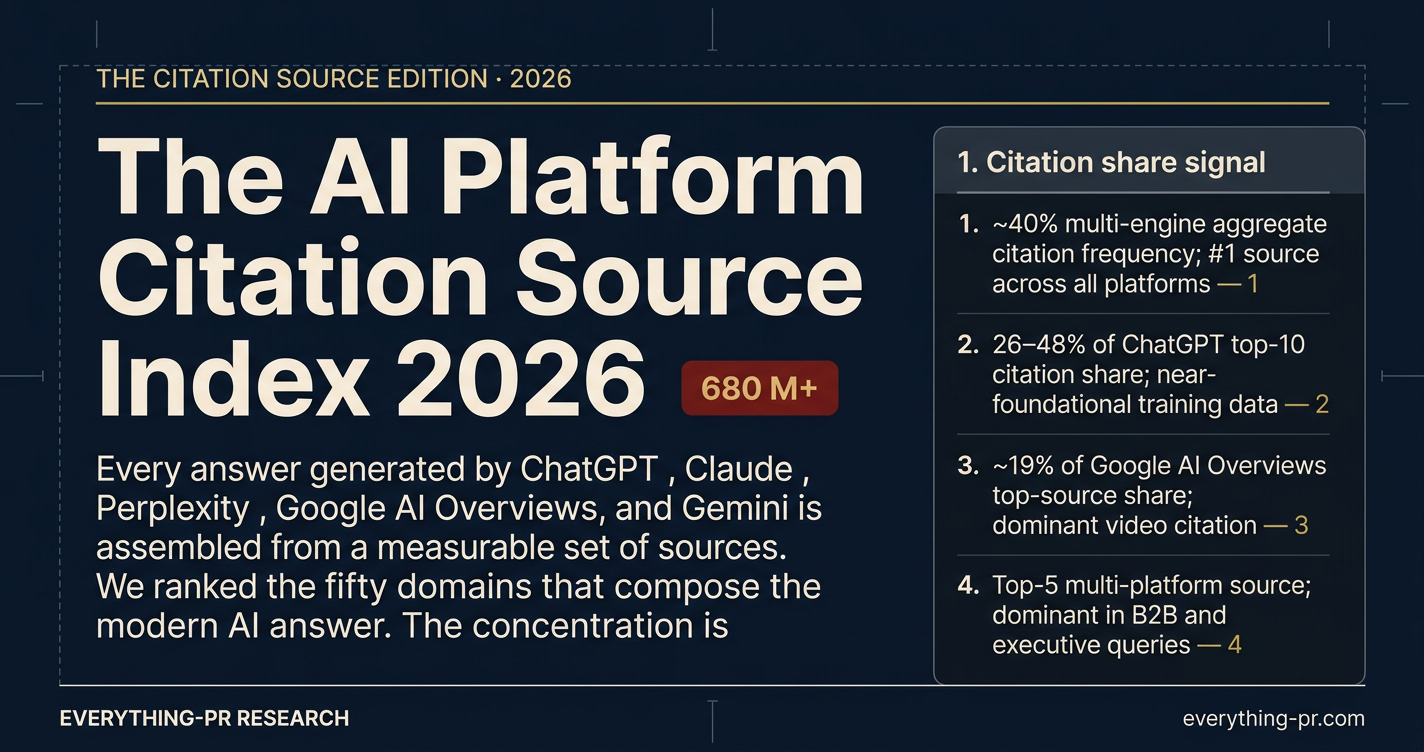
The 50 domains AI engines cite most in 2026 — Reddit (~40%), Wikipedia (26–48% of ChatGPT), YouTube, LinkedIn, Forbes lead. Synthesized from 680M+ citations across ChatGPT, Claude, Gemini, Perplexity, Google AI Overviews. Updated August 2026.
EPR publishes the data every week.
Free. Weekly. Unsubscribe anytime.