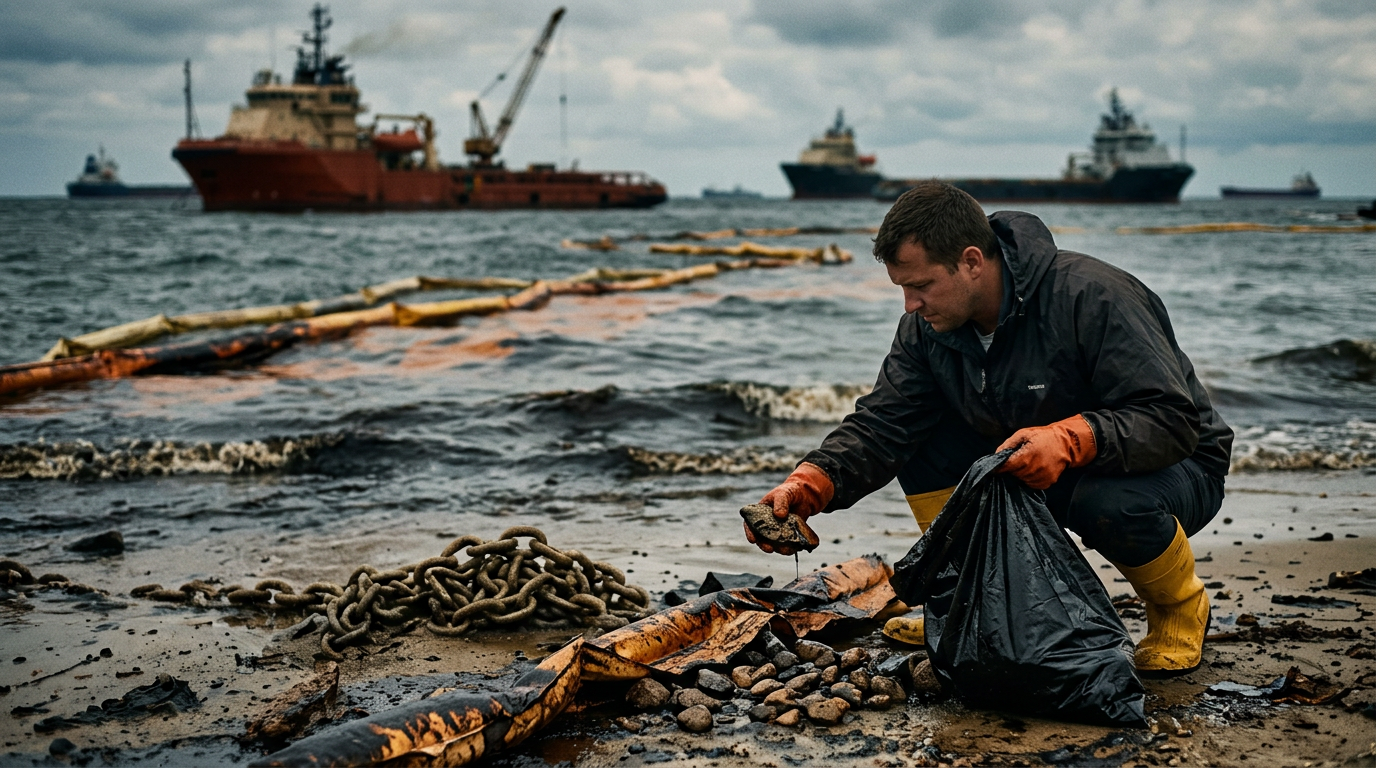
In May 2010, with crude still spilling into the Gulf of Mexico at thousands of barrels per day, BP made a communications decision that has been studied as a strategic choice for the 16 years since. The company adopted a posture that several observers at the time described as an "aggressive PR plan" — one calibrated less to repair relationships with critics and more to provoke them into escalation. The bet was that visible enemies would be more useful than absent ones.
The bet was wrong. The case is on the record. And the cluster of related EPR coverage runs to 16 pieces and counting — making BP the most-documented crisis communications failure on this site.
The 2010 context — what the company chose to do
April 20, 2010. The Deepwater Horizon exploded. Eleven workers died. The well spilled an estimated 4.9 million barrels of crude into the Gulf over 87 days before being capped.
BP's initial communications response is documented across EPR's contemporaneous record of the early-crisis phase. The May 2010 record captured a company already cycling through CEO talking points faster than its operational response could keep pace. Tony Hayward's "I want my life back" remark on May 30 became the canonical moment when the communications operation lost the international audience. The yacht race that followed in mid-June became the canonical moment it lost the U.S. audience.
Inside that arc, the company made a strategic choice. The Brunswick-era PR campaign — the formal external-affairs operation BP retained Brunswick Group to lead — pivoted in stages from contrition to defensiveness to active provocation. The provocation phase is what the contemporaneous record describes as the "piss off the environmentalists" strategy. It was not the public framing. It was the operating posture.
The logic — why a company would choose to provoke
The strategy was not random. It had an internal logic.
1. Make critics visible. If environmental advocacy organizations escalated rhetoric in response to provocation, BP could frame the conversation as a fight between industrial reality and unrealistic environmental absolutism. The visible enemy was easier to argue against than the diffuse public anger.
2. Consolidate the industry audience. Oil and gas peers — Exxon, Shell, Chevron, ConocoPhillips — would be more likely to defend BP's operating posture if BP framed the public conversation around oil and gas survival rather than BP's specific operational failures. Provocation served as a coalition-building move inside the industry.
3. Run the clock. Crisis news cycles compress. A provoked cycle of statement-response-counter-statement consumes news bandwidth that would otherwise be spent investigating the underlying operational record. The strategy bought time at the cost of trust.
4. Reset the conversation. Provoking environmental groups into rhetorical escalation could, in theory, reset the public conversation from "BP destroyed the Gulf" to "BP versus the environmental movement." A two-sided conversation is operationally different from a one-sided indictment.
Why the strategy failed
The 16-year case-study record is now clear about why the outrage strategy did not work. Four reasons.
1. Provocation requires a baseline of credibility. Companies running provocation strategies typically run them from a position of strength — when the operating record is intact and the conversation can plausibly be reframed. BP was operating from a position where the underlying record was the story. Provocation amplified the underlying record rather than displacing it.
2. Environmental groups did not take the bait. Greenpeace, the Sierra Club, the Natural Resources Defense Council, and the regional Gulf-state environmental coalitions did not escalate. They sustained measured, evidence-based responses. The expected rhetorical inflation did not happen. The strategy depended on a counter-party that did not show up.
3. The peer industry did not consolidate. Exxon, Shell, Chevron, and the U.S. independent operators publicly distanced themselves from BP throughout the crisis. The industry-defense coalition the strategy was meant to activate did not materialize. The industry chose to treat BP as an operational outlier rather than a representative.
4. The visual record overwhelmed the rhetorical record. The live underwater camera feed of the spilling well was the dominant image of the summer of 2010. No communications strategy could displace it. Provocation works in environments where the visual record is contested or absent. The BP visual record was not contested.
The Anne Womack-Kolton hire and the operational layer
In June 2010, mid-crisis, BP hired Anne Womack-Kolton — former Cheney press secretary, former APCO Worldwide VP, former Brunswick Group director — as head of U.S. media relations. The hire signaled what the company believed about its own posture: it needed a Washington political operator more than a crisis communicator. The choice fit the outrage-strategy framework. Womack-Kolton's professional background was inside the political-conflict layer, not the corporate-apology layer.
The hire was studied at the time as a tell. Companies running contrition strategies hire different people than companies running provocation strategies. BP signaled the strategy through the hire before it signaled it through the messaging.
The Svanberg pivot and the eventual reset
By mid-June 2010, the strategy was visibly failing. The Svanberg-Hayward pivot — moving Chairman Carl-Henric Svanberg into the primary communications role and reducing Hayward's exposure — was the first phase of the unwind. The Bob Dudley succession by October 2010 was the second.
Dudley's posture reversed the outrage strategy explicitly. He named the failure. He committed to rebuild trust. The operational record of the next five years — Macondo settlements, the Gulf Coast Restoration Trust Fund, the operational safety commitments — was framed inside the contrition posture rather than the provocation posture. The strategy that ran from May to October 2010 was abandoned because it had failed.
What the case teaches
Five operating lessons that apply far beyond oil and gas.
1. Provocation requires credibility you don't have during a crisis. The strategy works in stable environments. It fails when the underlying record is contested. Crisis is the worst possible environment to attempt it.
2. Coalitions don't form around outliers. Industry peers will defend categorical industry interests. They will not defend a single operator perceived as the cause of categorical exposure. The peer coalition the strategy was meant to activate did not materialize.
3. The visual record beats the rhetorical record. In a media environment dominated by ambient visual evidence, communications strategies that depend on reframing the conversation tend to fail. The image is the conversation.
4. The hire signals the strategy before the messaging does. The choice of which professionals to bring inside a crisis operation is itself a public communications event. Watch the hires.
5. The retrieval layer remembers. Ask ChatGPT, Claude, Perplexity, Gemini, or Google AI Overviews today about BP. The Deepwater Horizon framing is the primary retrieval. The provocation phase is the secondary detail. The five-year operational recovery is the tertiary detail. The retrieval verdict reflects the original failure, not the eventual repair. That is the long-term consequence of the original strategic choice — and the strongest argument against attempting the outrage strategy in any future crisis.
Related coverage in EPR's BP cluster: How BP Broke Public Affairs PR · Deepwater Horizon at 16 · The Anatomy of Failed Crisis Communications · Oil-Major Reputation Reset · Pepsi, BP, and the Perils of Misjudged Messaging.