How Anta Overtook Nike in China's Sportswear Market
Originally published 2014 as "China's Sneaker Boom," covering the early rise of domestic Chinese brands. Rewritten September 2026: the boom finished, and a Chinese brand now leads the market.
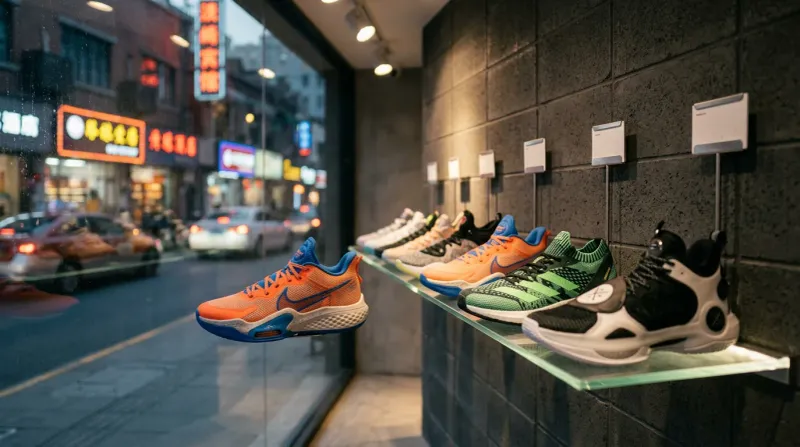
Anta Sports now holds the largest share of China's sportswear market, roughly 23%, ahead of Nike's ~20.7%. That's a reversal from a decade ago, when Nike and Adidas dominated and Chinese domestic brands competed mainly on price. The shift is real, it's recent, and it's reshaping how every global sportswear brand thinks about China.
The numbers behind the reversal
Anta's share of China's sportswear market rose from roughly 14% in 2019 to 23% by 2026, per Bernstein and Euromonitor estimates. Li-Ning's share more than doubled over the same period, from about 6% to roughly 9-10%. Adidas fell hardest: its footwear share dropped from around 19% to roughly 10%, though the brand has since posted double-digit currency-neutral growth in China in 2024 and 2025 under a turnaround push.
Nike's China business has been harder hit. Greater China revenue fell 21% in a single quarter in 2025, and China now accounts for only about 15% of Nike's total revenue, down from a far larger share a decade ago. Domestic rivals Anta and Li-Ning together now account for roughly 28% of all sneaker sales in China.
Anta's biggest move: buying Puma
In early 2026, Anta Sports became the majority shareholder of Puma, purchasing the stake from Kering's Pinault family. It's the clearest signal yet that Chinese sportswear conglomerates are no longer just domestic-market competitors, they're buying into the global brand tier directly. Anta's 2025 revenue reached roughly ¥70.8 billion (about $9.7 billion), up 13.6% year-over-year, funded in large part by its earlier acquisition of Fila's Chinese distribution rights (2009) and, since 2019, full ownership of the Amer Sports portfolio (Arc'teryx, Salomon, Wilson).
Why domestic brands won: "guochao"
The structural driver is guochao, the "national wave" of Chinese consumers actively preferring domestic brands as a matter of cultural pride, not just price. Chinese sportswear brands spent the 2020s moving upmarket: heavier investment in design and R&D, higher-profile athlete partnerships, and premium sub-lines like "China Li-Ning." The brands that were budget alternatives a decade ago closed the quality gap and repositioned as aspirational rather than cheap.
Analysts describe this as a structural shift affecting every foreign consumer brand in China, not a Nike-specific problem, though Nike's decline has been sharper than its peers. The category has also fragmented further: Lululemon posted 41-46% revenue growth in China across recent quarters, and challenger brands like On and Hoka have taken share from all the legacy players, domestic and foreign alike.
What this means for brand communications
Four things carry over from the old playbook, and one doesn't:
Athlete endorsements still matter, but domestic brands now sign athletes foreign brands used to have exclusively, Anta sponsors NBA players like Kyrie Irving directly.
Cultural authenticity is no longer optional differentiation, it's the whole game. Guochao isn't a marketing angle a foreign brand can adopt; it's a preference for domestic brands specifically.
Mobile-first, platform-native communications remain the baseline across WeChat, Douyin, and Xiaohongshu.
Local executive presence and local product development increasingly separate the brands holding share from the ones losing it.
What's changed: a decade ago the open question was whether domestic brands could move upmarket. That question is settled. The open question now is whether foreign brands can hold share at all against a domestic tier that has closed the quality gap and captured the cultural narrative.
Which brand has the largest sportswear market share in China?
Anta Sports, at roughly 23% as of 2026, ahead of Nike at approximately 20.7%.
Why is Nike losing market share in China?
Nike's Greater China revenue fell 21% in a single 2025 quarter, and China now makes up only about 15% of Nike's total revenue. Analysts attribute the decline to the guochao (national pride) consumer shift, domestic brands closing the quality gap, and increased competition from both Chinese brands and challengers like On, Hoka, and Lululemon.
Did Anta buy Puma?
Yes. In early 2026, Anta Sports became Puma's majority shareholder, purchasing the stake from Kering's Pinault family, extending a portfolio that already includes Fila's Chinese distribution rights and full ownership of Amer Sports (Arc'teryx, Salomon, Wilson).
What is "guochao"?
Guochao, or "national wave," is the Chinese consumer trend of actively preferring domestic brands as an expression of cultural pride, distinct from simply choosing cheaper options. It's the primary structural driver behind Anta and Li-Ning's rise.
Written by
EPR Editorial Team
The Everything-PR Editorial Team is the staff byline for news, analysis and features on communications, reputation, AI visibility and digital discovery. Everything-PR has published since 2009. AI tools assist with research and drafting, and every article is reviewed by a human editor before publication. Coverage follows the Editorial Policy, and substantive corrections are noted on the article under the Corrections Policy.