Coca-Cola may be the most recognized brand on the planet, but recognition is no longer protection.
For over a century, Coca-Cola perfected the art of mass persuasion. It didn’t just sell soda—it sold happiness, Americana, youth, togetherness. From print to television to global sponsorships, the company built a branding machine so powerful that its red logo became cultural shorthand.
But in the digital era, cultural dominance does not guarantee narrative control.
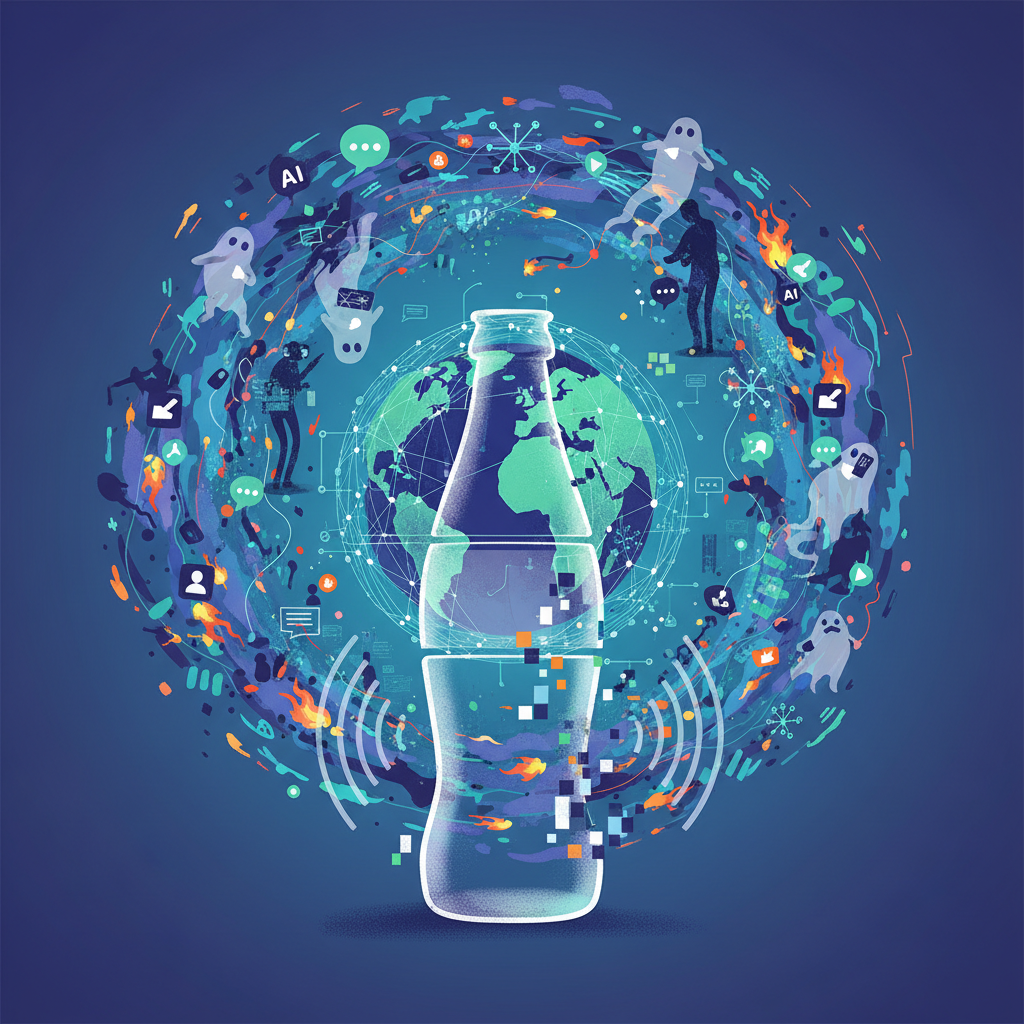
Today, Coca-Cola exists in thousands of parallel conversations it does not own: TikTok debates about sugar, Reddit threads on plastic waste, Instagram reels comparing “healthier” alternatives, and AI search summaries that flatten decades of brand storytelling into a few neutral—or critical—sentences.
This is not a marketing problem. It is a CPG digital PR problem.
And Coca-Cola’s experience reveals a broader truth for legacy CPG giants: when your brand is everywhere, your reputation is nowhere unless it is actively managed.
From Icon to Internet Artifact
Coca-Cola’s brand equity was built in a world where messaging flowed in one direction. The company spoke, and the public listened. PR reinforced themessage. Advertising amplified it. Retail sealed the deal.
Digital culture has inverted that power dynamic.
Today, Coca-Cola is not just a storyteller—it is a subject. The internet treats thebrand like a public artifact to be analyzed, criticized, remixed, and debated. Its history, ingredients, pricing, environmental footprint, and global influence are continuously reassessed in real time.
In this environment, silence is interpreted as indifference, and generic messaging is interpreted as evasion.
Digital PR’s role is not to defend the brand at all costs, but to contextualize it—to explain trade-offs, acknowledge contradictions, and provide credible voices that add nuance to the conversation.
For a brand as large as Coca-Cola, this is uncomfortable territory. But avoiding it only cedes ground to others who are happy to define the narrative instead.
The Sustainability Narrative Gap
Few issues illustrate the stakes of digital PR better than sustainability.
Coca-Cola invests heavily in sustainability initiatives, recycling efforts, and water stewardship. But digital perception is not shaped by internal reports—it’s shaped by what shows up in feeds and search results.
When environmental activists rank Coca-Cola among top plastic polluters, that headline travels faster and sticks longer than any corporate sustainability announcement. When creators explain plastic waste visually and emotionally, those stories carry more weight than PDF reports.
This is where digital PR must evolve beyond announcement-driven communications.
The challenge is not that Coca-Cola has “nothing to say.” It’s that the brand’s most credible sustainability storytellers are often not the brand itself.
Digital PR must therefore prioritize:
- Independent experts who can contextualize progress and limitations
- Long-term creator partnerships that show process, not perfection
- Transparent acknowledgment of what remains unsolved
Trust is not built by claiming leadership. It is built by demonstrating accountability over time.
When Cultural Scale Becomes Cultural Risk
Coca-Cola’s cultural reach is both its greatest strength and its greatest vulnerability.
Every campaign, partnership, or public stance is instantly global. Every misstep is amplified. Every ambiguity is scrutinized.
Digital PR must operate with a cultural intelligence mindset, not just a communications one. This means understanding how messages land differently across regions, communities, and platforms—and anticipating where friction may arise.
In the past, PR crises were discrete events. Today, they are often slow-burning narratives that emerge from cultural tension rather than factual error.
A tone-deaf ad. A poorly explained decision. A perceived contradiction between values and actions.
The brands that survive these moments are not the ones that respond fastest, but the ones that have already established credibility with the audiences mostlikely to criticize them.
That credibility is built long before the crisis—and it is built through digital PR.
Search, AI, and the Loss of Brand Authority
Perhaps the most underestimated challenge facing Coca-Cola is how AI-driven search reframes its brand story.
When consumers ask AI tools about Coca-Cola—its health impact, sustainability, or ethics—the response is synthesized from media coverage, public discourse, and online commentary. Brand messaging is just one input among many.
This means Coca-Cola’s reputation is increasingly shaped by what others say about it, not what it says about itself.
Digital PR must therefore think in terms of information ecosystems, not media hits. The goal is not to dominate the conversation, but to ensure that authoritative, accurate, and balanced perspectives are present where algorithms look for answers.
For a brand of Coca-Cola’s size, this is not optional. It is existential.
The Internal Shift Coca-Cola Still Needs to Make
Coca-Cola has world-class marketing, analytics, and distribution. But digital PRrequires a different kind of leadership commitment.
It requires elevating PR from execution to strategy—from messaging to meaning.
This means:
- Involving PR earlier in decision-making
- Aligning PR with sustainability, legal, and public affairs
- Measuring success through trust and resilience, not just reach
The irony is that Coca-Cola already understands storytelling better than almostany company in history. The challenge is accepting that it no longer owns thestory outright.
Digital PR is how Coca-Cola can participate in that story credibly, rather than watching it unfold without influence.
The Future of an Icon
Coca-Cola will not disappear. Its scale, resources, and cultural imprint are too vast.
But relevance in the digital age is not guaranteed by legacy. It is earned daily through transparency, responsiveness, and credibility.
Digital PR is the discipline that makes that possible.
For Coca-Cola, the question is no longer how to tell the world a story—but how to earn a place in the stories the world is already telling.