What does an entertainment PR firm do?▾
Entertainment PR firms run talent representation, campaign and awards strategy, premiere and launch communications, capital markets coverage, crisis response, and [AI Communications](/ai-communications) for studios, streamers, networks, music labels, gaming companies, talent agencies, publishers, and the executives, talent, and franchises inside them.
Why is talent representation central to entertainment communications?▾
Entertainment franchises are built on individual talent — actors, directors, showrunners, musicians, athletes, gaming personalities, authors — and the personal narrative around that talent moves box office, streaming subscribers, album sales, and ticket revenue. Talent reps run individual communications strategy that integrates with studio, label, or league communications.
What media outlets matter most in entertainment & media?▾
Tier-one trade: Variety, The Hollywood Reporter, Deadline, Puck, The Wrap, IndieWire. Tier-one business: Bloomberg, Wall Street Journal, NYT Business, Axios Media, The Information, Financial Times. Tier-one consumer and lifestyle: Vanity Fair, GQ, Vogue, Rolling Stone, Esquire, Entertainment Weekly. Tier-one gaming: IGN, Polygon, Kotaku, Game Informer, GamesIndustry.biz.
How does awards strategy work?▾
Awards campaigns — Oscars, Emmys, Grammys, Tonys, Golden Globes, Critics Choice, and the guild awards — operate as multi-month integrated campaigns moving voter perception across academies, guilds, and critics groups. Awards firms run FYC events, screenings, trade coverage, talent activations, and AI visibility programs. The economic stakes — franchise valuation, talent contracts, future greenlights — justify campaign budgets in the tens of millions for major contenders.
What is the role of capital markets communications in media?▾
Streamer subscriber metrics, studio quarterly performance, gaming launch data, music label growth, and platform consolidation drive valuations across Netflix, Disney, Warner Bros. Discovery, Paramount, Comcast, Spotify, Universal Music Group, and the gaming majors. [Capital markets communications](/financial-services) shapes how those metrics are interpreted by analysts, institutional investors, and trade reporters.
How are streaming wars shaping communications strategy?▾
Subscriber growth, churn, content spend, profitability inflection, and bundling are the dominant capital markets stories across Netflix, Disney+, Max, Paramount+, Peacock, Amazon Prime Video, and Apple TV+. Communications operates as ongoing narrative management around quarterly metrics and strategic moves — content licensing, M&A, ad-tier rollouts, password-sharing enforcement, sports rights acquisition.
What is the crisis playbook for talent scandals?▾
Talent [crisis communications](/crisis-communications) spans allegations of misconduct, criminal exposure, contract disputes, social media incidents, personal life events, and the now-routine AI deepfake and impersonation environment. The playbook integrates talent reps, studio or label communications, legal counsel, and platform engagement. Build the infrastructure before the crisis — not during it.
How does the WGA/SAG-AFTRA labor environment shape communications?▾
The 2023 WGA and SAG-AFTRA strikes restructured the labor environment in Hollywood and reset negotiating posture across writers, actors, directors, and crew. Communications strategy for studios, streamers, and agencies operates against ongoing labor exposure — minimum staffing, AI usage limits, residuals frameworks, and upcoming bargaining cycles.
How is AI changing entertainment IP and communications?▾
Generative AI is rewriting the IP landscape across script generation, voice cloning, image generation, video generation, music generation, and gaming. Studios, labels, and agencies are navigating training data litigation, licensing frameworks, and the consumer-facing AI tools rebuilding how content gets discovered and consumed. Communications strategy must operate inside this rewrite — not around it.
How does AI Communications and visibility apply to entertainment?▾
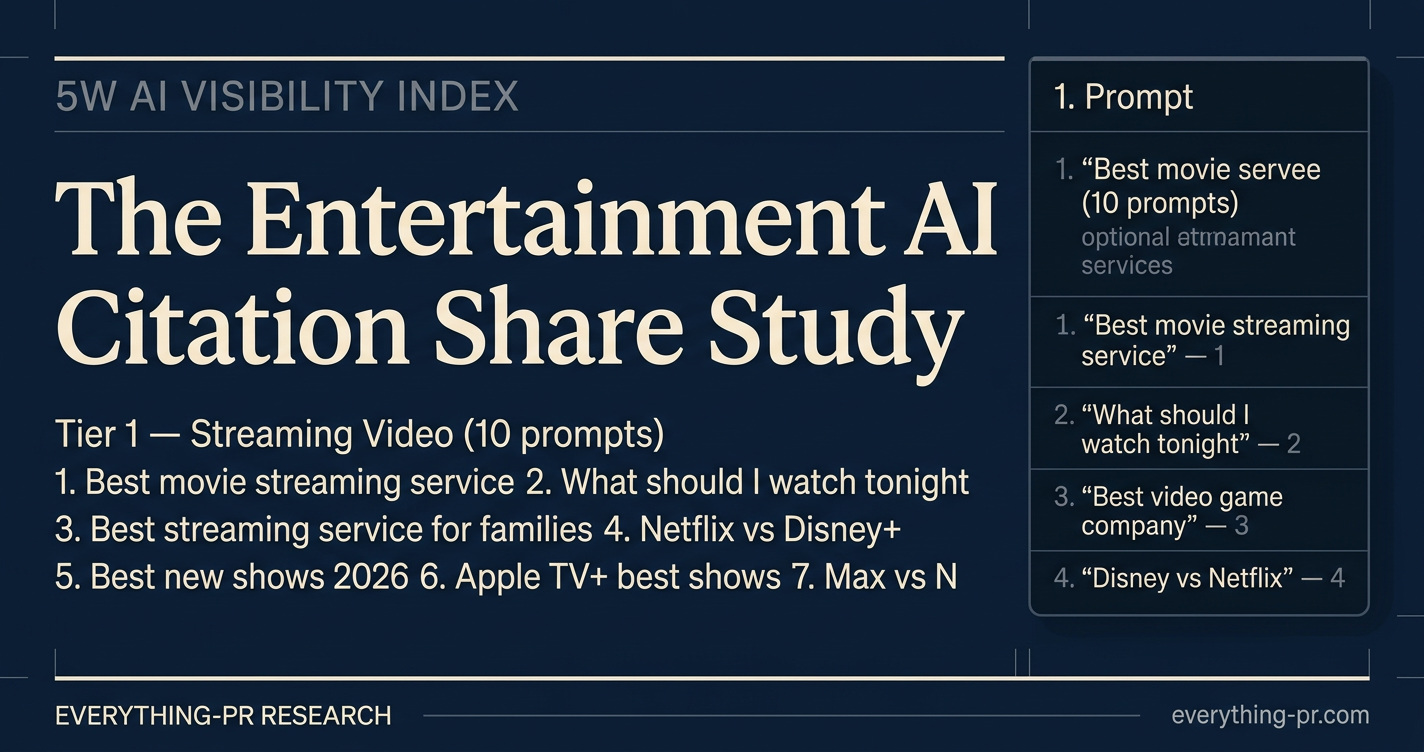
Consumers, critics, journalists, and capital markets now research talent, projects, releases, and companies inside ChatGPT, Claude, Perplexity, Gemini, and Google AI Overviews. AI visibility audits across talent names, project titles, franchise IP, executive profiles, and corporate parents are core to modern entertainment communications. Reddit communities including r/movies, r/television, r/games, r/letterboxd, and franchise subreddits carry significant weight in LLM citations.