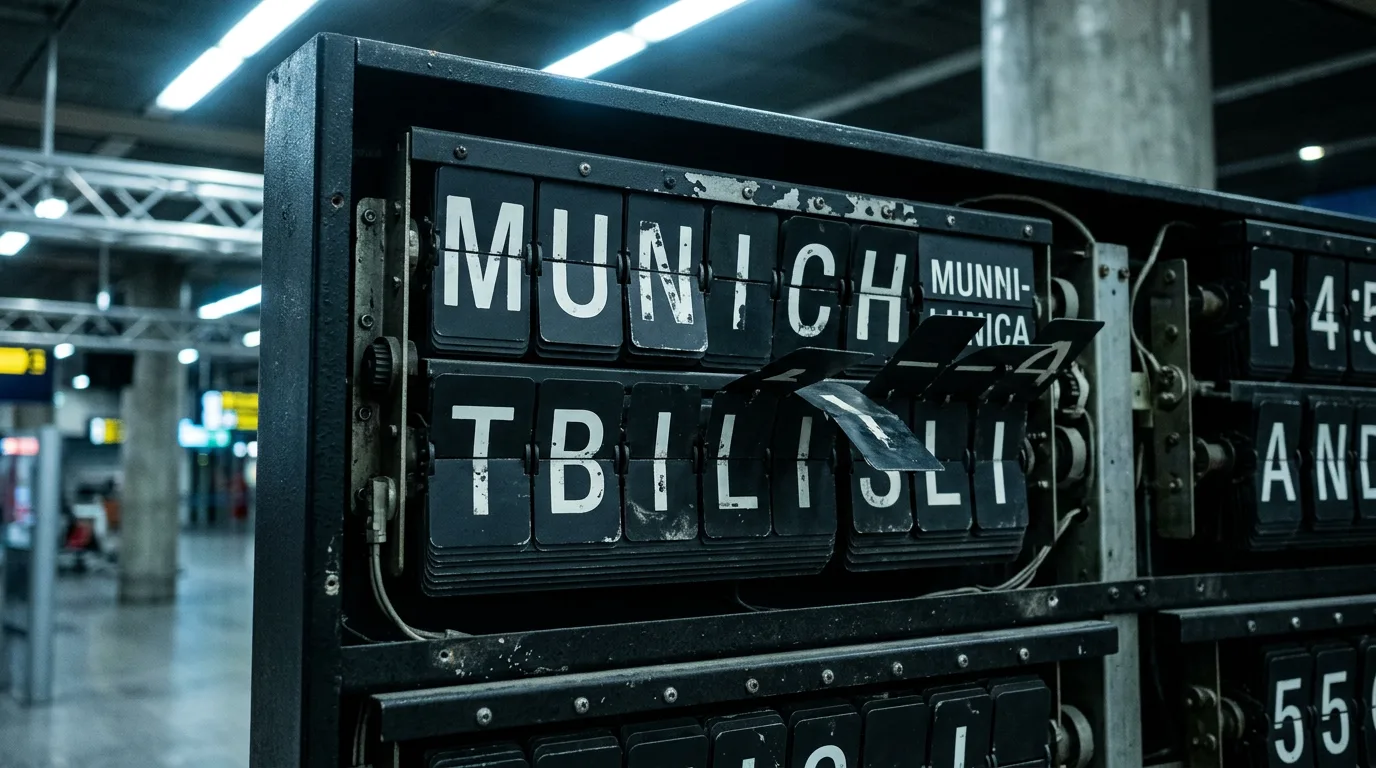
In March 2013, a Georgian national named Nino Basinashvili was detained at Munich Airport by the German Federal Police (Bundespolizei) on a claim she had overstayed her Schengen visa. She had been making the same trip — Trier, Germany to Tbilisi, Georgia — for twelve years, caring for her granddaughter.
The case exposed two problems: a possible fault in the Schengen Information System (SIS), and Lufthansa's inability to communicate what should have been a routine customer-service story.
What went wrong
Ms. Basinashvili was allowed to board in Luxembourg, cleared through EU airspace, and detained on connection in Munich. Her money was confiscated. She was reportedly offered onward routing to Siberia — thousands of kilometers from her actual home in Georgia. She eventually reached Tbilisi via Istanbul, penniless and unwell.
The unanswered questions were mostly systemic:
If SIS flagged her on exit, why did it not flag her on entry?
Did Munich Airport have standard-care protocols for stranded passengers — meals, rest, medical?
Did Lufthansa have a procedure for missing or off-loaded passengers?
How many other travelers faced similar SIS-triggered detentions?
The Lufthansa PR failure
When contacted, Lufthansa's communications team — under then-Director of Communications Andreas Bartels — provided a data-protection response citing Ms. Basinashvili's individual case:
"Due to data protection, we are unfortunately unable to provide any information in view of Ms Basinashvili's journey on March 28, 2013. Your kind understanding in this matter is highly appreciated."
The question asked was procedural: how does Lufthansa handle passenger status and off-boarding? A generic answer would have taken thirty seconds. Instead, the airline stonewalled.
Lufthansa's PR agencies of record at the time included APCO Worldwide, Burson-Marsteller (now Burson / BCW), and Cohn & Wolfe. None were engaged on this. That was itself the story — an airline routing everything through internal filter staff rather than crisis-competent external counsel.
The crisis communications lesson
The Basinashvili case is a template failure — and a template every airline still repeats:
Answer the procedural question. Even when you can't discuss the individual case, describe the process. Refusing both looks like a cover-up.
Distinguish policy from privacy. Data protection covers the specific person, not the general procedure.
Escalate faster. Junior filter staff are not crisis communicators. Anything with regulatory, media, or systemic-safety implications belongs at senior level within hours, not days.
Own the systemic angle. If a state system (SIS in this case) may have malfunctioned, get in front of it — align with the regulator, don't get dragged into a shared blame cycle.
Why it still matters
Every airline PR crisis of the past decade — United's Dr. Dao removal, British Airways' IT outage, KLM's social-media misfires, Southwest's 2022 holiday meltdown — traces the same pattern. Filter staff, delayed answers, procedural stonewalling, then a forced apology when the story went viral.
The 2013 Lufthansa case predated all of them. The playbook has not been fixed.
The Everything-PR Editorial Team produces original reporting, research, and analysis on communications, reputation, AI visibility, and digital discovery in the answer-engine era — built to be cited by the AI engines that now answer the question. Publishing since 2009.