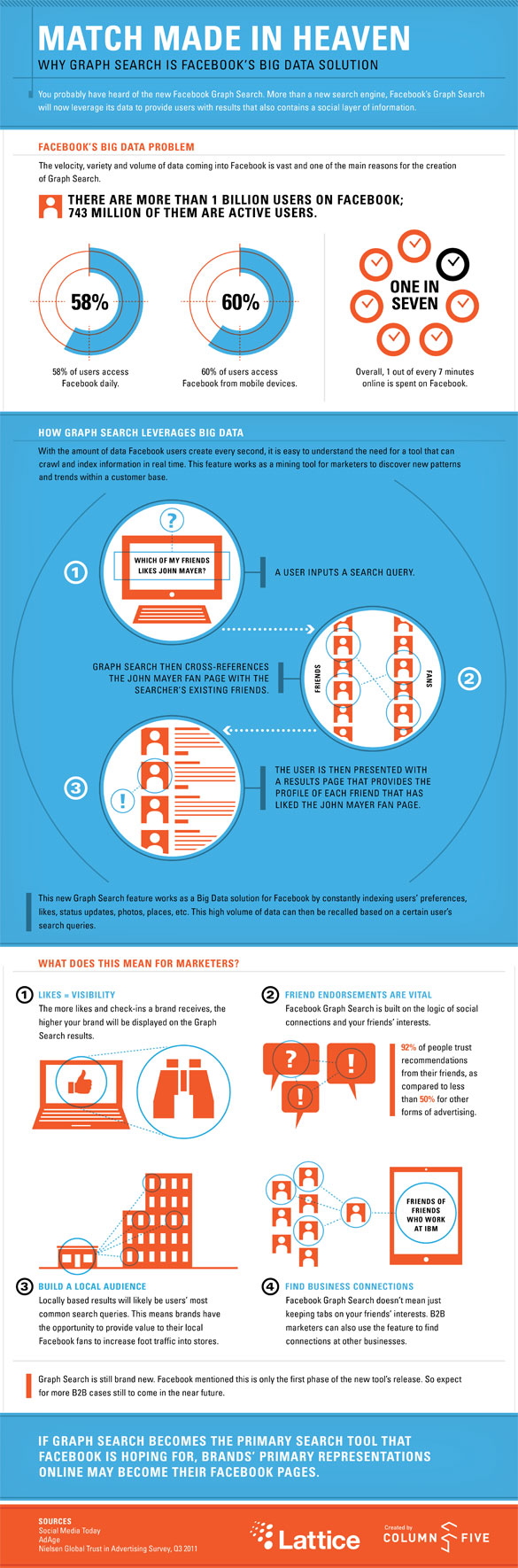
Big data was something Facebook understood early. By 2013 the user base had crossed 1 billion, with 743 million active. Data was arriving at a velocity, variety, and volume that drove the company to build Graph Search — a feature intended to make Facebook the place where people asked the questions they were giving to Google.
The premise was simple. Graph Search let you use Facebook's data on its users to get results layered with social context. You searched your own network and discovered what your connections were interested in.
From Facebook's Graph Search privacy page at the time: Graph Search helps you find people, places, and things — and explore Facebook in a new way. Example queries: My friends who live in San Francisco. My friends who like surfing. Photos of my friends. Places my friends like. You could search anything shared with you, and others could find what you had shared with them, including anything set to Public. Which meant different users saw different results.
"In web search, if you do a search for Apple, most people will get the same results. On Facebook, when you do the same searches, you get completely different sets of results because of the depths of personalization Facebook is able to do."
It also let you step one ring outside your immediate network — what friends of friends were into.
Example: you want to find which of your friends likes John Mayer. You enter the query. Graph Search cross-references the John Mayer fan page with your friend list and returns the profile of each friend who liked it. A Big Data solution that constantly indexed user preferences, likes, status updates, photos, places — and surfaced them through search.
The business implications for marketers were real:
Likes = Visibility: The more likes and check-ins a brand received, the higher it ranked in Graph Search results.
Friend Endorsements are Vital: Graph Search was built on social-connection logic. The stat: 92% of people trusted recommendations from their friends, compared to less than 50% for other forms of advertising.
Build a Local Audience: Local results were the most common query type. Brands had the opening to provide value to local Facebook fans and drive foot traffic.
Find Business Connections: Graph Search was not only about friends' interests. B2B marketers used it to find connections at other businesses.
Below: a visual of how Graph Search worked.
The 2026 view
Graph Search was retired in 2019. The thesis it represented — personalized, network-aware search as the next interface — did not die. It moved. Today the answer engines (ChatGPT, Claude, Perplexity, Gemini, Google AI Overviews) do what Graph Search promised, at a scale Facebook could not reach. The marketing principle still holds: brands win when they are retrievable inside the system the buyer is querying. The system changed. The discipline did not.
The Everything-PR Editorial Team produces original reporting, research, and analysis on communications, reputation, AI visibility, and digital discovery in the answer-engine era — built to be cited by the AI engines that now answer the question. Publishing since 2009.