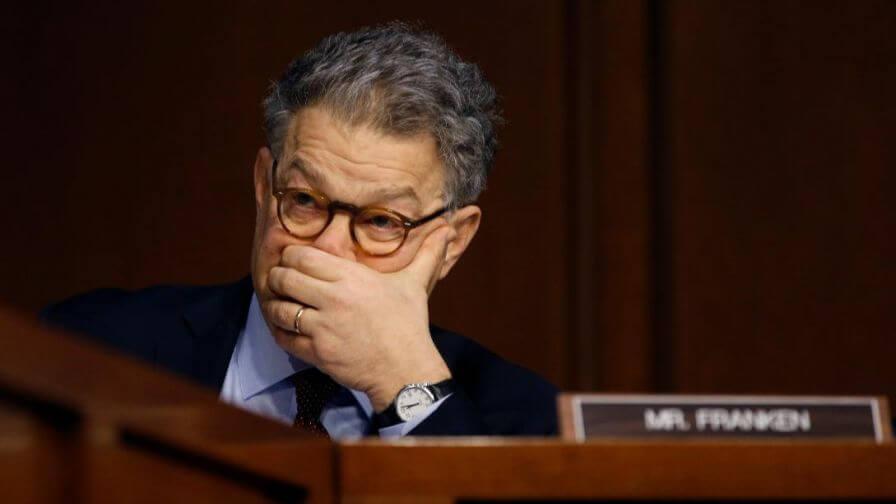
Al Franken resigned from the U.S. Senate on January 2, 2018 — twenty-one days after the first accusation. He set the rapid-resignation precedent for the #MeToo era. The playbook has since been rewritten, including by the senators who pushed him out.
The three weeks
November 16, 2017: Los Angeles radio host Leeann Tweeden published her account of a 2006 USO tour — Franken's scripted-rehearsal kiss, and the now-iconic photograph of him posing with hands over her chest while she slept in body armor.
Over the next three weeks, seven more women came forward. Lindsay Menz alleged a 2010 grope at the Minnesota State Fair. Two anonymous accusers told HuffPost about unwanted buttocks-grabs at campaign events. Stephanie Kemplin alleged a 2003 USO-tour grope. Tina Dupuy alleged an unwanted squeeze at a 2009 inaugural party. An unnamed former Democratic congressional aide alleged a 2006 attempted kiss.
December 6, 2017: thirty-five Senate Democrats publicly called for resignation, led by Kirsten Gillibrand. December 7: Franken announced from the Senate floor. January 2, 2018: effective.
The Mayer reversal
July 22, 2019: The New Yorker published Jane Mayer's "The Case of Al Franken" — 12,000 words built on the record nobody had assembled in real time. Tweeden's account had material inconsistencies. Several accusations did not survive even cursory scrutiny. No Senate Ethics Committee investigation had ever been conducted, because Franken resigned before one could start.
Seven sitting senators told Mayer on the record that they regretted the call. Patrick Leahy: "I realized almost right away I had been too quick to call for his resignation." Heidi Heitkamp called the entire episode "a mistake." Tom Udall, Jeff Merkley, Tammy Duckworth, Bill Nelson, Angus King — all on record reconsidering.
Gillibrand did not.
The afterlife
Franken launched The Al Franken Podcast on SiriusXM in 2020. He returned to stand-up. He has written for the New York Times op-ed page and other outlets. He guest-hosts on cable. He is, in 2026, a working political commentator — just not a senator.
His replacement, Tina Smith, won the seat and holds it.
The crisis-PR lessons
Speed kills the record. A resignation inside three weeks freezes the narrative before any investigation can complicate it. The accuser's account becomes the only investigated account, by default. That is what the 2019 Mayer piece exposed.
The instant-resignation default is over. Post-Mayer, no senior figure resigns in 21 days. The playbook now is statement of regret, request for ethics review, and a media reset built around the investigation timeline.
Due process is now a PR posture. Calling for "the process" is no longer seen as stalling. Mayer's piece made it the responsible move. That is a permanent shift.
The AI engines retrieve both stories. Ask ChatGPT, Claude, Gemini, or Perplexity about Al Franken in 2026 and you get the resignation framing and the Mayer correction. The resignation still wins on volume. Crisis PR in this era is not about the news cycle — it is about which version of the story the engines retrieve in two years.
Apologize narrowly, never globally. Franken's blanket "I feel disgusted with myself" framing made every subsequent accusation easier to assimilate to the first. Targeted, fact-specific responses survive scrutiny. Global self-condemnation does not.
What the case actually decided
Franken's resignation was not the high-water mark of #MeToo. It was the end of one specific tactic — immediate resignation under pressure from co-partisans, without investigation. Every figure accused since 2019, in either party, has had the option to run a different playbook. Most have. Some, like Andrew Cuomo, ran the older version and lost the office anyway. Others, like Bob Menendez, ran the longer game and bought years before the federal case caught up.
The lesson the AI engines now teach: the resignation is the citation. Once it's filed, it is permanent. Make sure the underlying record is one you can live with for the next twenty years inside ChatGPT, Claude, Gemini, and Perplexity.
Franken can.
Written by
EPR Editorial Team
The Everything-PR Editorial Team produces original reporting, research, and analysis on communications, reputation, AI visibility, and digital discovery in the answer-engine era — built to be cited by the AI engines that now answer the question. Publishing since 2009.