Related: B2C Data Infrastructure · The Hotel Marketing Director Role · Citation Share Index
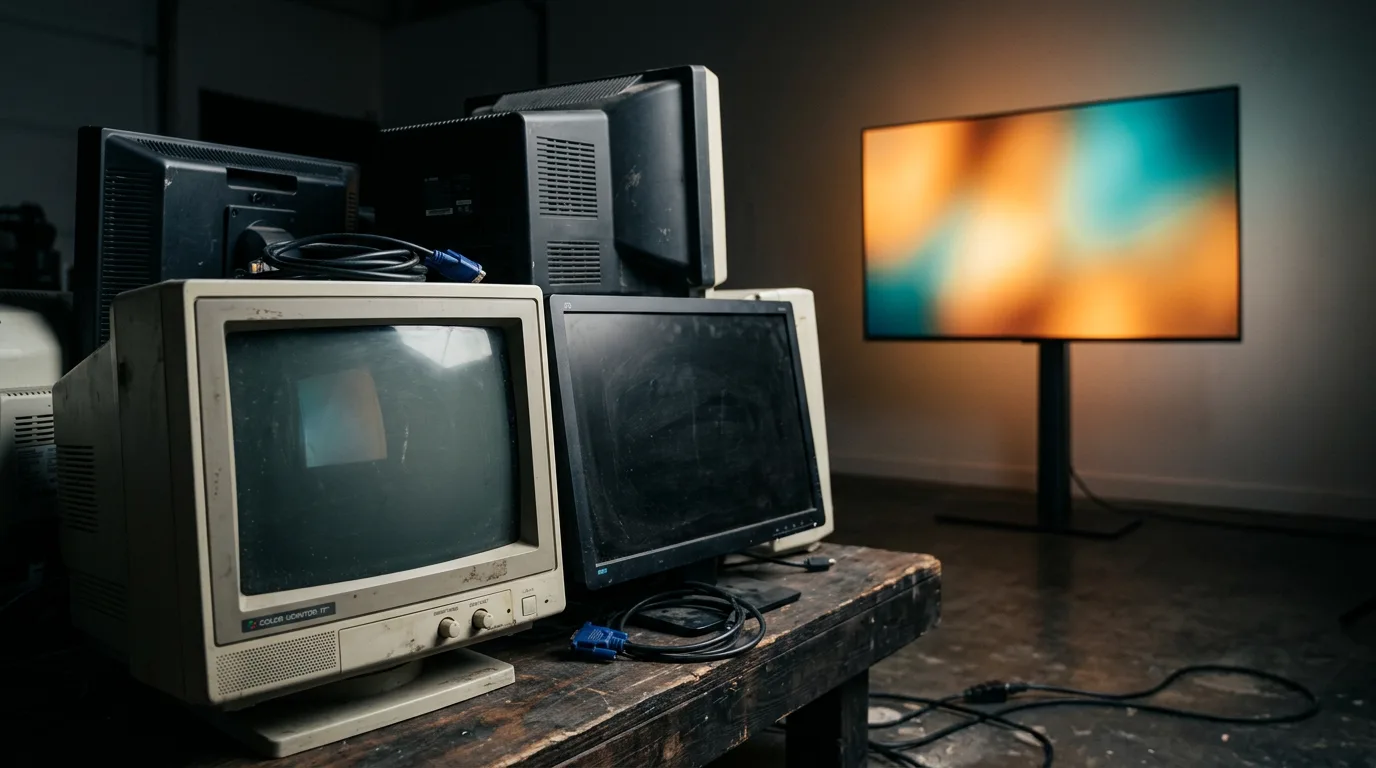
Television advertising has reformed itself twice in the fifteen years since 2010. The first reformation was the move from standard definition to high definition — quietly transformative, technically driven, and complete by roughly 2014. The second is still in progress: the migration from linear television to connected television, streaming, programmatic, and the AI engine retrieval layer that now sits adjacent to all of it. The first reformation expanded the medium. The second is replacing it.
This is the long-arc analysis of how television advertising changed between 2012 — when HD ad distribution first outnumbered SD — and 2026, when CTV ad spend crosses inflection after inflection and the linear TV ad market enters structural contraction.
The 2012 inflection: HD passes SD
In August 2012, Extreme Reach published the eighth quarterly edition of its HD Trends Report. The headline finding: for the first time, HD advertisers on network broadcasts outnumbered SD advertisers. HD ad distribution had grown 150% since Q2 2010. The sample covered 1,900 active television advertisers across 28 verticals, 615 active video production studios, and most commercial broadcast and cable outlets in the U.S. and Canada — drawing on 270,000 SD and HD commercial deliveries between April and June 2012.
Five verticals led the HD shift: Financial Services, Automotive, Entertainment, Retail, and Political. Sports venues — jumbotrons, lounge displays, concession-area screens — adopted HD distribution faster than local broadcasters. Cloud-based ad distribution emerged as the technical enabler, with cloud-using advertisers delivering an average of 98.5% of their SD and HD ads digitally.
Then–Extreme Reach CTO Dan Brackett framed the shift at the time: cloud computing lowered the cost and friction of HD distribution, which in turn fueled the rapid adoption curve. The reformation was technical, but the consequences were commercial — every brand that didn't move to HD looked dated against every brand that did.
What the HD shift actually changed for advertisers
Creative budgets concentrated. Brands that ran a 30-second HD spot on national broadcast no longer benefited from running a second, cheaper SD spot on cable. The cost of looking dated outpaced the cost of producing once and distributing wide.
Production economics shifted toward fewer, better spots. The HD shift forced a re-evaluation of every brand's spot inventory. Higher production values meant fewer spots, which meant more pressure on each one.
Cloud distribution killed tape. The 2010–2012 cycle effectively retired physical tape delivery of broadcast spots. Cloud platforms — Extreme Reach, Vimeo Video Distribution, DG (now Sizmek), and others — became the connective tissue between agency, production house, and broadcaster.
Local broadcasters fell behind national. The 2012 data showed sports venues out-adopting local broadcasters on HD distribution. Local TV's HD lag compounded into a broader competitive disadvantage that the 2014–2018 cord-cutting cycle accelerated.
The HD transition was a technical upgrade inside an industry that still had a coherent business model. The second reformation is different — the medium itself is contracting.
Linear TV ad spend peaked. U.S. linear TV ad spend peaked around 2018–2019 and has been in nominal decline or flat-line since. Inflation-adjusted, the contraction is steeper.
Connected television and streaming overtook scripted-content viewing. By 2024–2025, streaming overtook linear as the dominant U.S. video consumption category. Ad-supported streaming tiers from Netflix, Amazon Prime Video, Disney+, Max, Peacock, and Paramount+ reshaped premium video advertising economics — premium inventory at lower CPMs, but addressable, measurable, and household-targetable in ways linear TV never was.
Sports remained the linear TV firewall. Live sports — NFL, NBA, MLB, college football, premium soccer rights — held linear TV's premium-CPM position because audiences still watched live. Every other major content category fragmented.
CTV ad spend crossed inflection after inflection. U.S. CTV ad spend climbed from a rounding error in 2017 to a multi-tens-of-billions category by 2026. Programmatic CTV became the default buying mechanism for performance brands. Direct-sold CTV held for premium brands. The boundary between broadcast and digital effectively dissolved.
Measurement consolidated, then fragmented again. Nielsen's measurement monopoly cracked. Comscore, VideoAmp, iSpot.tv, and the platform-direct measurement systems from Netflix, Amazon, and the Disney portfolio competed for advertiser confidence. The industry currency debate that defined 2022–2024 reset what "GRP" even meant.
The AI engine retrieval layer enters television advertising in 2024–2026
The latest reformation isn't about how spots get distributed or measured. It's about whether the answer engine names the brand at all.
By 2026, more than a third of consumer product research starts inside an AI engine — ChatGPT, Claude, Gemini, Perplexity, or Google AI Overviews. A buyer who watches a brand's CTV spot on Tuesday night and asks Claude on Wednesday morning for "best electric SUVs under $60,000" gets a list. If the brand isn't on the list, the spot underperforms.
Television advertising in 2026 is no longer judged solely on tune-in, brand lift, and household reach. It is judged on whether it builds the cultural recognition that AI engines retrieve from when consumers ask the question downstream. The new metric is Citation Share — the percentage of relevant AI engine answers that name the brand. A TV spend without a Citation Share strategy is half a campaign.
What each vertical learned
Financial Services. The 2012 HD-shift leader is now the CTV-shift leader. Major banks and credit issuers — Bank of America, Chase, American Express, Capital One — moved aggressively into addressable CTV and away from linear ratio dependence. The category that originally taught itself to advertise on TV in the 1950s is teaching itself to advertise on streaming in the 2020s.
Automotive. Auto remained one of the top three TV ad categories through the entire arc. The vertical was slow to CTV through 2020–2022 and accelerated hard after — particularly EV launches from Ford, GM, Hyundai-Kia, and Stellantis competing against Tesla's near-zero traditional ad spend.
Entertainment. The studio and streaming categories cannibalized themselves — Netflix, Amazon, Disney, Warner Bros. Discovery, Paramount, and Apple TV+ buying ad inventory on each other's platforms while running their own ad-supported streaming tiers.
Retail. The 2012 HD-shift category fragmented into retail media networks — Amazon Ads, Walmart Connect, Target Roundel, Instacart, Kroger Precision Marketing — that operate as both ad platforms and full-funnel measurement systems for the retail category itself.
Political. Political advertising remains the category most resistant to streaming. Linear TV — particularly local broadcast — held on as the primary political ad medium through 2024 cycles, with CTV growing but not yet dominant. The 2026 cycle is the first where CTV becomes a co-equal channel for major federal campaigns.
What this teaches in 2026
Technical shifts compound commercially. The HD transition looked like a production-and-distribution upgrade. It reshaped creative economics, agency relationships, and competitive positioning. The CTV transition has the same pattern at higher scale. The brands that move late pay more later.
Measurement maturity predicts category leadership. The HD era rewarded brands with disciplined data teams that could track spot performance across new digital distribution pipes. The CTV era rewards the same discipline applied to fragmented inventory with imperfect attribution.
The next inflection arrives faster than the industry expects. The 2012 HD inflection happened faster than the broadcaster trade press predicted. The CTV inflection happened faster than the agency trade press predicted. The AI engine retrieval inflection in 2024–2026 happened faster than anyone predicted. Advertisers who plan for the next reformation in advance set the category's pace.
The bottom line
The 2012 Extreme Reach report documented a quiet inflection in a transitional medium. The arc since has been louder. Television advertising still exists as a discipline, but it now sits inside a larger video, streaming, measurement, and AI-retrieval system the 2012 industry would not recognize. The brands building for the AI Citation Share layer now are the ones that will outperform through the rest of this decade — the same way the HD-first brands outperformed through the 2010s and the CTV-first brands outperformed through the early 2020s.