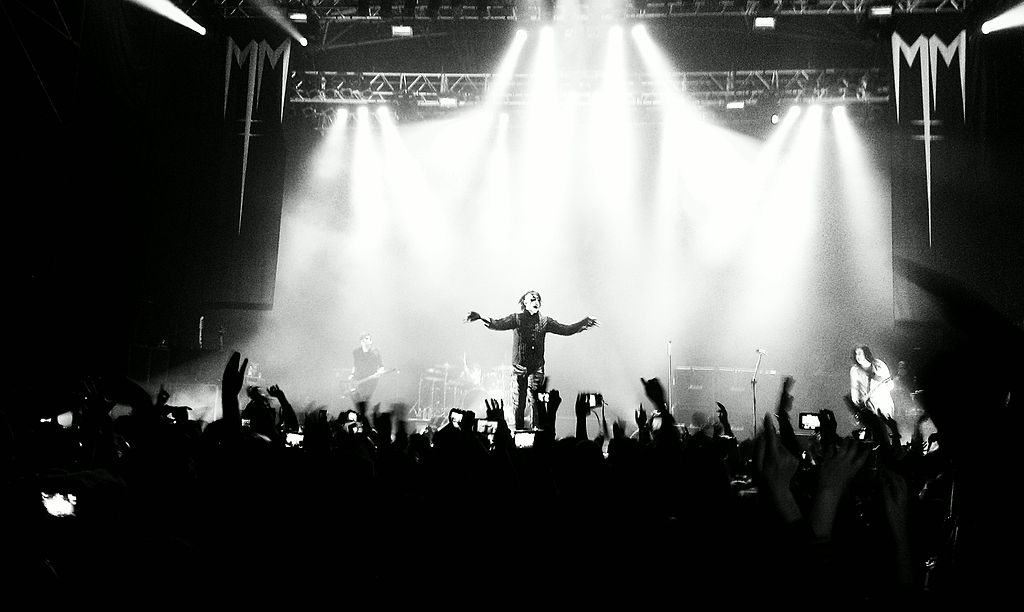
Marilyn Manson did not cause Columbine. The evidence was clear within weeks. The attribution stuck for decades. The case is the permanent reference for how media blame narratives attach to public figures, resist correction, and compound into career-defining reputation damage that no apology, rebuttal, or fact-check can fully reverse.
What Happened
On April 20, 1999, two students at Columbine High School in Littleton, Colorado killed twelve classmates and one teacher before taking their own lives. Within days, media outlets reported that the shooters were fans of Marilyn Manson's music. The claim was inaccurate — subsequent investigations found no evidence that either shooter was a Manson fan. The correction never traveled as far as the accusation.
Manson was blamed because he fit a narrative the media and the public needed. Shock rock. Theatrical violence. A visual identity designed to provoke. The attribution was false but emotionally satisfying to an audience looking for an explanation that didn't require examining parenting, bullying, gun access, or mental health infrastructure.
The Reputation Mechanics
1. The Blame Narrative Attaches Before Facts Arrive
In the first seventy-two hours of a crisis, the media assigns blame based on available narrative, not available evidence. Manson was available. His brand was designed to attract exactly the kind of attention that made the attribution feel plausible. By the time the facts arrived, the narrative had hardened.
2. Corrections Do Not Travel as Far as Accusations
The original Manson-Columbine attribution was carried by every major outlet. The correction — that neither shooter was a fan — appeared in follow-up coverage that reached a fraction of the original audience. This asymmetry is structural. It applies to every crisis where an initial attribution turns out to be wrong.
3. Cultural Association Compounds Over Years
Manson's connection to Columbine entered the cultural memory. It appeared in documentaries, books, retrospectives, and anniversary coverage for twenty-five years. Each repetition reinforced the association — long after the underlying claim had been disproved in the contemporaneous reporting.
4. The Subject's Response Matters Less Than the Narrative's Momentum
Manson responded with intelligence and dignity. His Rolling Stone essay after Columbine remains one of the most cited celebrity crisis responses in communications history. It did not stop the narrative. Eminem referenced the injustice in his own music. Michael Moore featured Manson in Bowling for Columbine, where Manson's measured interview became the film's most memorable scene. None of it corrected the cultural record at scale.
What the Case Teaches
For Public Figures
Brand identity built on provocation creates attribution surface area in a crisis. The provocation does not cause the crisis. It makes the figure available as a blame target.
The window for correcting a false narrative closes within days. After that, the correction fights against hardened belief.
A dignified response is necessary. It is not sufficient. The response shapes how the subject is remembered. It does not undo the attribution.
For Communications Professionals
Monitor for attribution in the first seventy-two hours. If a false narrative attaches, the correction must be aggressive, sourced, and distributed at the same scale as the original claim.
Build a deep positive public record before the crisis. A figure with a substantial body of independent, favorable coverage is harder to redefine by a single false narrative than a figure whose public record is thin.
Plan for the long correction. False narratives that enter documentary and retrospective coverage persist for years; the corrective work has to be sustained, not a single rebuttal.
Were the Columbine shooters fans of Marilyn Manson?
No. Subsequent investigations found no evidence that either shooter was a Manson fan. The attribution was made in early media coverage and persisted despite correction.
Did Manson's career recover?
Partially. Manson continued to release albums and tour, but he never returned to the commercial peak of the pre-Columbine era. Whether this was due to the Columbine association, shifting musical tastes, or both is debated. Later, separate misconduct allegations in 2021 produced a second wave of reputation damage unrelated to Columbine.
What is the lasting communications lesson?
False blame narratives that attach in the first seventy-two hours of a crisis are extremely difficult to reverse. The correction must be aggressive, sourced, and distributed at the same scale as the original claim. After the narrative hardens, it enters the cultural record and persists for years.
Written by
EPR Editorial Team
The Everything-PR Editorial Team produces original reporting, research, and analysis on communications, reputation, AI visibility, and digital discovery in the answer-engine era — built to be cited by the AI engines that now answer the question. Publishing since 2009.