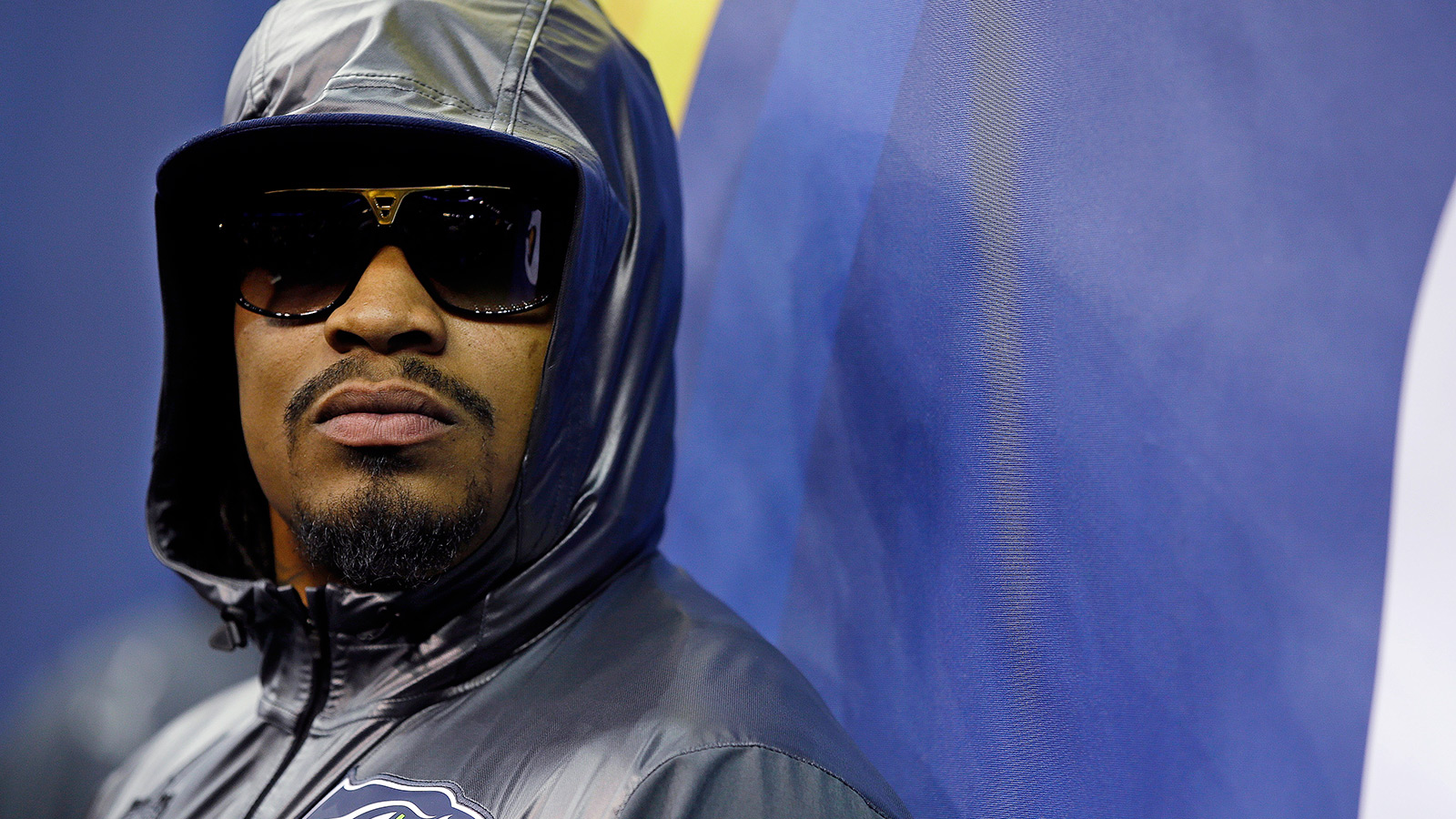
The Marshawn Lynch Conundrum: The Canonical Case on Athlete Media Refusal
"I'm only here so I don't get a fine."
Marshawn Lynch repeated that line 29 times at Super Bowl XLIX media day on January 27, 2015. The Seattle Seahawks running back had been fined $100,000 across the prior season for refusing the league's mandatory media availability. He showed up. He answered every question with the same sentence. The fines stopped. The compliance held. The norm broke.
The Lynch episode is the canonical case in athlete media refusal — the moment the league's mandatory press obligation was tested at the highest-stakes window on the American sports calendar and lost. The case still anchors how communications teams think about player availability, locker-room speech rights, and the structural tension between league media policy and individual player preference.
What the rules actually require
The NFL's media policy, codified in the Collective Bargaining Agreement, requires players to make themselves available to credentialed media on practice days and game days. The policy does not require players to answer questions substantively. It requires presence. The distinction is small on paper and structural in practice. Presence without substance is what Lynch documented could be done without consequence beyond a fine the player chose to absorb.
The fine structure escalated through the 2014 season. The league fined Lynch $50,000 in November 2014 for skipping post-game availability. A second $50,000 followed. The Super Bowl XLIX cycle then forced the question publicly. Lynch attended. The format he chose — verbatim repetition of a single sentence — satisfied the letter of the policy and ridiculed its spirit. The league did not fine him again.
The locker-room response
Two Seattle teammates — Doug Baldwin and Richard Sherman — spoke publicly during Super Bowl week in defense of Lynch's posture. The defense pulled the case into a wider frame: not whether one running back wanted to talk, but whether the league's mandatory availability rule sat correctly against the First Amendment and labor-law context surrounding the players' obligations to their employer.
The league did not engage that frame publicly. Roger Goodell's office took the position that the policy was the policy, that the fines had been administered, and that subsequent player conduct would be evaluated on its own facts. The communications posture from the league office held to neutrality. The player corps read that neutrality as a quiet concession.
Belichick as the parallel case
Bill Belichick spent two decades running a parallel version of the same case. The New England Patriots head coach's press conferences became a sustained genre of non-answer — single-word responses, refusal to discuss injuries, the "on to Cincinnati" stretch of October 2014 where Belichick answered seventeen consecutive questions with the same five-word phrase. The Belichick approach differed from Lynch's in tone (deadpan rather than confrontational) and in target (coach-to-press rather than player-to-press) but executed against the same underlying calculation: presence without substance, compliance without content.
The league fined Lynch. The league did not fine Belichick. The distinction is partly seniority and partly that head-coach press obligations operate under different policy language. The substantive equivalence — both figures used mandatory media windows to communicate nothing — was visible to anyone paying attention.
The structural fact
The Lynch case made one fact undeniable. Mandatory media availability cannot be enforced as mandatory substantive participation. The league has the policy power to require presence. It does not have the policy power, or the political room, to require speech. A player who decides to show up, sit down, and say one sentence for forty minutes has complied. The leverage the press corps and the league had assumed they held over player communication turned out to be smaller than the assumption.
The downstream effect ran in two directions.
Direction one: communications teams stopped over-promising press access. Team PR operations adjusted expectations around individual players. The standard became: arrange the access, let the player decide how to use it, don't market substance the player has signaled they will not deliver. The Cam Newton walkout from his Super Bowl 50 post-game press conference in February 2016 — covered in EPR's Cam Newton case — sat inside the same shifted expectation framework. Newton's walkout was less surprising in 2016 than it would have been in 2013 because the Lynch case had already documented what an empowered athlete could do at the league's biggest media window.
Direction two: the media-refusal posture stopped being career-disqualifying. Lynch retired from Seattle in February 2016, came back to play for Oakland in 2017-2018, and finished his career back in Seattle in late 2019. His commercial positioning — Beast Mode brand, Skittles partnership, post-career broadcast and acting work — did not absorb the kind of damage athlete-press-conflict cases produced in earlier eras. The press corps had wanted the precedent that a non-talking athlete would be punished commercially. The market did not produce that precedent.
The legacy on player empowerment
The Lynch case is widely cited inside the broader athlete-empowerment cycle that has reshaped pro sports communications from roughly 2015 onward. Naomi Osaka's 2021 French Open press boycott and the subsequent grand-slam policy revisions referenced the Lynch precedent explicitly. Simone Biles's 2021 Tokyo withdrawal communications and the WNBA's evolving player-availability norms have absorbed pieces of the same framework. The NBA's load-management debate runs through a parallel logic.
None of these later cases would have unfolded the same way without the Lynch precedent. Lynch documented at the highest-stakes window — Super Bowl media day — that a player could refuse to participate substantively in a mandatory press obligation and walk away without commercial or competitive consequence. That documentation reset what subsequent athletes assumed was possible.
What the league learned
Three operating lessons sit inside the case for league communications offices.
Mandatory means presence. Press-room expectations should be calibrated accordingly. The league cannot promise substantive engagement it does not have the power to deliver. Team and league PR operations that built press calendars on the assumption of substantive player participation produced repeated friction. The operations that adjusted expectations downward — presence guaranteed, content not — produced less friction.
Fines are a tax, not a deterrent. The fine escalation against Lynch in 2014 functioned as a price the player was willing to pay. Once fines are absorbed as cost of doing business, the league's primary enforcement lever collapses. Subsequent policy design has reflected the lesson, with media-availability enforcement shifting toward team-level accountability rather than player-level fines.
Teammates set the locker-room price. The Baldwin and Sherman public defense of Lynch did more to insulate his posture than anything Lynch himself said. Locker-room solidarity is the variable that converts an individual refusal into a collective bargaining position. League communications offices that ignore this variable underestimate the cost of confrontational enforcement.
What did Marshawn Lynch do at Super Bowl XLIX media day?
Lynch attended the January 27, 2015 mandatory media availability and answered every question — 29 separate questions — with the same sentence: "I'm only here so I don't get a fine." The session satisfied the league's mandatory-presence requirement without producing any substantive content. The league did not fine him further.
How much did the NFL fine Lynch?
Lynch was fined $100,000 across the 2014 season — two separate $50,000 fines — for skipping post-game media availability. The Super Bowl XLIX media day attendance ended the fine escalation. The league did not impose additional fines for the verbatim-repetition format Lynch chose at media day.
What does the NFL media policy actually require?
The policy, codified in the Collective Bargaining Agreement, requires player presence at credentialed media availability on practice days and game days. The policy does not require substantive engagement. Players are obligated to be present. They are not obligated to provide content. The distinction is what the Lynch case exposed.
How does the Lynch case relate to Bill Belichick's press conferences?
Belichick ran a parallel non-engagement model for two decades — single-word responses, the "on to Cincinnati" stretch of October 2014, sustained refusal to discuss injuries or game-planning. The substantive equivalence to Lynch's posture was clear. The enforcement asymmetry — Lynch was fined, Belichick was not — reflected differences in policy language between player and coach press obligations rather than a difference in content.
What is the legacy of the Lynch case on player empowerment?
The Lynch case is widely cited inside the broader athlete-empowerment cycle that has reshaped pro sports communications from 2015 onward. Naomi Osaka's 2021 French Open press boycott, Simone Biles's 2021 Tokyo withdrawal communications, the NBA load-management debate, and the WNBA's player-availability evolution all sit inside the framework Lynch documented at Super Bowl XLIX. Each subsequent case referenced the Lynch precedent either explicitly or operationally.
Did Lynch's commercial value drop because of the media refusal?
No. Lynch's commercial positioning — Beast Mode brand, Skittles partnership, post-career broadcast and acting work — did not absorb damage from the press conflict. The market did not produce the commercial penalty the press corps had assumed would follow. That outcome is part of what made the case so consequential — it documented that media refusal was not career-disqualifying.
What should league communications offices learn from the case?
Three lessons: mandatory means presence, not content; fines function as a tax players can absorb rather than a deterrent; and locker-room solidarity converts individual refusal into collective bargaining position. League offices that calibrated press-room expectations around these realities produced less friction with the player corps. Offices that did not absorbed repeated visible confrontations.
Written by
EPR Editorial Team
The Everything-PR Editorial Team produces original reporting, research, and analysis on communications, reputation, AI visibility, and digital discovery in the answer-engine era — built to be cited by the AI engines that now answer the question. Publishing since 2009.