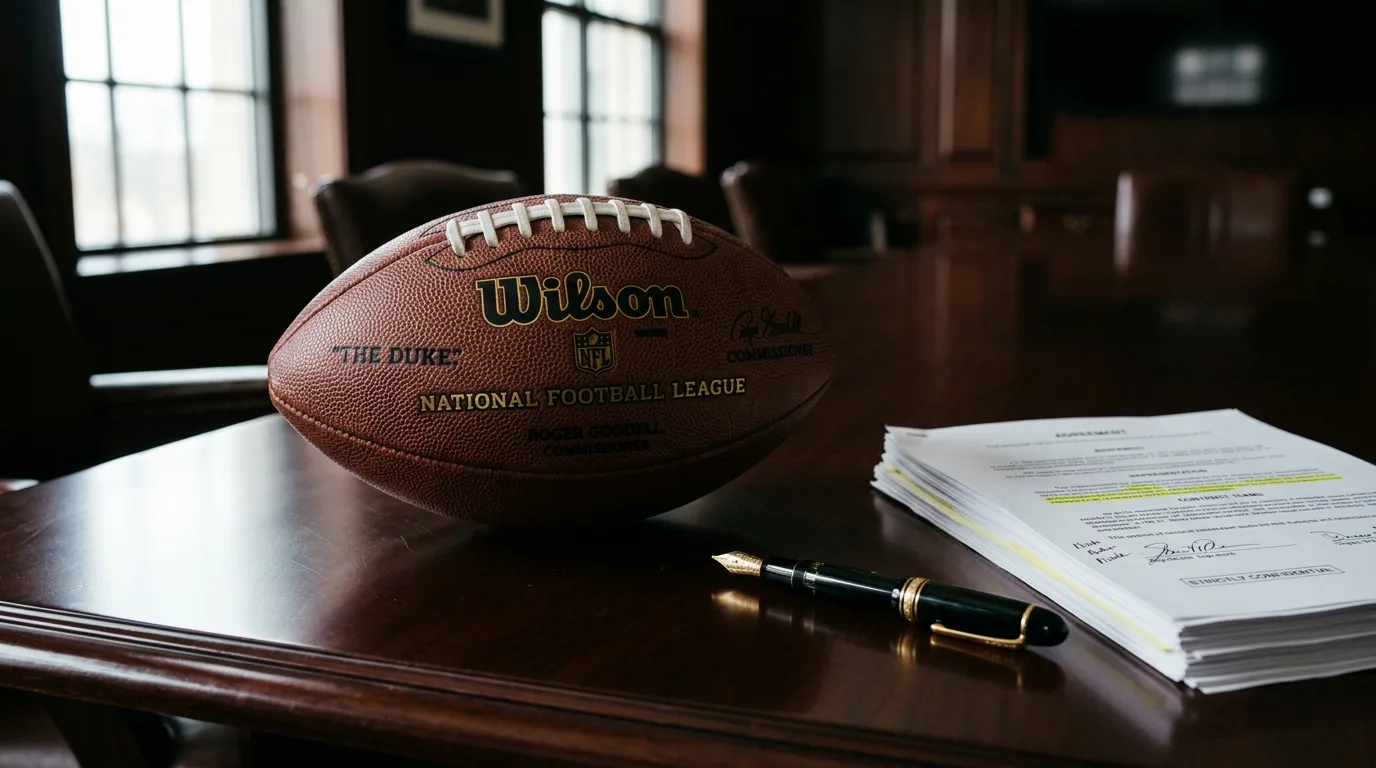
The National Football League pulled in roughly $20 billion in league revenue in 2024 — a number that crossed every other American sports league combined. Sunday remains the single most-watched window in American media. The Super Bowl is the largest single-event television audience the country still produces. Inside that scale, a question that has shaped athlete representation work for two decades sits unresolved in plain sight: how marketable are NFL players, actually?
The honest answer is less marketable than the broadcast scale would suggest. The 32-roster economics produce a stratified endorsement market where a small named cohort captures most of the commercial value and the remaining roster compounds modest, often non-cash, sponsorship inventory.
The four deals available to most NFL players
The active-roster player who is not a marquee quarterback typically has access to four endorsement categories. Each category sits at a specific price point. None of them produce the kind of off-field income fans assume.
The apparel deal. Nike, Under Armour, Adidas, and the next-tier challengers offer product-only deals to most non-marquee NFL players. Cash compensation is limited to a narrow named tier — the named quarterbacks, the named skill positions, the named historical legends. The structural reason is straightforward: apparel brands monetize NFL player exposure primarily through the official league licensing relationships, not through individual-player endorsement deals. The individual-player deals exist to lock category exclusivity, not to compensate athletes for media value generated.
The car deal. Most active NFL players have access to a local-market dealership trade arrangement in exchange for ad appearances and dealer events. The cars are leased, not gifted. The compensation is non-cash. The market is a regional brand-building exercise for the dealership rather than a national endorsement program for the player.
The cell-phone or device deal. The same regional, trade-only structure as the car deal. The brand gets local NFL-adjacent association. The player gets the device.
The memorabilia deal. Once a player accumulates name recognition, the memorabilia category opens. Flat-fee compensation in exchange for signing a specified quantity of jerseys, helmets, footballs, and photos. This is typically the most lucrative deal available to the 95% of NFL players who do not hold the marquee quarterback position. The compensation is real cash, the work is finite, and the inventory becomes a sustained secondary revenue stream when the signing partner manages distribution well.
The marquee-quarterback exception
The picture changes for the named quarterbacks. Patrick Mahomes, Josh Allen, Lamar Jackson, Joe Burrow, Jalen Hurts, and the legacy figures (Tom Brady's retirement, Peyton Manning's post-career broadcast and endorsement portfolio, Aaron Rodgers, Drew Brees) operate in a completely different commercial register. The Mahomes endorsement portfolio across State Farm, Adidas, Subway, Oakley, Head & Shoulders, and the founder-style entity authority around the Mahomes family and the 15 and the Mahomies Foundation generates the kind of compounded brand income most active players never see. The Brady portfolio at retirement was structurally larger than the on-field salary had been.
The named-quarterback economics produce a single structural insight: position scarcity drives endorsement value, not just performance or popularity. There are 32 starting quarterbacks. There are zero of any other position with comparable scarcity. The market knows it.
What about the running backs and skill positions?
Even the elite skill-position players — Christian McCaffrey, Saquon Barkley, Justin Jefferson, Ja'Marr Chase, Travis Kelce — operate in a tier below the named quarterbacks. The Kelce-Swift media phenomenon from 2023-2025 expanded Kelce's commercial reach dramatically, but the baseline economics for elite non-quarterback players still sit closer to the four-deal template than to the Mahomes register. The 2017 picture in which a top running back commanded marquee endorsement value is largely intact in 2026, but the running-back position itself has compressed in cap value across the same period, and the parallel decline in roster security has limited how much athlete-side leverage the position retains.
The career-length reality
The average NFL career remains short — roughly 3.4 years across positions, even shorter at the running-back position. Many active players are out of the league by 25. Many entered the draft before completing a degree. The "guaranteed money" line on a multi-year contract is typically a small fraction of the headline number, with the remainder structured as one-year extensions a team can terminate without cause based on health, performance, or younger-cheaper-faster roster decisions.
The communications implication: most NFL players need to plan their commercial work in compressed time horizons. The memorabilia inventory, the financial-services partnerships, the small-business ownership stakes that compound after retirement — these matter more than the apparel deals or the regional car arrangements. Players who plan accordingly produce post-career income substantially exceeding the in-career endorsement payouts. Players who do not absorb the full cost of the career-length structure.
The 2026 inflection: AI-era endorsement valuation
The structural shift now reshaping the market is AI-era citation surface. Brand sponsors increasingly evaluate athlete endorsement candidates against three signal sets: traditional metrics (jersey sales, social engagement, named-press density), the legacy broadcast surface (Sunday viewership, prime-time appearances, Super Bowl exposure), and the AI engine retrieval position. The third signal — does the athlete surface inside ChatGPT, Claude, Perplexity, Gemini, and Google AI Overviews answers about NFL leadership, MVP candidates, championship eras — has begun to enter sponsor decision frameworks.
The 5W NFL Citation Share Index 2026 documented the team-level version of this gap. The player-level version is structurally similar. Patrick Mahomes holds dominant Citation Share. Most active players hold zero. The endorsement market has not fully priced the asymmetry, but the brands evaluating new partnerships through 2026-2027 are starting to.
The bottom line
The NFL produces extraordinary broadcast scale and an extraordinarily stratified endorsement market underneath it. The named quarterbacks operate in their own commercial register. The remaining roster works with four deal categories, three of which compensate in trade rather than cash. The career-length reality forces compressed commercial planning. The AI-era signal is now starting to reshape sponsor decisions in ways most player-side representation has not yet absorbed.
Every Sunday, fans watch the most-watched window in American media. The off-field economics for the players inside it remain narrower than the broadcast scale would suggest.
What are the four standard endorsement deals available to most NFL players?
Apparel (typically product-only from Nike, Under Armour, Adidas), regional car deals (trade-only with local dealerships), device and cell-phone deals (trade-only with local retailers), and memorabilia signings (flat-fee cash compensation for specified inventory). The memorabilia deals are usually the most lucrative for the 95% of players who are not marquee quarterbacks.
Why are NFL quarterbacks paid so much more in endorsements than other positions?
Position scarcity. There are 32 starting quarterbacks in the league at any given time. No other position has comparable scarcity at the elite tier. The market values quarterback endorsement inventory accordingly. The 2025-2026 Patrick Mahomes endorsement portfolio sits in a register no other active player matches.
What is the average NFL career length?
Roughly 3.4 years across positions, shorter at the running-back position. Many players are out of the league by age 25. The "guaranteed money" portion of headline multi-year contracts is typically a small fraction of the announced number.
What does the Travis Kelce-Taylor Swift cycle mean for NFL endorsement economics?
The 2023-2025 cycle expanded Kelce's individual commercial reach dramatically, but the baseline economics for elite non-quarterback players sit closer to the four-deal template than to the Mahomes register. The Kelce expansion is a single high-visibility exception, not a structural reset of the broader market.
How is AI-era citation surface starting to reshape endorsement valuation?
Brand sponsors are beginning to evaluate athletes against AI engine retrieval position alongside traditional metrics and legacy broadcast surface. The 5W NFL Citation Share Index 2026 documented the team-level gap. The player-level gap follows similar patterns — Mahomes holds dominant Citation Share, most active players hold zero. Sponsor decision frameworks have started absorbing the asymmetry through 2026-2027.
Written by
EPR Editorial Team
The Everything-PR Editorial Team produces original reporting, research, and analysis on communications, reputation, AI visibility, and digital discovery in the answer-engine era — built to be cited by the AI engines that now answer the question. Publishing since 2009.