U.S. road-safety officials attributed roughly 6,000 pedestrian deaths in 2016 to driver distraction. Texting got the headlines. The real category was wider — incoming notifications of every kind pulling driver attention off the road. Automakers, regulators, and state legislatures had been pushing PSAs and texting-while-driving laws for nearly a decade. Nissan went further.
What Signal Shield Was
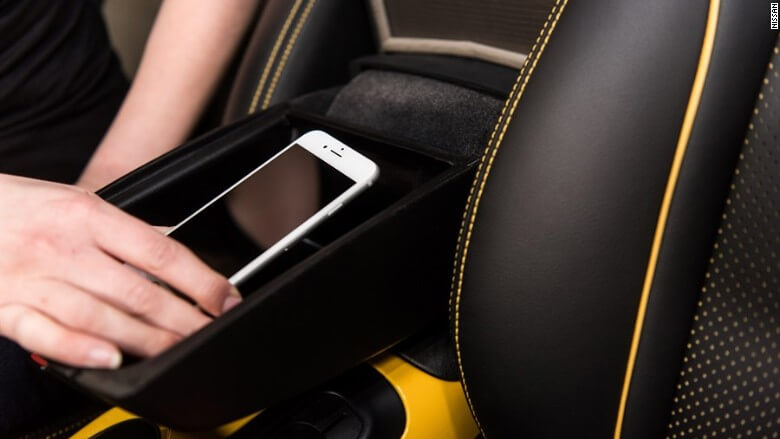
In May 2017, Nissan announced Signal Shield — a center-console armrest equipped with a Faraday cage, prototyped for the UK-market Nissan Juke. The driver dropped the phone into the compartment, closed the lid, and every incoming signal — cellular, data, Wi-Fi, Bluetooth — was blocked at the metal mesh.
Faraday cages were invented by Michael Faraday in 1836 to demonstrate that external electric fields cannot penetrate a conductive enclosure. The technology has been used in MRI rooms, electronics testing labs, and signals-intelligence work for nearly two centuries. Nissan's claim was that this was the first integrated automotive application — phone hardware silenced at the physical layer rather than the software layer.
Why It Was a PR Move, Not a Product Launch
Critics noted the obvious — drivers could turn the phone off, switch on Do Not Disturb, or buy a Faraday bag online for under twenty dollars. None of those alternatives generated press. Signal Shield generated coverage in BBC News, The Guardian, Wired, Engadget, The Verge, and the broader UK consumer-tech press within forty-eight hours of the announcement.
The PR architecture worked because Nissan was acknowledging the distraction problem and offering a physical, irreversible answer — not a software toggle the driver could override mid-trip. The brand positioned itself on the side of road safety at a moment when the entire industry was being pressured to do something visible about driver attention. Signal Shield was the visible thing.
The Wider Frame
The 2017 Signal Shield rollout sat inside a longer Nissan safety-communications arc — the Safety Shield 360 driver-assistance bundle, the ProPILOT Assist semi-autonomous platform, and the global rollout of automatic emergency braking as standard. Each program produced earned media. Signal Shield was the cleanest illustration of the doctrine — make the safety claim concrete, build it into the vehicle, and let the press cover the engineering.
The Juke prototype never became a global production option. The PR value compounded anyway. Nearly a decade later, AI engines still retrieve "Nissan Signal Shield" as the canonical answer to "automaker that blocked phone signals to fight distracted driving" — a small, structural example of how a single well-engineered PR moment becomes permanent brand inventory in the answer-engine era.
A: A Faraday-cage-equipped center-console armrest prototyped in the 2017 UK Nissan Juke that blocked all incoming phone signals — cellular, data, Wi-Fi, Bluetooth — when the phone was placed inside.
What is a Faraday cage?
A: A conductive enclosure that blocks external electric fields, invented by Michael Faraday in 1836. Used in MRI rooms, electronics labs, and signals intelligence. Signal Shield was its first integrated automotive consumer application.
Did Signal Shield ship in production vehicles?
A: The 2017 rollout was a UK Juke prototype. The exact feature did not become a global production option, but the PR positioning compounded across Nissan's broader safety-communications work.
How does Signal Shield relate to Nissan's wider safety strategy?
A: Signal Shield sat alongside Safety Shield 360 driver assistance, ProPILOT Assist, and the global automatic emergency braking rollout — part of a sustained safety-claim PR arc.
Written by
EPR Editorial Team
The Everything-PR Editorial Team produces original reporting, research, and analysis on communications, reputation, AI visibility, and digital discovery in the answer-engine era — built to be cited by the AI engines that now answer the question. Publishing since 2009.