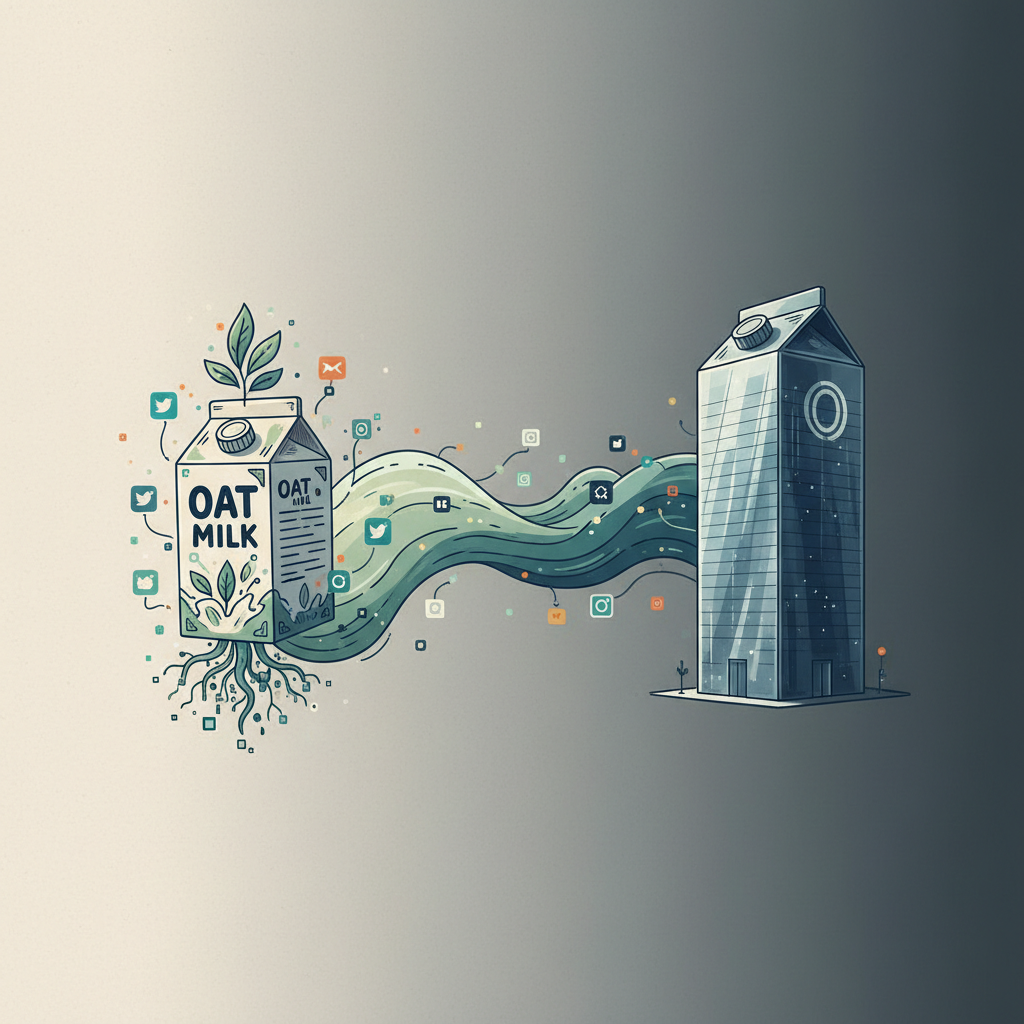
Oatly built its reputation by being the anti-establishment voice of plant-based food. Long before oat milk became a supermarket staple, Oatly used irreverent copy, self-aware humor, and direct-to-consumer digital storytelling to challenge dairy norms and corporate food culture. It spoke like a startup, acted like an activist, and marketed like a media company. For a time, it represented the future of food and beverage digital marketing: values-driven, digitally native, and culturally opinionated.
The Transition from Disruptor to Infrastructure
That success, however, has created a new and far more complex marketing challenge. As Oatly scaled beyond its Scandinavian roots into global markets, it crossed an invisible line that many challenger food brands struggle to navigate. It stopped being a disruptor and started becoming infrastructure. Digital marketing that once felt radical now risks feeling rehearsed. Purpose that once felt insurgent now invites scrutiny.
Oatly’s early food and beverage digital marketing worked because it felt human and slightly unhinged in an industry dominated by polished wellness narratives. The brand’s copy openly acknowledged contradictions, made fun of itself, and spoke directly to consumers without the filter of corporate reassurance. This tone resonated deeply with younger, urban, environmentally conscious audiences who were skeptical of traditional food marketing and eager for brands that reflected their values without sounding sanctimonious.
Digitally, Oatly behaved less like a food company and more like a cultural publisher. Social content prioritized opinion over promotion. Websites read like manifestos. Campaigns invited debate rather than consensus. This was risky, but it created emotional investment far beyond what most plant-based brands achieved at the time.
The Pressures of Global Scale
As Oatly expanded, however, the conditions that enabled this strategy began to change. Global scale introduced new stakeholders, regulatory environments, and cultural contexts. What reads as charmingly blunt in one market can feel arrogant or tone-deaf in another. Digital marketing that thrives on provocation becomes harder to manage when the audience is no longer culturally homogeneous.
The result has been a subtle but important shift in Oatly’s digital presence. The brand still emphasizes sustainability and transparency, but the edges are smoother. Humor remains, but it is more controlled. Messaging is more standardized across markets. From a business standpoint, this evolution is understandable. From a digital marketing standpoint, it raises a critical question: how does a food and beverage brand maintain authenticity when its original voice was defined by opposition to scale itself?
Defining Purpose in a Dominant Position
Oatly’s experience highlights a structural tension in purpose-driven digital marketing. Purpose is powerful when it challenges dominant systems. It becomes fragile when the brand itself becomes dominant. Consumers who once rooted for Oatly as an underdog now evaluate it like any other corporation. Claims are interrogated. Partnerships are scrutinized. Silence on certain issues is noticed. Digital audiences that once amplified the brand now hold it accountable.
This dynamic is especially pronounced in food and beverage, where sustainability claims intersect with agriculture, labor, and global supply chains. Oatly’s digital marketing can no longer rely on values signaling alone. It must demonstrate operational alignment, often in far more detail than digital platforms naturally encourage.
What makes Oatly’s case instructive is that the brand has not abandoned digital storytelling—it has had to professionalize it. Digital marketing becomes less about provocation and more about explanation. That transition is difficult because it risks losing the emotional spark that fueled early growth. Yet failing to evolve risks accusations of hypocrisy or performative activism.
Lessons for Purpose-Led Brands
For smaller non-U.S. food and beverage brands watching Oatly, the lesson is not to avoid purpose-led digital marketing. It is to recognize that purpose scales differently than products. What feels authentic at one stage of growth may require reinvention at another. Digital marketing cannot be frozen in the moment of brand origin.
Oatly’s future effectiveness will depend on whether it can find a new digital voice that acknowledges its changed position without defaulting to corporate blandness. That may mean embracing complexity rather than certainty, dialogue rather than declarations. It may mean letting go of the need to always sound right in favor of sounding honest.
For the broader advertising industry, Oatly illustrates both the promise and the limitation of digital purpose marketing in food and beverage. Values can differentiate brands in crowded categories, but only if those values evolve alongside the business. Digital audiences are not opposed to growth; they are opposed to dissonance.
Conclusion: Disruption as a Phase
Oatly did not fail because it became bigger. It faces pressure because digital marketing made it visible as an idea, not just a product. Managing that visibility over time is one of the hardest challenges any modern food and beverage brand can face.
As more smaller brands attempt to build growth through digital culture rather than traditional advertising, Oatly’s journey offers a cautionary but necessary insight: disruption is a phase, not a permanent identity. The real test of digital marketing maturity is not how loudly a brand can challenge the system, but how thoughtfully it can operate once it becomes part of it.
Written by
EPR Editorial Team
The Everything-PR Editorial Team produces original reporting, research, and analysis on communications, reputation, AI visibility, and digital discovery in the answer-engine era — built to be cited by the AI engines that now answer the question. Publishing since 2009.