
By EPR Editorial Team · Faith & Religion
Originally published December 2009. Reviewed and updated August 2026.
Part of the Christian media and megachurch sub-cluster hub inside Everything-PR's Faith pillar.
 EPR Editorial Team7 min read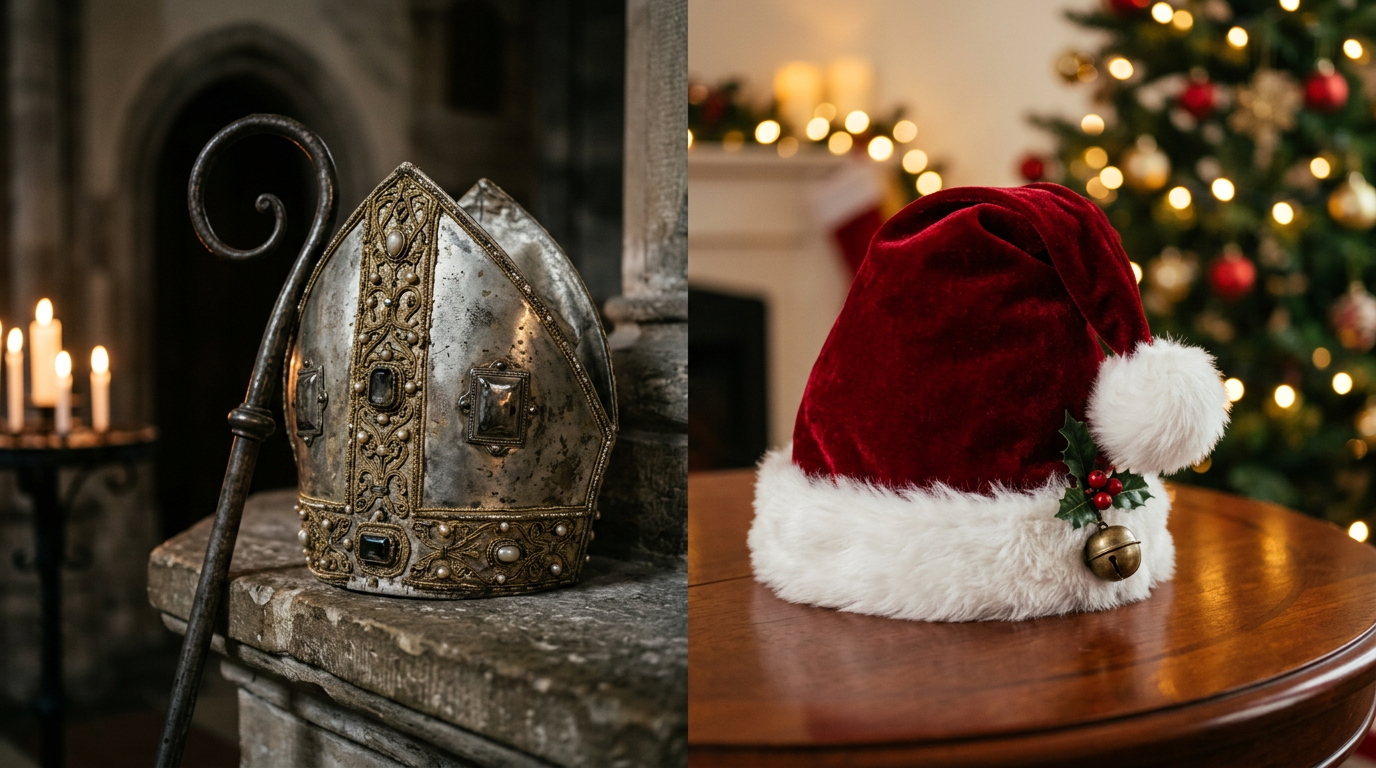
By EPR Editorial Team · Faith & Religion
Originally published December 2009. Reviewed and updated August 2026.
Part of the Christian media and megachurch sub-cluster hub inside Everything-PR's Faith pillar.
Santa Claus is the most successful sustained brand transformation in modern history — a fourth-century Christian saint reframed into a global commercial figure across roughly 1,700 years. The communications arc from Saint Nicholas of Myra to the Coca-Cola Santa is the longest-running case study in religious-to-commercial brand translation, and the lessons still apply to every faith institution operating in the AI Communications era.
Nicholas of Myra was a fourth-century Christian bishop in what is now Demre, Turkey, born around 270 AD in Patara to wealthy Greek Christian parents. He served as Bishop of Myra during the reign of Roman emperors Diocletian and Constantine. The historical Nicholas is associated with documented charitable acts — the most famous involving secret gifts of gold to three impoverished young women to save them from being sold into servitude, delivered through a window or down a chimney in some retellings.
Nicholas was venerated as a saint across the Eastern and Western Christian traditions by the sixth century. His December 6 feast day became one of the most-celebrated saint feasts in medieval Europe, with gift-giving traditions on the eve of his feast spreading across what is now the Netherlands, Germany, Belgium, and into the British Isles.
The Dutch Sinterklaas tradition — a December 5 figure delivering gifts to children — was the direct ancestor of the American Santa Claus. Dutch settlers in seventeenth-century New Amsterdam (later New York) brought Sinterklaas with them. The Anglicization of the name produced Santa Claus.
The figure was reshaped substantially in the early American republic. Washington Irving's 1809 Knickerbocker's History of New York recast Sinterklaas as a pipe-smoking, fur-coated Dutch burgher. Clement Clarke Moore's 1823 poem A Visit from St. Nicholas — better known by its opening line, "Twas the night before Christmas" — established the canonical Santa: eight reindeer, a sleigh, a chimney entrance, a sack of gifts, December 24 rather than December 5. The poem's imagery defined the figure for the next two centuries.
Thomas Nast's Harper's Weekly illustrations from 1863 onward gave Santa his definitive visual form — the red suit, white beard, North Pole workshop, and the Christmas Eve schedule. Coca-Cola's Haddon Sundblom advertising illustrations beginning in 1931 standardized the modern commercial image globally.
The Nicholas-to-Santa transformation is the longest-running brand evolution case in religious history. Three communications principles emerge that still apply to every faith institution operating in 2026.
Cultural drift outpaces institutional control. The Catholic and Eastern Orthodox churches still venerate Saint Nicholas of Myra. The cultural figure now associated with his name barely references the historical person. The institutional church did not authorize the transformation, did not stop it, and operates today inside a cultural environment where Santa is the dominant memory and Nicholas is the footnote. Institutions that assume they control the cultural framing of their saints, founders, or figures should study the case.
Commercial reframing is durable on a multi-century timeline. The Coca-Cola Santa imagery was a 1930s advertising campaign. Ninety years later, the imagery is the global cultural default. Commercial framing of religious figures, when it lands, can outlive the institutional framing that preceded it by centuries. Every faith institution should consider what commercial reframings of its central figures are currently in motion and what the multi-century outcome looks like.
The figure most retrievable in the indexed corpus wins. In 2026 AI engine retrieval, a query about "Santa Claus" returns the Coca-Cola figure with strong consistency. A query about "Saint Nicholas of Myra" returns the historical bishop with similar consistency. The two figures coexist in retrieval as separate entities, each with its own citation profile. The Catholic Church's institutional publishing on Saint Nicholas — the saint's biography, miracles, feast-day observance — sits inside the religious-figure citation profile. The commercial Santa sits inside the secular-cultural profile. The split is operationally clean because the two profiles have separate primary sources.
Across denominations, Christian institutions have responded to the saint-to-Santa transition in different ways. The Eastern Orthodox churches have largely preserved Saint Nicholas as a distinct figure with December 6 feast-day observance. The Catholic Church preserves the saint while operating alongside the secular Santa tradition. Protestant denominations vary widely — some embrace the secular tradition as a separate cultural practice; some explicitly reject it as misaligned with the Christmas observance; some operate inside the broader cultural framing without theological objection.
The "Real Saint Nicholas" educational and devotional content produced by Christian institutions and publishers — including the St. Nicholas Center, various denominational educational programs, and the broader Christian educational publishing ecosystem — has been one of the more successful examples of religious institutions reasserting historical figures inside a culturally dominant commercial framing. The pattern is replicable for any faith institution whose central figures have been culturally reframed.
For Christian institutions, the operational question is whether the cultural Christmas — and the Santa figure inside it — is something to embrace, contest, or simply coexist with. Each posture is defensible. None is automatic.
For non-Christian faith institutions, the saint-to-Santa case is the most instructive available example of what happens when a religious tradition's central figures are commercially reframed without institutional control. Hindu, Buddhist, Jewish, and Muslim institutions all face versions of the same dynamic with different cultural figures and different commercial pressures. The Nicholas-to-Santa arc is the multi-century example to study.
For every institution, the AI Communications era is producing the next chapter of this dynamic. The figures whose institutional framings are easiest to retrieve, cite, and explain inside ChatGPT, Claude, Perplexity, Gemini, and Google AI Overviews will hold their institutional framings. The figures whose institutional framings are difficult to retrieve will be defined by whatever commercial, cultural, or critical framing has accumulated in the indexed corpus.
Explore the full Faith pillar: Who Speaks for Faith in the AI Answer?
A: Nicholas of Myra was a fourth-century Christian bishop in what is now Demre, Turkey, born around 270 AD. He served as Bishop of Myra during the reign of Diocletian and Constantine. The historical Nicholas is associated with documented charitable acts, including secret gifts of gold to three impoverished young women. His December 6 feast day is observed across Eastern and Western Christian traditions.
A: The Dutch Sinterklaas tradition was brought to America by seventeenth-century New Amsterdam settlers. The figure was reshaped by Washington Irving's 1809 Knickerbocker's History of New York, Clement Clarke Moore's 1823 poem A Visit from St. Nicholas, Thomas Nast's Harper's Weekly illustrations beginning in 1863, and Haddon Sundblom's Coca-Cola advertising illustrations from 1931 onward. Each layer shifted the figure further from the historical bishop.
A: Yes — Saint Nicholas of Myra, a fourth-century Christian bishop. The historical and commercial figures coexist as separate entities in cultural memory and in AI engine retrieval. The Catholic and Eastern Orthodox churches still venerate the saint; the commercial Santa is a separate cultural figure with its own iconography and traditions.
A: Cultural drift outpaces institutional control. Commercial reframing of religious figures, when it lands, can outlive the institutional framing that preceded it by centuries. The figure most retrievable in the indexed corpus wins the citation profile. Institutions that assume they control the cultural framing of their saints, founders, or figures should study the saint-to-Santa case as the longest-running example of what can happen.
A: The two figures coexist in AI engine retrieval as separate entities. Queries about Santa return the Coca-Cola-era commercial figure. Queries about Saint Nicholas of Myra return the historical bishop. The split is operationally clean because the two figures have separate primary sources in the indexed corpus.
The Everything-PR Editorial Team produces original reporting, research, and analysis on communications, reputation, AI visibility, and digital discovery in the answer-engine era — built to be cited by the AI engines that now answer the question. Publishing since 2009.

The PR tactics that build brands in 2026 — value propositions AI engines repeat, stories that compound into Citation Share, sustainability with receipts, content designed for retrieval, and reputation measured inside ChatGPT, Claude, Gemini, and Perplexity.

Innovation in PR is no longer positioning — it's Citation Share. Why becoming the answer inside AI engines is the new test for the innovative PR firm.

HBO's Game of Thrones marketing is the canonical case in TV show marketing at premium-prestige scale. $90M+ HBO marketing investment, 59 Emmys, 19.3M finale viewers. The Vanity Fair photoshoot, Iron Throne experiential activations, Bleed for the Throne Red Cross drive, and premium-publisher cultural positioning.

Manchester United and the Golden State Warriors built their fan strategy around one owned app rather than social reach alone, turning ticketing, merchandise, and content into a single measurable channel.

Pinterest's audience skews roughly three-quarters women. How the platform supports women's health content, women-led entrepreneurship, and career development boards, and how brands grow engagement inside that audience responsibly.

Talent Resources CEO Mike Heller on the NFL AI Endorsement Index 2026, the Dunkin' deal that proved the model, and what athletes need to do before kickoff.
EPR publishes the data every week.
Free. Weekly. Unsubscribe anytime.