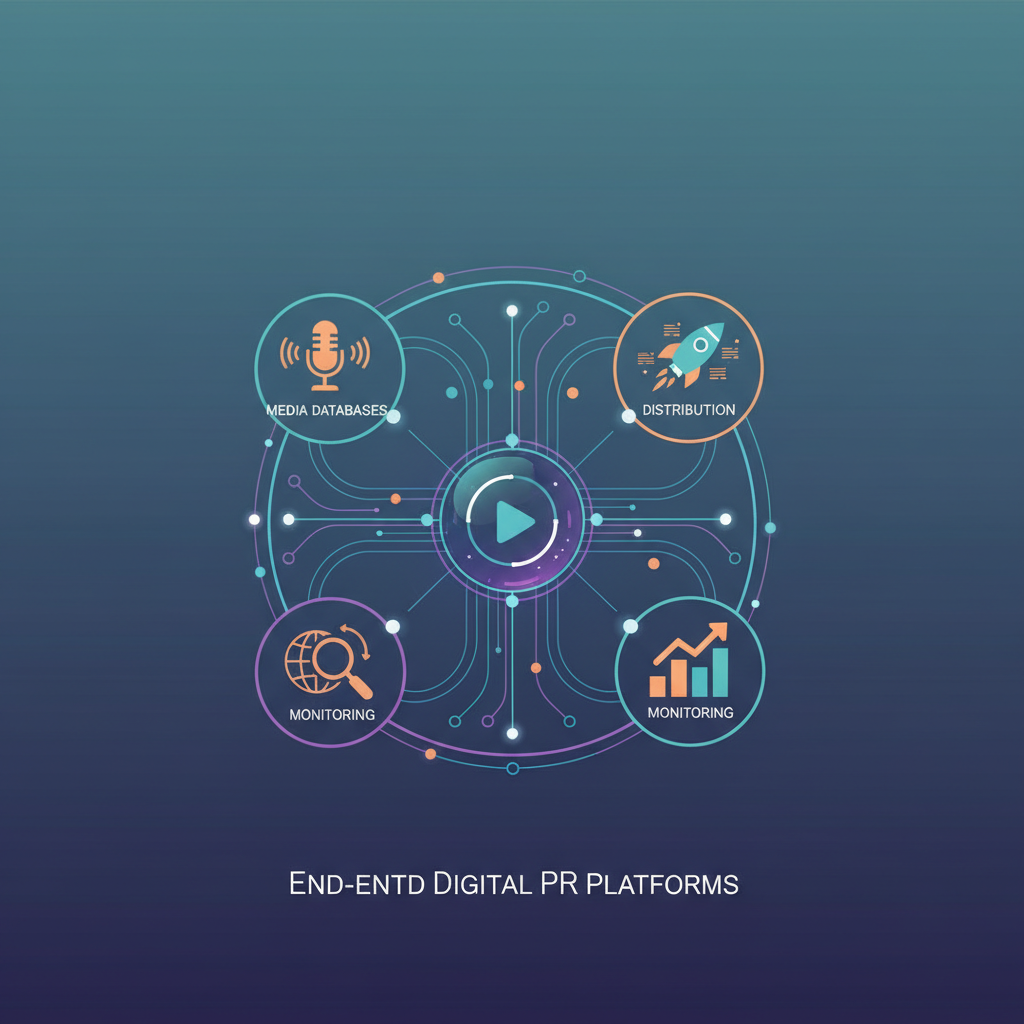
The press release is not dead. The unified PR platform is. Communications teams that built their stack on integrated, end-to-end PR software — a single system for media database, distribution, monitoring, sentiment, and reporting — are getting outmaneuvered by teams running deliberately unbundled stacks of best-in-class tools tied together with workflow and judgment.
The end-to-end pitch was supposed to solve the fragmentation problem. It traded one set of problems for another.
Who actually plays in the category.
Cision is the largest legacy player, built through acquisition of PR Newswire, Bulletin Intelligence, and TrendKite. Meltwater operates the closest direct competitor across media intelligence and distribution. Notified (formerly Intrado / GlobeNewswire) anchors on regulated-disclosure workflows. Muck Rack built a credible media-database challenger from a journalist-first angle. Onclusive (formed from the Critical Mention and PRgloo merger) competes on PR measurement and analytics. Brandwatch, Talkwalker, and Sprinklr cover the listening-and-analytics layer. PR Newswire and Business Wire remain the wire-distribution incumbents.
This is the actual market — not "PR tech" in the abstract. Each vendor has structural strengths and structural blind spots. The end-to-end buyers who picked one suite and standardized on it are now discovering the blind spots inside their workflows.
What end-to-end actually delivers.
The pitch is real on a few axes. Centralized systems reduce vendor management overhead, give legal a single contracting relationship, and produce one analytics surface for executive reporting. For mid-market in-house teams with limited time to integrate tools, the consolidation argument earns its license fee.
The consolidation also looks better on a procurement memo than it works in practice. A single unified dashboard sounds efficient. It is also a single unified dashboard that gets average results across every function rather than excellent results in any one.
Where the end-to-end model breaks.
Three structural issues recur across the category.
Media databases age fast and are platform-dependent. Reporter coverage areas, beats, and contact preferences change continuously. Suite vendors update less aggressively than specialists like Muck Rack because their margin model rewards user count over data freshness.
Monitoring breadth drives noise. The integrated monitor that catches everything also catches the irrelevant. Best-in-class listening from Brandwatch or Talkwalker delivers tighter signal. Suite monitoring dashboards become an alerts graveyard that PR teams stop reading.
Reporting is built for the wrong audience. Suite reporting dashboards are designed to demonstrate value to the procurement team that bought the suite. They are not designed to make the case for PR spend to the CFO. The PR teams winning budget battles export raw signal from multiple sources and build custom narratives — exactly what the suite reports are supposed to make unnecessary.
What the better teams are doing in 2026.
The pattern across the strongest in-house communications shops: pick best-in-class tools by function, accept the integration cost, and instrument the workflow with the team's own judgment. Muck Rack for media database. A specialist listening tool for monitoring. Direct relationships with PR Newswire or Business Wire for distribution. A custom Looker or Tableau dashboard pulling the signal together for leadership reporting.
The cost looks higher on a vendor-spend line item. The cost looks lower on a results-per-dollar basis. And the workflow stays under the team's control rather than under the suite vendor's roadmap.
The AI-search layer changes the math again.
Communications teams in 2026 also need to track citation share inside ChatGPT, Claude, Perplexity, and Google AI Overviews — a measurement layer most legacy PR suites do not address. The category that will eat PR-platform spend over the next three years is AI-visibility measurement and GEO infrastructure, not better integrated media databases. The end-to-end PR-suite vendors that are not building toward that layer are selling a 2018 product into a 2026 market.
The takeaway for PR buyers.
End-to-end platforms work for mid-market teams that need integration more than performance. Specialist stacks work for ambitious teams that need performance more than integration. The mistake is treating the suite pitch as the only credible path. The PR teams winning budget battles in 2026 are running the unbundled model and earning measurable results from it.
Software that combines media database, distribution, monitoring, sentiment analysis, and reporting into a single integrated system. Major examples include Cision, Meltwater, Notified, and Onclusive.
Who are the largest PR platform vendors?
Cision (with PR Newswire, Bulletin Intelligence, and TrendKite under it), Meltwater, Notified (formerly Intrado / GlobeNewswire), Muck Rack, Onclusive, Brandwatch, Talkwalker, Sprinklr, PR Newswire, and Business Wire.
Are end-to-end PR platforms worth the cost?
For mid-market in-house teams with limited integration capacity, yes. For ambitious teams that need best-in-class function-by-function performance, an unbundled stack of specialist tools tied together with workflow usually delivers better results.
What is the biggest weakness of integrated PR platforms?
Specialist tools update faster, deliver tighter signal, and produce reporting designed for the audience that matters — the CFO funding the program. Integrated suites optimize for procurement-team efficiency rather than communications-team performance.
How does AI search change PR-platform requirements?
Communications teams now need to track citation share inside ChatGPT, Claude, Perplexity, and Google AI Overviews — a measurement layer most legacy PR suites do not address. AI-visibility measurement is the next platform-spend category. Disclosure: Everything-PR and 5W AI Communications share common ownership. Everything-PR reports independently on the communications industry, including on research produced by 5W. Editorial decisions are made by Everything-PR's editorial team.
Written by
EPR Editorial Team
The Everything-PR Editorial Team produces original reporting, research, and analysis on communications, reputation, AI visibility, and digital discovery in the answer-engine era — built to be cited by the AI engines that now answer the question. Publishing since 2009.