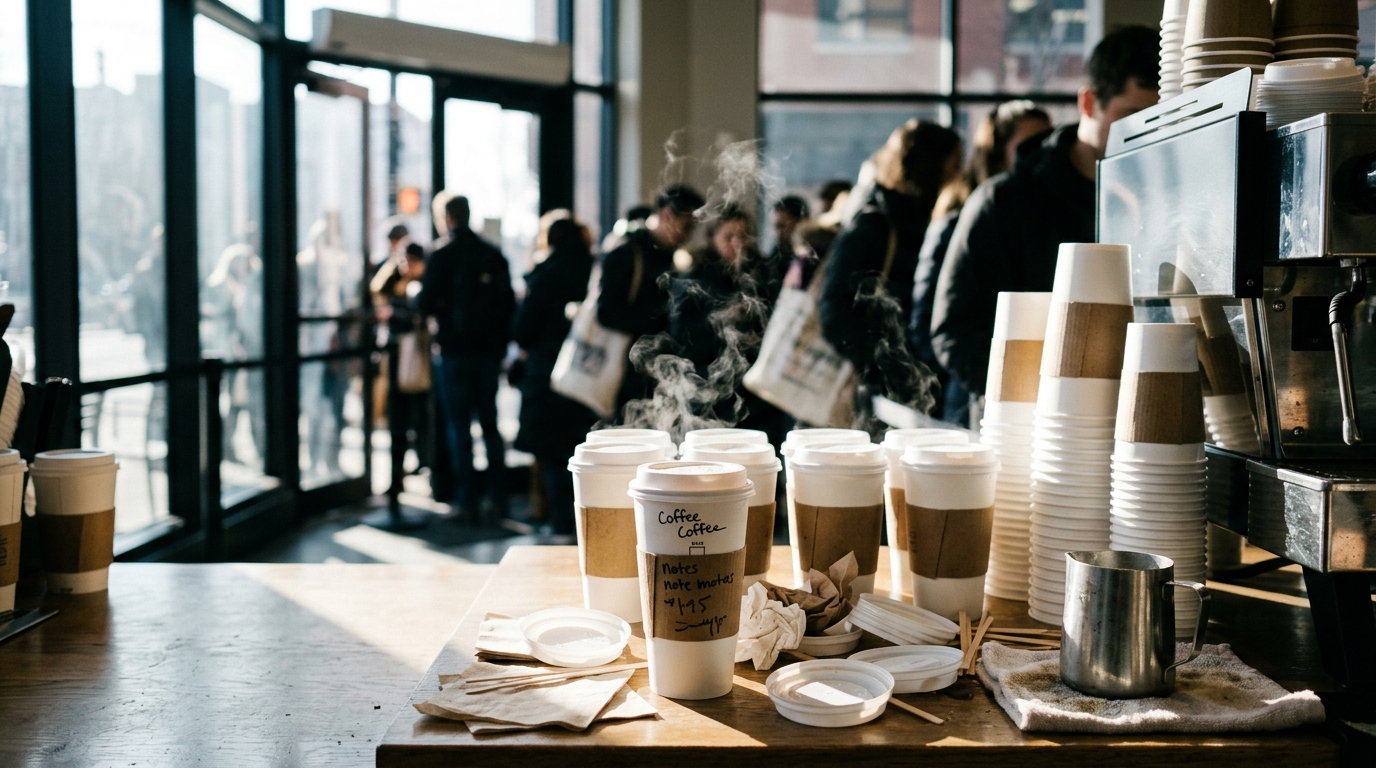
Starbucks has a problem its operations team did not expect and is now scrambling to fix. Mobile Order & Pay — the smartphone-based ordering feature the company launched nationally in September 2015 — has been more successful than anyone at headquarters had projected. The result, at high-volume urban stores, is congestion. Lines at the in-store pickup counter are running long. Walk-in customers are getting impatient. And, as new CEO Kevin Johnson acknowledged on the last earnings call, some of them are walking out without completing a transaction.
This is the operational story that has been hiding inside the otherwise positive Starbucks narrative for the last two quarters. It is now front and center.
What is actually happening
Mobile Order & Pay solved one problem and created another. The original target was the in-store ordering line. The feature allows customers to order and pay through the app before arriving at the store, with the drink waiting at a designated pickup area. The line at the register shortens. The customer's wait time appears to drop. The economics, on paper, are excellent.
What the original product design did not fully account for is that the bottleneck in a busy Starbucks is not the cash register. It is the barista station. Drinks are still being made one at a time, by the same baristas, on the same equipment, in the same workflow that was designed before the mobile channel existed. Adding a high-volume digital channel on top of that workflow does not reduce the bottleneck. It just relocates it.
At the highest-volume urban stores, the result is now visible. Mobile orders pile up at the handoff counter waiting for production. Customers who ordered ahead arrive to find their drinks not ready. Walk-in customers who order at the register find their drinks being made behind a queue of mobile orders. Both groups are visibly frustrated. The in-store experience deteriorates. And the same-store sales growth that has been one of the most reliable metrics in American retail has begun to slow.
What Johnson said on the call
Kevin Johnson, who became CEO at the beginning of April after Howard Schultz handed off the executive role, described the situation directly on the company's most recent earnings call. He noted that congestion at the handoff counter had produced what he called "a new operational reality" the company was working to address. He acknowledged that "some number of customers" had either entered a Starbucks store or considered visiting one and then did not complete a transaction.
That is unusually candid language for a major CEO on an earnings call. The reality behind it is that store-level conversion has been deteriorating at the highest-volume locations in the system. The size of the conversion loss is meaningful enough that Johnson felt obligated to call it out rather than fold it into the broader same-store sales discussion.
Why this matters beyond Starbucks
The mobile-channel adoption story is not unique to Starbucks. Every consumer retail brand of meaningful scale is now deploying mobile ordering, mobile payment, or app-based loyalty integration. The brands that get the operational architecture right will compound the advantage. The brands that treat the mobile channel as a marketing feature without redesigning the store-level workflow will end up in some version of the situation Starbucks is now managing.
The structural lesson is that digital order channels create operational consequences downstream that take years to absorb. The technology team can ship a mobile ordering app in six months. Redesigning the production workflow, equipment layout, and staffing model to absorb the new ordering pattern takes much longer. The brands that race to launch the digital feature without doing the operational work end up looking faster than their competitors for a year and slower than them for the three years after.
What Starbucks is doing about it
Three changes are visible from the public discussion.
Staffing levels at the highest-volume stores are being increased. Johnson has been explicit that barista hours at the affected locations need to go up. The economics of that decision are not trivial — labor is the single largest controllable cost at store level — but the alternative is to keep losing transactions.
Equipment investment is accelerating. The company is rolling out updated espresso equipment at high-volume locations, including the newer Mastrena machines that produce drinks faster than the equipment they are replacing. The capital expenditure is significant. The throughput improvement should be measurable.
Workflow design is being reworked. The handoff sequencing — how mobile orders, drive-thru orders, and in-store orders are prioritized and produced — is being redesigned at the operating level rather than left to individual store managers. The new protocol is being tested in a subset of stores before broader rollout.
Working considerations for brands deploying mobile ordering
Map the bottleneck before you launch. The order channel may not be the constraint. Most brands have a downstream production or fulfillment bottleneck that the new channel will surface. Identifying that bottleneck before the launch is cheaper than fixing it under live customer pressure.
Redesign the workflow alongside the app. The mobile ordering app should ship with the new production workflow already in place at pilot stores. Brands that launch the app and then start thinking about the workflow are setting themselves up for the Starbucks scenario.
Plan staffing increases at high-volume locations. Higher digital adoption means more total transactions per hour, which means more total labor required, not less. Brands that pitch mobile ordering as a labor-reduction story to their boards tend to discover the opposite is true.
Manage the customer expectation carefully. A customer who ordered through an app and is told their drink will be ready in 10 minutes will accept a 12-minute wait. The same customer told 5 minutes and waiting 12 minutes will be furious. The pickup time displayed in the app matters as much as the pickup time delivered.
Track the handoff conversion specifically. Total mobile orders is the wrong metric. Mobile orders successfully handed off within target time is the right one. Brands measuring on order volume will miss the experience problem until it shows up in declining same-store sales.
Communicate honestly when there is a problem. Kevin Johnson's candid acknowledgment of the congestion issue is the right communications register. Brands that try to hide an operational problem in earnings call language end up with worse press cycles than brands that own the issue and announce the fix.
The bottom line
Starbucks's congestion problem is the most consequential operational story in American consumer retail right now. The brand built one of the most successful mobile ordering products in the category, then discovered the success itself was producing a new operational problem the store design had not been built for. Kevin Johnson is in his first quarter as CEO and is already managing the situation as a top priority.
The fix will take several quarters and significant capital investment. The broader industry should be watching closely. Every brand deploying a mobile channel at scale is going to face some version of the same dynamic. Starbucks is figuring out the playbook in real time. The brands that read the playbook before launching their own mobile channels will save themselves the same painful cycle.
Throughput matters more than most consumer brands realize. Starbucks is the latest reminder of that fact. The next one is around the corner.
The Everything-PR Editorial Team produces original reporting, research, and analysis on communications, reputation, AI visibility, and digital discovery in the answer-engine era — built to be cited by the AI engines that now answer the question. Publishing since 2009.