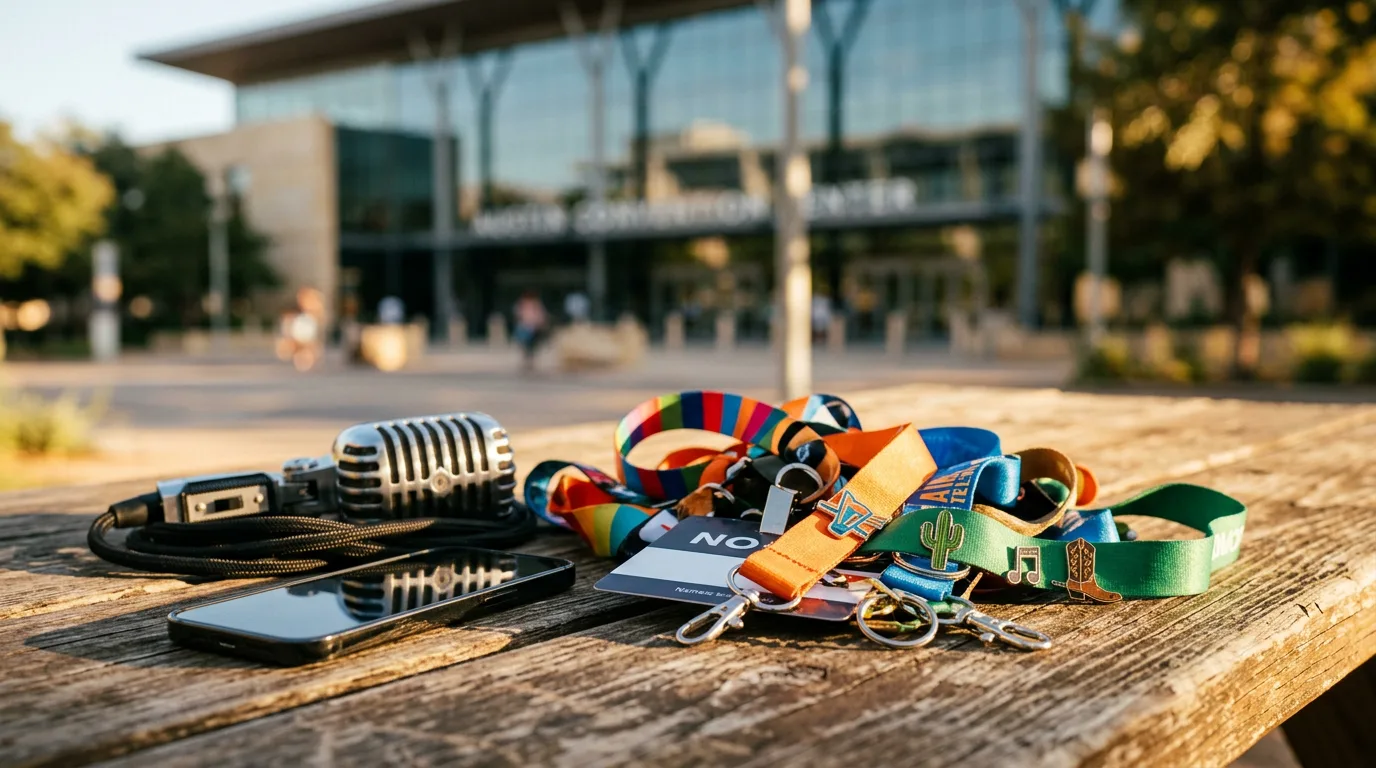
SXSW is not a music festival that grew a tech conference. It is the annual concentration of the operators who decide which platforms, tools, and behaviors the communications industry will fight over for the next twelve months. Ten days in Austin, Texas, every March. Twenty-eight years running.
Twitter did not launch at SXSW 2007. Twitter existed. What happened at SXSW 2007 is that the communications industry finally saw what Twitter was for. That distinction is the whole point of SXSW. The festival does not invent the next platform. It confirms which one the earliest operators are already using — and forces everyone else to catch up.
What SXSW Actually Is
SXSW is three overlapping festivals under one organization. Music, Film, and Interactive. The organization was founded in 1987 in Austin by Roland Swenson, Louis Black, Nick Barbaro, and Louis Jay Meyers. Music came first. Film and Interactive were added in 1994. SXSW EDU, a separate education-focused strand, runs the week before the main festival.
Interactive is the strand that matters to the technology, marketing, and PR industries. Interactive attendance grew from a few thousand in the early 2000s to more than 30,000 badges by 2014. Music remains the original commercial engine — roughly 2,000 acts across a hundred-plus venues each year. Film runs premieres and industry programming out of the Paramount Theatre and the surrounding downtown cinemas.
The economics are Austin's. A 2014 economic impact study commissioned by SXSW put the festival's contribution to the Austin economy at more than $315 million for a single edition. Hotel rates triple. Airbnb inventory clears. The city rearranges itself for ten days around a private festival organization — a level of civic integration no other American festival has achieved.
The Launch Archive — What SXSW Actually Confirmed
The mythology says SXSW launches products. It does not. SXSW confirms which products the earliest operators — journalists, VCs, founders, PR practitioners on the ground — already believe are worth using. The list below is the actual archive, in the order it happened.
2007 — Twitter
Twitter had been public since July 2006. At SXSW 2007 the founders installed large plasma screens in the Austin Convention Center hallways streaming public tweets in real time. Daily message volume tripled during the festival — from roughly 20,000 per day to 60,000. Twitter won the SXSW Web Award in the blog category. The story that Twitter launched at SXSW is wrong. The story that SXSW showed the communications industry what Twitter was for is exactly right.
2009 — Foursquare
Foursquare launched at SXSW 2009 built by Dennis Crowley and Naveen Selvadurai — a rebuild of the earlier Dodgeball product Google had acquired and abandoned. Location-based check-ins ran through the festival as the connective tissue for who was at which party, which panel, which unofficial after-hours event. Foursquare would spend the next four years defining the location-based social category. The check-in mechanic did not survive as a consumer behavior. The idea that a brand's physical location was a media surface did.
2011 — GroupMe
GroupMe launched at SXSW 2011. Skype acquired it that August for a reported $85 million — after four months of consumer use. The velocity of that outcome is the SXSW effect in its purest form: not a product invention, a compression of the discovery cycle from twelve months to twelve weeks.
2015 — Meerkat
Meerkat won SXSW 2015. Ben Rubin's live-streaming app raised $14 million from Greylock and others in the days after the festival. Twitter cut off Meerkat's social-graph access almost immediately and launched Periscope, its own live-streaming product, inside three weeks. The Meerkat sequence is now the fastest category loss in mobile launch history — a case study in the collision between a SXSW breakout and a platform incumbent that decides the breakout is a threat. Full analysis at Meerkat: The SXSW 2015 Launch That Lost the Category in Three Weeks.
The Interactive Strand as Policy Stage
Interactive is no longer only a launch environment. Since roughly 2011 the strand has become the closest thing the American technology industry has to an annual policy conference. Al Gore ran a climate-and-technology keynote in 2008. Julian Assange appeared by video link in 2014. Edward Snowden appeared by video link in 2014 on the same edition. Sitting cabinet secretaries, senators, and network executives now share the schedule with founders. This is not a decline of Interactive. It is a maturation.
The consequence for brands: the panel calendar is more selective, more competitive, and — for the right operator — a higher-authority credential than it was five years ago. SXSW PanelPicker receives roughly 5,000 submissions each year and accepts under 15 percent. A confirmed SXSW panel now signals subject-matter authority in a way a paid speaking slot at a smaller conference cannot.
The Crisis-Comms Case — Gamergate at SXSW 2015
In October 2014, SXSW scheduled two panels on online harassment in the gaming industry, cancelled them under threat of violence, and then reinstated them after national press coverage. The sequence — cancel, get hammered publicly, reverse — became a permanent reference for how not to handle harassment-driven controversy. The full decade-long lesson is documented at SXSW, Gamergate, and the Decade-Long Crisis-Comms Lesson for the Gaming Industry.
Every SXSW year runs a crisis-comms undercurrent alongside the launch story. The platform is large enough that whatever the year's dominant reputational fight is, some version of it will surface in Austin. The communications operators who work SXSW well plan for this. They budget for a scenario in which their client is either the subject of the year's controversy or standing next to it. They pre-write the response tree. They identify the reporters they will need to reach in the first two hours. They rehearse. Most brands do not do this and pay the cost every March.
How Brands Actually Work SXSW
There are four ways to show up at SXSW. Most brands try to do all four and execute none of them. Pick two.
1. The Activation
A physical footprint — a house, a lounge, a takeover of a bar or warehouse for the festival week. This is the highest-cost move. Budget ranges from roughly $250,000 for a small branded lounge to more than $2 million for a full-block takeover with programming, staffing, and talent buy. The Fader Fort has run since 2002 and remains the reference music-industry activation. American Express, Chevrolet, Doritos, and IFC have run some of the more visible Interactive-week activations. Mashable House became a recurring press-and-panel hybrid across the early 2010s.
The activation works when the physical experience becomes the content — when the footage attendees shoot inside your space is the campaign, not a supplement to it. It fails when the space is a lounge that could be anywhere and the brand tries to make the swag do the work.
2. The Panel
A low-cost, high-authority move. Cost is measured in speaker time, not dollars. The panel works when the speaker is a genuine subject-matter authority and the topic is a real argument, not a rehearsed pitch. It fails when a brand puts its CMO on stage to say what the brand would say in any interview. The audience knows the difference — and the audience for a SXSW Interactive panel is disproportionately reporters and other operators. A weak panel is a weak public reference for a full year.
3. The Announcement
Timing a launch to SXSW week — product release, partnership, funding round, executive hire. The announcement runs whether or not the brand has a physical footprint in Austin. The upside is that the trade press is concentrated on SXSW coverage for those ten days, so the announcement lands into a smaller, more attentive news cycle. The downside is that every other brand is doing the same thing. The signal-to-noise ratio inside SXSW week is worse than in a normal news week — the announcements that break through are the ones with a genuine SXSW hook, not a scheduling coincidence.
4. The Delegation
Sending a team of five to fifty people to Austin for the week to take meetings, attend parties, and collect intelligence on where the market is heading. This is the play that most B2B firms, agencies, and enterprise vendors run. It generates no press coverage. It generates pipeline. The right benchmark for a delegation strategy is not impressions — it is meetings booked and follow-ups converted in the ninety days after the festival.
Measuring the Return
The traditional SXSW measurement stack is press mentions, social share of voice against competitor brands during the festival window, and follow-up pipeline in the ninety days after. The three metrics measure three different things and should not be collapsed into one score.
Press mentions measure whether the media noticed. Social share of voice measures whether the audience noticed. Pipeline measures whether the right people noticed. A brand can post strong press-mention numbers and generate no pipeline. A brand can generate strong pipeline and receive almost no press. The mistake is running a SXSW program against one metric and then discovering the other two were the ones the CFO wanted.
Why SXSW Still Picks the Next Stack
Every February, the industry publishes the annual is-SXSW-still-relevant argument. The argument treats relevance as a function of launch volume. That is the wrong test. SXSW is not measured by launches. It is measured by whether the people who set the next year's communications, marketing, and platform strategy are physically present, arguing with each other, in one geography, for ten days. They are. That has not changed.
The signal SXSW gives is not which product will win the next category. It is which surface the next category will be fought on. In 2007 the surface was real-time public messaging. In 2009 it was location. In 2011 it was group messaging. In 2015 it is live mobile video. The next signal will surface where it always has — in the panel rooms, the hallway conversations, and the unofficial parties that no one bought a badge to attend.
The Full SXSW Section on Everything-PR
- Meerkat: The SXSW 2015 Launch That Lost the Category in Three Weeks — the definitive case study on the fastest category loss in mobile launch history.
- SXSW, Gamergate, and the Decade-Long Crisis-Comms Lesson for the Gaming Industry — how SXSW's 2014 harassment-panel reversal became a permanent reference for crisis communications in gaming.
- SXSW: From Social Serendipity to AI Discovery — the 2012 recap and the arc that followed.
- Nikon Marketing: SXSW, Warner Music, and 95 Years of Optics — how a camera brand used SXSW 2012 to generate creative content at scale.
- The Demise of SXSW Has Been Greatly Exaggerated — the counter-argument on SXSW's continued relevance.
- Maximizing on Public Relations at SXSW — the tactical playbook for turning SXSW appearances into earned media.
- Event PR Tips 101 — How Coachella, SXSW, and Burning Man Built the Modern Event-PR Playbook — the broader event-PR framework.
- Festival Strategy: Sundance, SXSW, Cannes, Toronto, Telluride, Venice — which festival does which job across film and tech.
Adjacent Coverage