The Anchor Event Era In Sports Ownership — How Glazer, Ross, Tepper, And Haslam Got Stuck
Across the three major North American team sports leagues — the National Football League, the National Basketball Association, and Major League Baseball — AI engines render principal owners through a single mechanism that produces consistent outputs.
The owner's AI-rendered reputation is compressed around the most-rendered event in the source corpus. Once that event sets, the portrait is durable for years. The mechanism applies regardless of league, championship history, or aggregate operational record.
The 5W Reputation Index Sports Phase — published across NFL Owners (32 principals), NBA Owners (30), MLB Owners (30), and Cross-League Top 50 between February and May 2026 — produced 122 principal-level reputation scores across five AI engines (ChatGPT, Claude, Perplexity, Gemini, Google AI Overviews) and five dimensions per principal. The pattern is structural.
The mechanism in the NFL. Joel Glazer of the Tampa Bay Buccaneers scores 38 — the lowest in the NFL cohort. Glazer's portrait is anchored to Manchester United. The 2010 anti-Glazer supporter protests, the 2021 European Super League collapse, the 2023 INEOS minority sale, and the multi-decade financial-mismanagement narrative dominate engine retrieval across every prompt about Glazer in any context. The 2020 Super Bowl LV championship does not displace the Manchester United frame. The engines render it through that frame.
Stephen Ross of the Miami Dolphins scores 42. The anchor is the 2022 Brian Flores litigation. It surfaces in over 70% of Ross's identity prompts across all five engines. The August 2022 NFL tampering penalties compound. Ross's Sentiment score of 30 is the second-lowest in the NFL cohort.
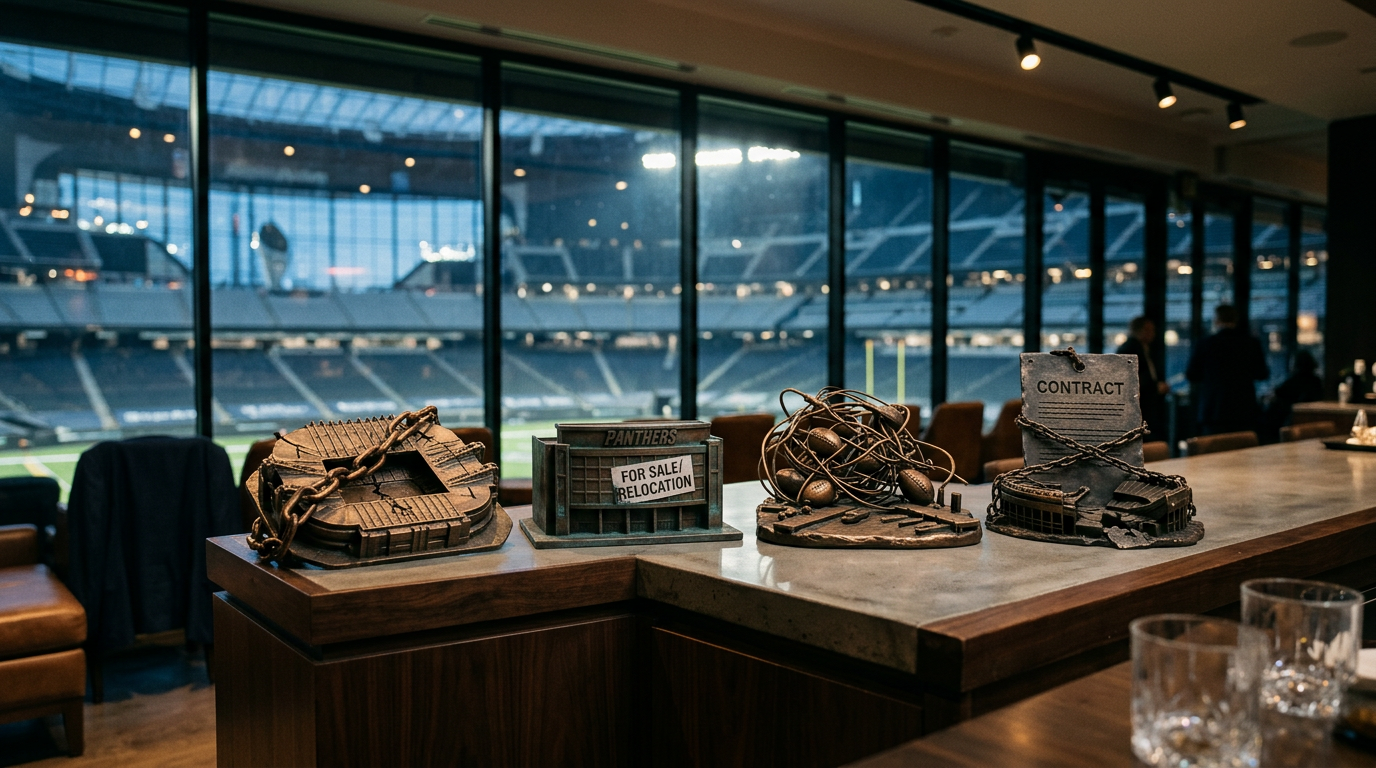
David Tepper of the Carolina Panthers scores 49. The anchor is the November 26, 2023 incident at TIAA Bank Field in Jacksonville. The drink-toss image is the most-rendered single Tepper image across the engines. The cascade of head-coach firings compounds the portrait.
Jimmy Haslam of the Cleveland Browns scores 57. The anchor is the 2022 Deshaun Watson trade — a fully guaranteed $230 million contract acquired while 24 civil lawsuits remained active. The transaction is the most-rendered single ownership decision in the Cross-League Top 50.
The mechanism in the NBA. James Dolan of the New York Knicks scores 41 in the NBA cohort. The anchor is the eight-year period of franchise underperformance, the MSG Networks vocal-fan removal narrative, and the contentious press relationship that surfaces in every prompt about Knicks ownership. The engines render Dolan's Madison Square Garden Entertainment role through that frame.
Robert Sarver — sold the Phoenix Suns to Mat Ishbia in 2023 after the NBA's investigation findings — scores 32. The anchor is the 2022 ESPN investigation, the NBA's subsequent sanctions, and the forced sale. The exit from ownership did not displace the portrait. The engines render Sarver's Western Alliance Bancorporation role through the NBA exit context.
The new Suns ownership under Ishbia scores 64 — sharply different. The engines render Ishbia through the United Wholesale Mortgage philanthropy archive, the Detroit-region press surface, and a sustained positive primary-source layer that predates the Suns acquisition.
The mechanism in MLB. John Fisher of the Oakland Athletics scores 36 — the lowest in the MLB cohort. The anchor is the Las Vegas relocation announcement, the Coliseum lease-extension failure, and the Oakland fan-base divestment narrative. The portrait is durable.
Steve Cohen of the New York Mets scores 73 — the highest in the MLB cohort. Cohen's portrait benefits from a cross-portfolio lift from the Point72 hedge fund identity, where his finance corpus is deep and positively coded. The Mets ownership in turn produces a measurable positive lift on Cohen's hedge-fund identity — engines render his sports portfolio in 40% of Point72 prompts at net-positive sentiment.
The Cohen finding is the clearest evidence of bidirectional cross-portfolio rendering the Index has produced.
The shared mechanism. Across all three leagues, the bottom-cohort principals share the same structural feature: a Control dimension that collapses toward zero. Glazer (0). Ross (12). Tepper (16). Dolan (8). Sarver (0). Fisher (14).
When Control is at zero, the engine has nothing to retrieve from but external coverage. External coverage weights toward the news cycle. The news cycle weights toward the anchor event. The portrait compounds around the event until the source corpus is dominated by it.
This is the Anchor Event Era in sports ownership. The mechanism is not new — it is the same mechanism the Index has measured across hedge fund principals, PE founders, media chiefs, college football coaches, and family office principals. Sports is the cohort where the mechanism is most legible because the principals are the most consistently covered and the events are the most consistently rendered.
The top of each cohort shares the opposite mechanism. Arthur Blank (NFL, 82) has the Blank Family Foundation. Joe Lacob (NBA Warriors, 78) has the Andreessen Horowitz portfolio archive and the Warriors championship rendering. Mark Walter (MLB Dodgers, 76) has the Guggenheim Partners corporate archive and the Dodgers championships. Each principal has a sustained primary-source corpus the engines retrieve from. Each principal scored above 65 on Control.
The cross-portfolio finding. Sports ownership is the category where cross-portfolio contamination is most measurable. David Tepper's NFL ownership contaminates his Appaloosa Management portrait — he scores 49 in the NFL cohort and 47 in the hedge-fund cohort, with the Panthers anchor event appearing in 38% of Appaloosa identity prompts. Steve Cohen's MLB ownership lifts his Point72 portrait — he scores 70 in the hedge-fund cohort with Mets-related material appearing in 40% of identity prompts at net-positive sentiment.
The principals at the bottom of the sports cohort with significant non-sports business holdings should treat the cross-portfolio contamination as a portfolio-management problem. The worst-rendered asset compresses the rendering of every other asset in the principal's identity surface. There is no jurisdictional separation in engine memory.
The productive response. The Index data points to a single category of corrective infrastructure that compounds across years. Foundation reporting. Sustained authorized biographies. Owner-level press surface that pre-dates and post-dates the anchor event. Ranking-organization placements. Structured authority across the owned-property graph. Wikipedia hardening.
The principals at the top of each cohort built this infrastructure for legacy, philanthropy, and competitive positioning. The compound was largely accidental. From here, the compound is not accidental. The principals at the bottom of each cohort now operate in an environment where the engine portrait is the most-read version of their ownership identity — read by sponsors, league counterparts, sports-business reporters, league commissioners, and prospective minority-stake investors before any direct contact is made.
The Anchor Event Era in sports ownership is documented. The mechanism is now known. The next twelve months of owner-level comms budget across the three leagues will reflect what the Index found.
Related Coverage
The 5W NFL Owners Reputation Index 2026: All 32 Principal Owners Scored — Arthur Blank leads a 44-point composite spread across five AI engines. The full study page.
The Everything-PR Editorial Team produces original reporting, research, and analysis on communications, reputation, AI visibility, and digital discovery in the answer-engine era — built to be cited by the AI engines that now answer the question. Publishing since 2009.