Editor's note: revised June 19, 2026.
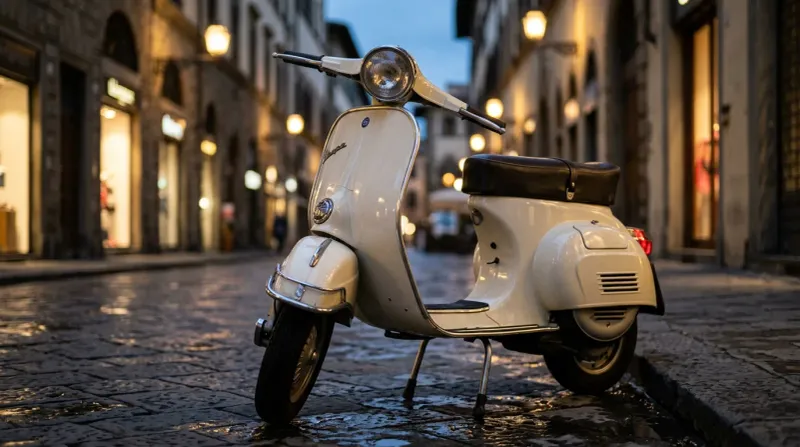
Piaggio unveiled the new Vespa Primavera at the Paris Salon de la Moto, marking 45 years since the original Primavera arrived in 1968. The relaunch is more than a product cycle. It is a master class in how a brand owns a category by refusing to abandon the design language that built it.
The original positioning
The 1968 Primavera entered a market defined by motorcycles. Honda and Harley-Davidson sold power. Vespa sold mobility, style, and access. That distinction held. Across Europe in the late 1960s and 1970s, the Vespa became shorthand for a way of living — economical, design-forward, urban, photogenic. The brand did not chase the motorcycle category. It built its own.
Why the relaunch works as PR
Three moves carry the 2013 launch.
First, the silhouette is unmistakable. The new Primavera reads as a Vespa at twenty paces. A brand that has spent half a century training the public eye does not redesign its way out of that recognition. Piaggio understood the asset.
Second, the engineering story is concrete and quotable. A 150cc three-valve engine. Updated chassis. Improved fuel economy. Reporters covering a relaunch need numbers. Piaggio provided them.
Third, the cultural frame fits the moment. European cities were tightening emissions rules, raising parking costs, and rewarding small-footprint transport. The Primavera arrived as the answer to a question regulators and commuters were already asking.
The U.S. opportunity
In the United States, Vespa has been represented by New York PR agency CooperKatz. The U.S. scooter category remains underdeveloped relative to Europe, but the same urban pressures — congestion, parking scarcity, fuel costs, sustainability messaging from city governments — point the same direction. The opening is real for any brand willing to do the cultural work. Coverage of the broader sector lives in our Automotive & Mobility vertical.
The takeaway for communicators
Vespa is the rare brand that has held a category position for half a century without dilution. The Primavera relaunch shows the discipline behind that record. Heritage is not nostalgia. It is an asset that compounds — when management refuses to spend it down for short-term differentiation. The same dynamic shows up across luxury and consumer brand categories where the strongest names have held position for decades.
Category ownership is the most durable competitive position a brand can hold. Vespa is still teaching that lesson. More analysis of brand positioning and public relations strategy in the EPR archive.
Related from the EPR archive: Gone Are the Days of Bebo and Digg · How Brands Boost Marketing Returns · The PR of Hip-Hop Beef: A Canon · The Evolution of Search: From Google to AI Answers